
Budget conversations around ceiling beams almost always come down to one number: what does it cost per linear meter installed? That number is more complicated than it looks, because the purchase price of the beam itself is only one slice of a larger cost pie. Labor, finishing, structural reinforcement, shipping, and ongoing maintenance all contribute, and they diverge sharply between real timber and faux wood. This article breaks those numbers apart so contractors, importers, and project owners can compare apples to apples.
The headline price gap
On a material-only basis, faux polyurethane beams typically run 40-60% less than comparable real timber beams. A 6-meter, 8-inch-by-8-inch rough-sawn pine beam might list for $180-$260 per length, while an equivalent PU beam in a similar visual profile often lands between $90 and $150 per length. Heavier hardwoods push the real-timber number even higher: reclaimed oak, antique fir, and European chestnut can run $400-$700 per length in similar dimensions.
However, raw material cost is the line item most likely to mislead a budget. The total installed cost tells a different story.
Material cost in detail
Real timber beam material costs
Real timber beam pricing varies by species, grade, and source. New-growth kiln-dried Douglas fir and pine sit at the affordable end, typically $12-$20 per linear foot for standard 6x6 or 8x8 dimensions. Reclaimed beams, prized for their aged appearance and tighter grain, run $25-$60 per linear foot depending on provenance and condition. Specialty hardwoods, including white oak, walnut, and cedar, occupy the top of the range, often $40-$90 per linear foot for comparable dimensions.
Beyond the beam itself, real timber projects typically require:
- Blocking, scabs, or wrap-and-glue backing for long spans
- Kiln-dried or acclimated material to prevent post-install shrinkage
- Specialty sealers, stains, or wax finishes suited to the species
- Replacement of warped or checked pieces (waste factor of 10-15% is common)
For a 30-meter residential beam run using mid-grade fir, material costs can easily reach $4,000-$6,000 before any finishing supplies are added.
Faux polyurethane beam material costs
A comparable PU beam installation in the same visual style typically runs $4-$8 per linear foot for stock finishes, or $6-$12 per linear foot for hand-finished premium looks. The same 30-meter project lands in the $1,200-$2,400 range for materials. That 50-65% saving on the materials line alone is what most buyers notice first.
Where faux beam costs can rise is in customization. Factory color-matching, custom cross-sections, and unusual lengths can add 20-40% to the base material cost. Importers ordering full containers often negotiate prices closer to the bottom of those ranges, while one-off residential buyers pay closer to the top.
Labor cost comparison
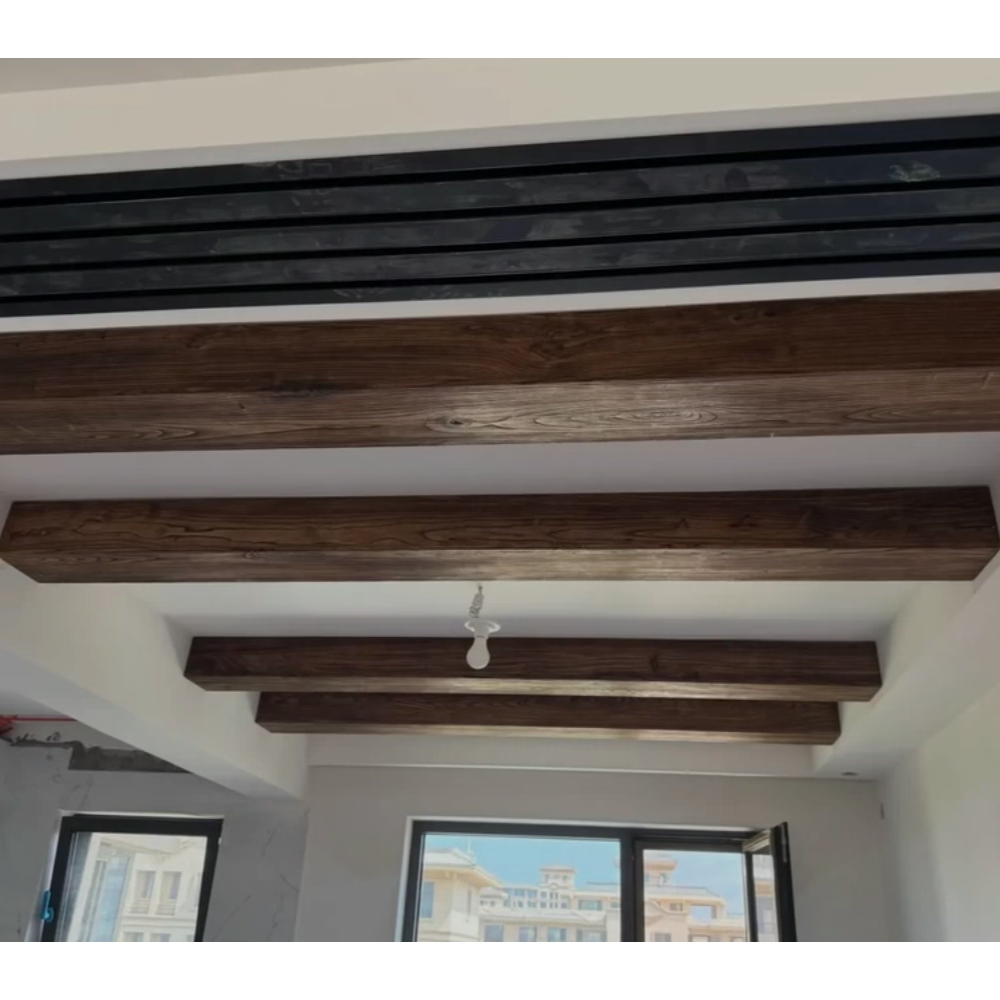
Material is only half of the equation. Labor is where the gap between real and faux widens further.
Installing real timber beams
A crew installing solid timber beams needs at minimum two strong workers, often three or four for lengths over 5 meters. Real timber installation typically includes:
- Lift equipment or scaffolding for ceiling work
- Heavy-duty fasteners, lag bolts, and structural connectors
- Time spent aligning twisted or crowned pieces
- Sanding, sealing, and finishing on-site after install
Labor for a real timber beam install commonly runs $15-$30 per linear foot, putting a 30-meter project at $4,500-$9,000 in labor alone. Where structural modifications are needed (adding blocking between joists, sistering rafters, or building a support beam for very long spans), labor climbs further.
Installing faux polyurethane beams
PU beam installation is a fundamentally different scale of work. A typical residential crew of two can mount most beam runs using cordless drills, basic carpentry tools, and the manufacturer's mounting hardware. Labor commonly runs $4-$10 per linear foot, with the lower end reflecting straightforward runs on accessible ceilings and the higher end covering tall ceilings, complex angles, or multi-level layouts.
The same 30-meter faux beam project lands at $1,200-$3,000 in labor, roughly one-third of the real-timber labor cost.
Finishing and surface preparation
Real timber beams require finishing before and after installation. Pre-installation, beams often need sanding, conditioning, and a base coat of stain or sealer. Post-installation, joints need to be blended, knots stabilized, and the entire surface given one or two topcoats. Finishing labor and materials add $3-$8 per linear foot to a real-timber project.
Faux beams ship with factory finishes that need no on-site sealing. Touch-up at miters and fastener heads takes minutes, not hours, and uses a small kit provided by the manufacturer. Total finishing cost on a faux project typically runs under $1 per linear foot.
Shipping and logistics
Shipping weight and volume drive meaningful cost differences, especially for importers and project managers sourcing across borders.
A 6-meter solid fir 8x8 weighs around 75 kg, while a faux beam of the same visual profile weighs 25-35 kg. Across a full 40-foot container, that weight delta translates to either lower freight costs per meter or the ability to ship more linear meters per container. Faux beams also nest and stack efficiently because of their uniform dimensions, while real timber often requires custom crating to prevent damage in transit.
For LCL (less-than-container-load) shipments, the volumetric savings on faux beams can be the deciding factor. A 2-cubic-meter faux beam order can match a 4-5 cubic-meter real timber order in linear coverage, halving the per-meter shipping cost on a shared container.
Lifecycle cost over 20 years
Lifecycle cost captures what happens after install. Real timber beams in conditioned interior spaces generally hold up well, but they do require refinishing on a 7-12 year cycle depending on exposure. Refinishing a 30-meter beam run costs roughly $2,000-$4,000 per cycle in a typical market.
Faux beams require only occasional cleaning and minor touch-up. Over 20 years, maintenance costs on a faux beam run are commonly under $500 total.
When initial install cost plus lifecycle maintenance are summed, faux beams typically come out 40-55% less expensive than real timber across the full ownership period.
Where real timber still wins
Honest cost analysis has to acknowledge where the numbers favor real wood. Several scenarios still justify the higher spend:
- Structural applications where the beam carries roof load
- Historic restorations where material authenticity matters to code or grant requirements
- High-end custom homes where buyers specifically request and pay for solid timber
- Projects in regions with strong reclaimed-wood supply chains and competitive pricing
In these cases, the cost premium is part of the value being delivered, not an inefficiency to optimize.
Where faux beams deliver the strongest return
Faux beams make the most economic sense when:
- The goal is visual impact rather than structural support
- Tight installation timelines limit crew time on site
- Multi-unit or large-scale projects amplify per-meter labor savings
- Long-term maintenance budgets are limited
- Shipping weight is a constraint (remote sites, upper floors, international freight)
For commercial developers, hospitality groups, and large residential renovation contractors, these conditions describe most projects. The economic case for faux beams grows stronger as project scale increases.
A worked example: 40-meter hotel lobby ceiling
Consider a 40-meter decorative beam run in a hotel lobby ceiling at 6 meters height. Real fir timber in a 10x10 rough-sawn profile would cost roughly:
- Material: $7,500
- Labor and rigging: $9,500
- Finishing: $2,500
- Shipping: $1,200
- Total installed: ~$20,700
The equivalent faux beam project in a comparable finish would cost:
- Material: $3,200
- Labor: $2,800
- Touch-up finishing: $300
- Shipping: $700
- Total installed: ~$7,000
The faux option saves roughly $13,700 on a single lobby ceiling, with no meaningful difference in visual outcome for the guest.
Reading the price quotes
When comparing quotes from suppliers, several line items deserve close attention. Confirm whether the price includes factory finish or just primer. Ask about fastener systems and whether mounting hardware is included or sold separately. Check whether the price covers miter cuts or if those are added. And clarify shipping terms, including whether the quote is FOB factory, CIF port, or DDP project site.
For importers, requesting pro-forma invoices with these line items broken out makes cross-supplier comparison much easier and surfaces hidden costs that can swing the real budget by 15-25%.
The bottom line
Across material, labor, finishing, shipping, and lifecycle maintenance, faux polyurethane beams deliver the same visual outcome as real timber at roughly half the total cost of ownership. The exact percentage varies by project, region, and specification, but the directional finding holds in nearly every market analysis. For projects where the goal is a beautiful timber look on a workable budget and timeline, faux beams are the cost-effective default.
Technical References
ASTM standards cited in every specification
Test Data
Lab results from internal testing program
Updated 2026
Reviewed against current product specs


