
Why Cracks Happen in Real Timber
Understanding why PU faux beams resist cracking starts with understanding why real timber cracks. Wood is a hygroscopic material — it absorbs and releases moisture continuously based on the humidity of its environment. When wood absorbs moisture, it expands. When it releases moisture, it contracts. Over time, this cycle of expansion and contraction creates stress in the wood grain, and the stress eventually manifests as cracks, checks, and splits.
The cracking is not random. It follows the grain, which is why you see long splits running along the length of a timber beam rather than across it. The checks are most pronounced on the ends of beams, where the wood dries fastest, but they can appear anywhere along the surface. The damage accumulates over years, and the beam that looked perfect on install day looks increasingly weathered — and eventually structurally compromised — over time.
Seasonal humidity swings accelerate the process. A timber beam in a mountain cabin that is heated through the winter and closed up in the summer experiences more extreme humidity cycles than a timber beam in a climate-controlled city apartment. The mountain cabin beam cracks faster, which is why real timber ceiling installations in mountain and coastal environments require more maintenance than in temperate climates.
PU faux beams do not absorb moisture. The polyurethane foam core is closed-cell, meaning the cells do not interconnect. Water cannot penetrate the material, and the beam cannot expand or contract in response to humidity changes. The result is a beam that maintains its dimensions and its surface integrity indefinitely, regardless of the environmental conditions.
The Material Science of PU Faux Beams
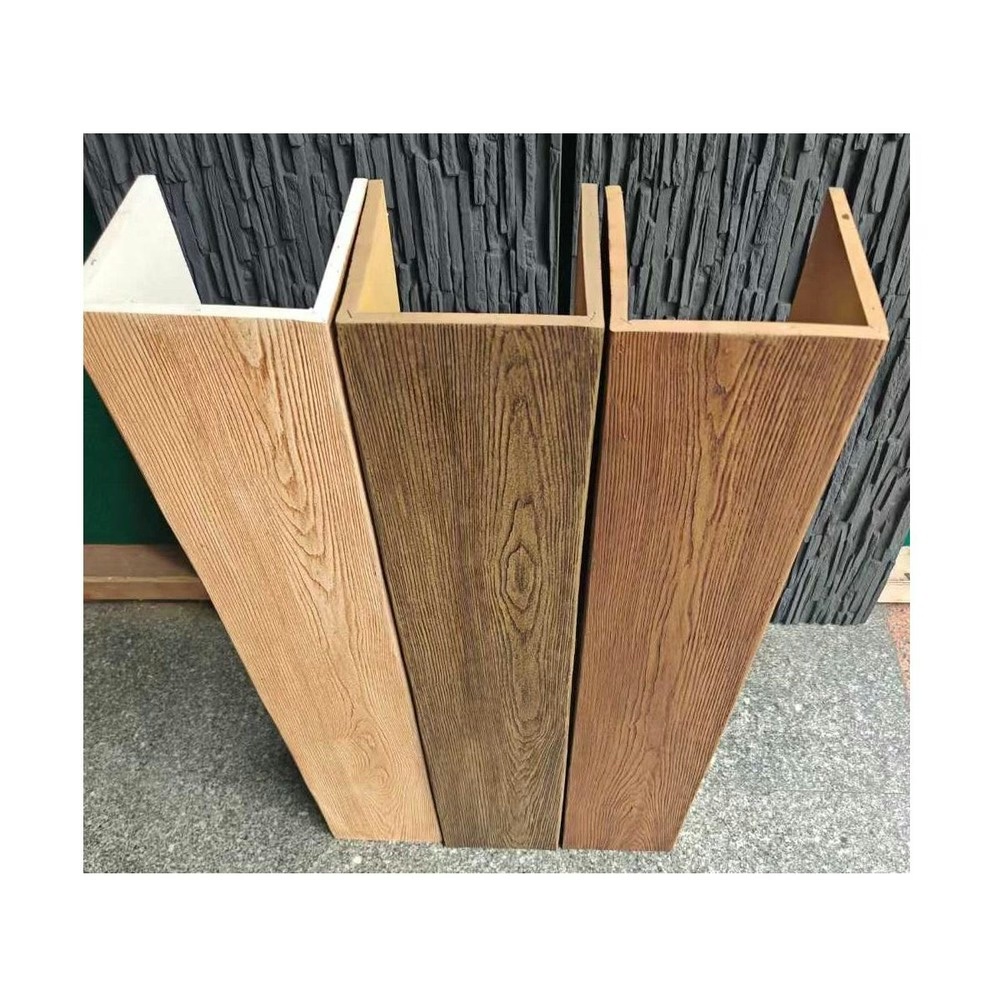
Polyurethane faux beams are manufactured by pouring a liquid polyurethane mixture into molds that replicate the profile and texture of real timber. The mixture expands and cures, forming a solid foam core with a density and a surface hardness that varies by product line.
The core material has several properties that contribute to its long-term stability:
- Closed-cell structure. The cells do not interconnect, which means moisture cannot penetrate and the material cannot absorb water.
- Consistent density. Unlike natural wood, which varies in density based on the growth ring pattern, PU foam has uniform density throughout. This consistency means the material responds uniformly to temperature and humidity changes.
- High dimensional stability. PU foam does not warp, twist, or bow the way wood does. The beam stays straight and true through its service life.
- Surface adhesion. The factory-applied finish bonds to the foam surface, creating a unified coating that does not peel or delaminate under normal conditions.
The surface finish is as important as the core material. Most PU faux beams are finished with a water-based stain or paint that is applied in the factory and sealed with a clear topcoat. The finish is formulated to bond with the polyurethane surface and to resist UV degradation, moisture penetration, and surface abrasion. When the finish is properly applied and maintained, the beam maintains its appearance for decades.
Why This Matters in Specific Environments
The crack-resistance of PU beams is not equally valuable in all environments. It is most valuable in the environments where real timber performs worst:
Mountain and High-Altitude Homes
Mountain environments have extreme temperature swings, low humidity in the heating season, and high humidity in the summer. Real timber responds to all of these conditions, expanding in humidity, contracting in heat, and cracking under the stress. PU beams handle the same conditions without moving. The closed-cell foam does not absorb the moisture that causes real timber to expand and contract, and the beam stays dimensionally stable through decades of seasonal cycles.
Coastal Properties
Coastal environments add salt air to the humidity equation. Salt accelerates the degradation of many materials, including the surface of real timber. The moisture in salt air carries chloride ions that penetrate wood grain and break down the cellular structure from within. PU foam does not have grain, and salt air does not affect the closed-cell foam or the factory-applied finish.
Vacation Rentals and B&B Properties
Properties that are closed up for extended periods experience the worst humidity swings. A property that is heated through the winter and then closed up without ventilation when the heat is turned off creates a humid environment that accelerates timber degradation. PU beams handle this scenario without issue. The beam can be exposed to the humid air without absorbing moisture, and the surface finish stays intact.
Radiant Floor Heating Systems
Radiant floor heating creates a warm, dry environment that accelerates the drying of real timber beams. The surface of a timber beam over a radiant system can dry faster than the core, creating stress that leads to surface checking. PU beams do not dry out and do not check. The material responds uniformly to the radiant heat without creating stress at the surface.
Durability Specifications and Testing
PU faux beam manufacturers publish durability specifications that give designers and project managers the data they need to compare products. The key specifications are:
- Density. Measured in kilograms per cubic meter. Higher density foam is more resistant to impact and surface abrasion. Residential products typically range from 32 to 80 kg/m³.
- Compressive strength. Measured in megapascals. Higher compressive strength means the beam resists denting and crushing. Residential products typically range from 0.15 to 0.4 MPa.
- Thermal stability. The temperature range within which the material maintains its dimensions and properties. High-quality PU foam maintains stability from -30°C to +80°C.
- Moisture absorption. Measured as a percentage of weight gain after immersion. Closed-cell PU foam typically absorbs less than 2% by weight after 24 hours of immersion.
- UV resistance. The degree to which the surface finish resists degradation under UV exposure. Products with UV-stabilized topcoats maintain their color for 10 to 15 years in typical residential conditions.
These specifications should be reviewed as part of the product selection process. Products from established manufacturers include detailed technical data sheets, and the specifications can be compared across product lines to identify the best fit for a given project.
Installation Practices That Support Long-Term Performance
The durability of the beam material is only part of the long-term performance picture. The installation practices matter equally:
- Proper blocking. Beams should be installed over solid blocking between ceiling joists, not simply adhered to drywall. The blocking provides a solid substrate for the fasteners and distributes the load across a wider area.
- Expansion joints. In long runs or in environments with significant temperature swings, small expansion joints at the beam ends allow for minor movement without stress. The joints are hidden by the caulk and the touch-up finish.
- Sealed topcut surfaces. The ends of beams, where the foam is exposed, should be sealed with a compatible primer and topcoat. This prevents moisture penetration at the most vulnerable point.
- Proper ventilation. The space above the beams should be ventilated to prevent the buildup of humid air. Even though the beams do not absorb moisture, the surrounding materials — joists, insulation, drywall — benefit from ventilation.
These practices are straightforward and are specified by the manufacturer in the installation instructions. Following the instructions is the most reliable way to ensure the long-term performance the material is capable of delivering.
Maintenance for Long-Term Appearance
PU faux beams require less maintenance than real timber, but they are not maintenance-free. A few practices keep the beams looking their best over time:
- Regular dusting. The textured surface of a rustic beam collects dust over time. A soft brush attachment on a vacuum cleaner, or a dry microfiber cloth, removes the dust without damaging the finish.
- Occasional cleaning. For beams in kitchens or high-traffic areas, a damp cloth with a mild soap can be used to remove accumulated grime. The surface should be dried immediately after cleaning to prevent water spotting.
- Touch-up as needed. The manufacturer touch-up kit should be kept on hand for the life of the installation. Small scuffs, scratches, or areas of wear can be touched up with the matching finish from the kit.
- UV protection. For beams in rooms with significant sun exposure, the UV-stabilized topcoat is worth specifying. The topcoat extends the finish life and reduces the rate of color shift under UV exposure.
The maintenance requirements are significantly lower than for real timber, which needs periodic sanding, re-staining, and sealing to maintain its appearance. For project managers running multi-unit developments, the lower maintenance requirement translates directly to lower operating costs.
What to Communicate to Clients
A short conversation about the material's properties helps clients understand why PU beams are a sound investment. The key points:
- The material is dimensionally stable. Unlike real timber, PU does not expand, contract, or crack with humidity changes. The beam stays straight and true for the life of the installation.
- The finish is durable. The factory-applied finish is formulated for long-term performance and resists UV degradation, moisture penetration, and surface abrasion.
- The maintenance is low. The beams do not need periodic re-staining or sealing. A wipe-down is usually enough to keep the surface clean.
- The warranty reflects the performance. Most manufacturers offer warranties of 10 to 25 years on the finish, which reflects the expected service life of the product.
For clients who are comparing PU beams to real timber, the conversation usually comes down to the upfront cost versus the long-term cost. Real timber has a lower upfront cost in some markets, but the ongoing maintenance, the shorter service life, and the risk of cracking and degradation add up. PU beams have a higher upfront cost and a lower long-term cost, and the durability is guaranteed by the manufacturer warranty.
The Bottom Line
Crack-proof PU faux beams are a material choice that pays dividends over time. The dimensional stability of the closed-cell foam, the durability of the factory-applied finish, and the low maintenance requirements make the beams a sound investment for any project where long-term performance matters. For mountain homes, coastal properties, vacation rentals, and commercial spaces, the crack-proof properties are not a luxury — they are a practical requirement. For designers and project managers, specifying PU beams is a decision that removes a category of callbacks and keeps the client satisfied for years after the install.
Technical References
ASTM standards cited in every specification
Test Data
Lab results from internal testing program
Updated 2026
Reviewed against current product specs


