
Most importers who order faux wood beams from Chinese factories end up choosing from a catalog of existing profiles in a handful of standard colors. The catalog works for 80 percent of projects. The other 20 percent — a hotel that needs a Class A fire rating, a coastal resort that wants salt-spray resistance, a museum that wants museum-grade low-VOC emissions — those projects need a different resin.
Modified polyurethane resin isn't a single product you can order by SKU. It's a conversation between your spec sheet and a chemist who can adjust the polyol blend, the isocyanate ratio, the catalyst package, and the additive stack to give you exactly the behavior your project requires. This article walks through what that conversation looks like in practice, what's actually adjustable on a production line, and how to avoid the common pitfalls when commissioning a custom formula.
Why a standard PU formula sometimes isn't enough
Polyurethane foam sold for decorative beam manufacturing is built around three priorities: it has to pour and cure cleanly in long, thin molds, it has to take wood grain texture faithfully, and it has to be affordable enough to compete with real timber. Those priorities produce a foam that is, frankly, a compromise. The density is moderate, the fire performance is acceptable for most residential interiors, and the cell structure is uniform but not optimized for any particular extreme.
The compromise is fine until your project moves into a regulated environment. Hotels in the U.S. and EU frequently need to demonstrate ASTM E84 Class B or Class C surface burning characteristics. Public buildings may require Class A on ceilings specifically. Cruise ships, casinos, and high-rise commercial lobbies each have their own certifications. A standard decorative PU foam often cannot meet those numbers without modification.
Climate adds another layer. A standard closed-cell PU foam is dimensionally stable between roughly -20°C and 60°C, which covers most interiors but excludes outdoor pavilions in cold-winter regions, sun-exposed pool enclosures in desert climates, and unconditioned warehouses in places like Dubai or northern Canada. Each scenario asks something different from the resin.
And then there are aesthetic extremes. A reclaimed barn-wood look with deep, irregular grain asks for a foam that flows into fine detail. A high-gloss lacquered beam in a contemporary condo asks for a foam with a different cell structure entirely. Both can be done, but not with the same formula.
Common modification requests we see
Across the last several years, the most frequent custom-formula briefs from importers have clustered around a handful of needs:
- Higher density (200 to 400 kg/m³) for structural-feel beams that won't flex when handled
- Fire-retardant packages meeting ASTM E84 Class B or Class A, often with documented third-party test reports
- UV-stabilized formulas for sunlit interiors and partially outdoor applications
- Lower-VOC formulations for healthcare, education, and LEED-credited projects
- Anti-microbial additives for hospitality and food-service settings
- Water-blown or partially water-blown formulations to replace HCFC/HFC blowing agents for projects with sustainability targets
If your project needs any of these, you're already in custom-formula territory.
What's actually adjustable in a PU beam formula
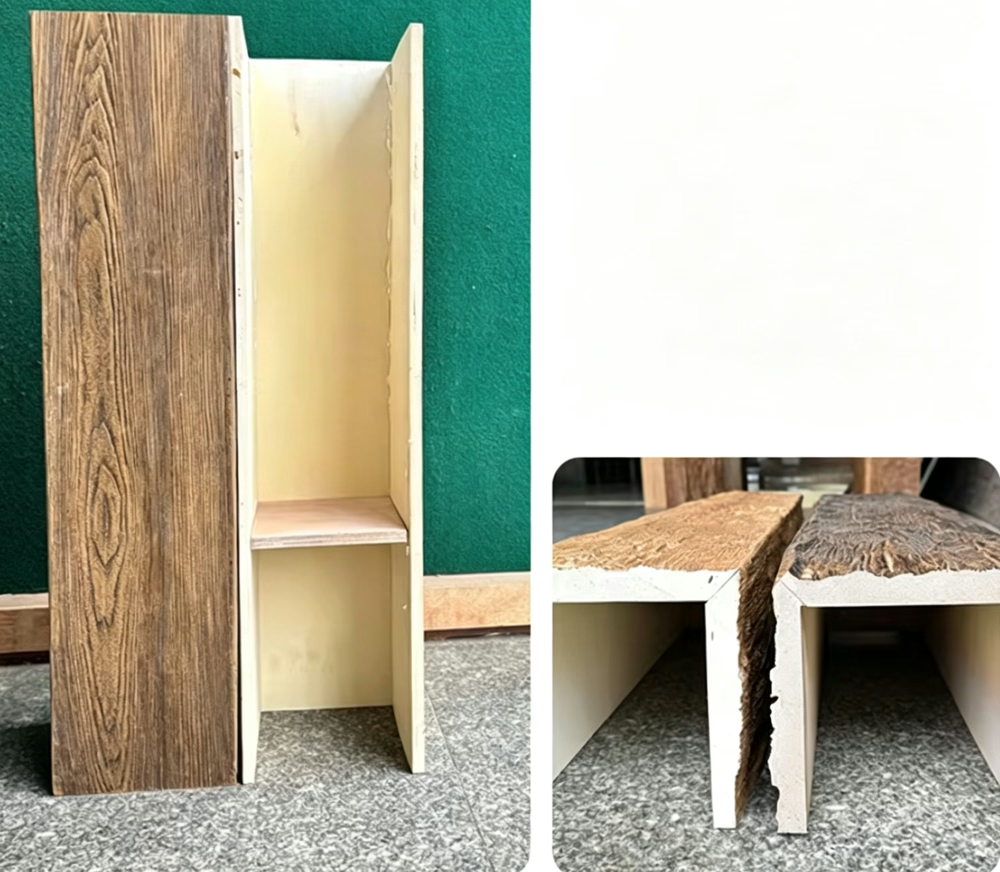
A polyurethane system used for faux beams is a two-component reactive system: an A-side (the isocyanate, usually polymeric MDI or a modified variant) and a B-side (a polyol blend with catalysts, surfactants, blowing agents, and additives). When the two sides meet and react, they form a rigid foam that fills a mold, skins over, and cures into the finished beam shell.
That sounds simple, but every line on the B-side spec sheet is a lever. Here's what a manufacturer can change without redesigning the production line:
Polyol blend
The polyol side carries the bulk of the formulation's "personality." A polyether polyol gives a tougher, more chemical-resistant foam. A polyester polyol gives better adhesion to coatings and slightly higher temperature resistance. Blending them changes the feel of the cured foam — whether it sands cleanly, whether it holds a screw, whether it feels dense or chalky at the surface.
Isocyanate index
Running the reaction slightly over-indexed (an NCO:OH ratio of 105 to 110 instead of the standard 100) produces a more rigid foam with better heat resistance. Under-indexing produces a slightly more flexible foam that resists chipping during shipping but trades off surface hardness.
Blowing agent
Pentane-blown systems are the historical default. HFC-245fa gives better insulation value but faces phase-out pressure. Water-blown systems (where water reacts with isocyanate to generate CO₂) are the most sustainable option and are increasingly common in European-sourced foam. Each blowing agent produces slightly different cell structure, which in turn affects how faithfully the foam picks up grain detail.
Fire-retardant package
The most-requested additive for B2B projects. Liquid phosphate ester FRs (TCPP, TDCPP alternatives) can be blended into the polyol side without major process changes. Solid FRs (melamine, expandable graphite) require slurry handling and changes to mixing. The difference between ASTM E84 Class C and Class A usually comes down to loading level and FR package choice, and the loading affects foam density and processing — so a Class A beam will be heavier and slightly more expensive than a Class C beam of the same dimensions.
Catalysts
Amine catalysts control the rise profile and cure speed. If you're pouring a very long curved beam (six meters or more), you need a slower cream time to let the foam fill the mold before gelling. If you're doing short straight beams, you can run hotter and reduce cycle time. Catalyst adjustments don't change the foam's final properties much, but they change everything about how the factory runs.
Surfactants and cell stabilizers
These control cell size and uniformity. For beams that will be sanded, painted, or stained to look like real wood, fine uniform cells matter. For beams that will be coated with a thick textured finish, cell uniformity matters less.
Additives for color, UV, antimicrobial
Pigments can be pre-dispersed into the polyol side for through-color beams. UV stabilizers (HALS, UV absorbers) extend color stability in sun-exposed applications. Antimicrobials are silver- or zinc-based additives that prevent surface mold growth in humid environments.
How the development process works
A custom resin formula isn't developed in an afternoon. The realistic timeline for taking a new formula from initial brief to first production-quality pour is four to eight weeks, broken into roughly three phases.
Phase 1: Specification and matching (1 to 2 weeks)
You send your target spec sheet — fire rating, density range, color, finish, any regulatory documents — and the factory's technical team proposes a starting formula. If the factory has a library of in-house formulas (most medium-sized Chinese PU beam makers have 20 to 50 stock formulations), the proposal is often a tweaked existing formula rather than a from-scratch design. The starting formula is poured into small test blocks and tested for density, surface hardness, and (if requested) basic fire performance.
Phase 2: Lab tuning (1 to 3 weeks)
The starting formula is adjusted, typically in three to five iterations, until it hits your target on every measurable parameter. For fire-rated beams, this phase includes sending samples to a third-party lab for ASTM E84 testing. A single E84 test costs roughly $1,500 to $3,000 USD and takes two to four weeks for results, so the timeline stretches here if fire certification is required.
Phase 3: Trial pour and production validation (1 to 3 weeks)
The final formula is poured into a production mold at the factory. The trial pour confirms that the foam flows correctly into the mold geometry, releases cleanly from the mold surface, and produces a beam with the expected finish and dimensional stability. If the trial pour fails, you're back to lab tuning. If it succeeds, you have a production-ready formula.
The real cost of a modified formula
Custom resin development is not free, and it's not cheap. Expect to pay a one-time formula development fee ranging from $1,500 to $8,000 USD depending on complexity. Fire-rated formulas with full third-party certification sit at the upper end. Simple density or hardness changes can be much cheaper.
The per-unit cost of the resulting beam is also higher than a stock-formula beam. The exact uplift depends on what's changed, but a realistic range is 8 to 25 percent above the standard catalog price. Fire-rated formulas add the most cost because the FR additives themselves are expensive and because heavier foam density means more raw material per beam.
Volume discounts still apply, but they apply against the higher base price. A 5,000-piece order of fire-rated beams will be considerably more expensive per piece than the same volume of standard beams, even at the maximum discount tier.
What to ask your supplier before signing off
A few questions worth asking any factory that proposes a custom PU formula:
- Which third-party lab do you use for ASTM E84 testing, and can you share recent reports on similar formulas?
- What density range can the formula hold consistently across a 5,000-piece production run?
- How does the modified formula affect mold cycle time?
- Is the formula compatible with your existing grain texture molds, or does it require mold surface changes?
- What's the lead time for a re-order once the formula is locked in?
The answers separate a serious custom-formula supplier from one who's quoting you a standard catalog beam and calling it custom. Both can produce a product labeled "modified polyurethane," but only one will actually meet your project spec.
When a stock formula is the right answer
Not every project needs a custom formula. If you're sourcing faux wood beams for a residential development, a restaurant chain, or any application where standard decorative PU performance is acceptable, the stock catalog is faster, cheaper, and lower-risk. Save the custom-formula conversation for projects where the spec genuinely demands it — fire rating, extreme climate, sustainability certification, or unusual finish requirements. For everything else, the catalog is your friend.
For importers and project managers who do need a modified formula, the conversation is worth having early — at the design development phase, not the procurement phase. Pulling in the resin supplier at the design stage means the formula can be developed in parallel with mold tooling, instead of after the mold is already paid for. That's the difference between a custom beam that's on time and on budget and one that's neither.
Modified polyurethane resin is one of the few areas of faux beam manufacturing where Chinese factories genuinely have deep technical capability and well-developed processes. Take advantage of it where the project warrants it, and don't over-engineer it where it doesn't.
Technical References
ASTM standards cited in every specification
Test Data
Lab results from internal testing program
Updated 2026
Reviewed against current product specs


