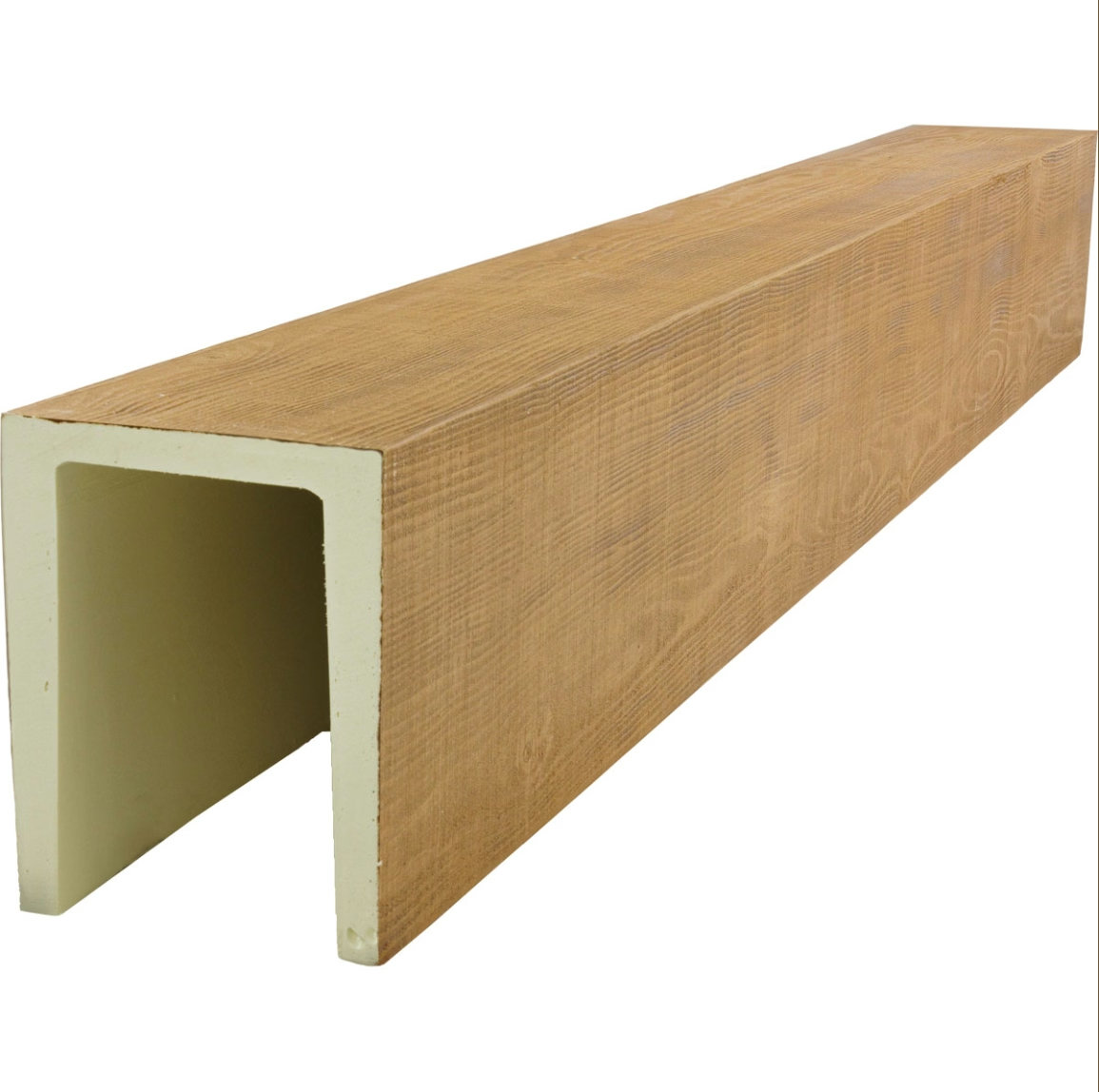
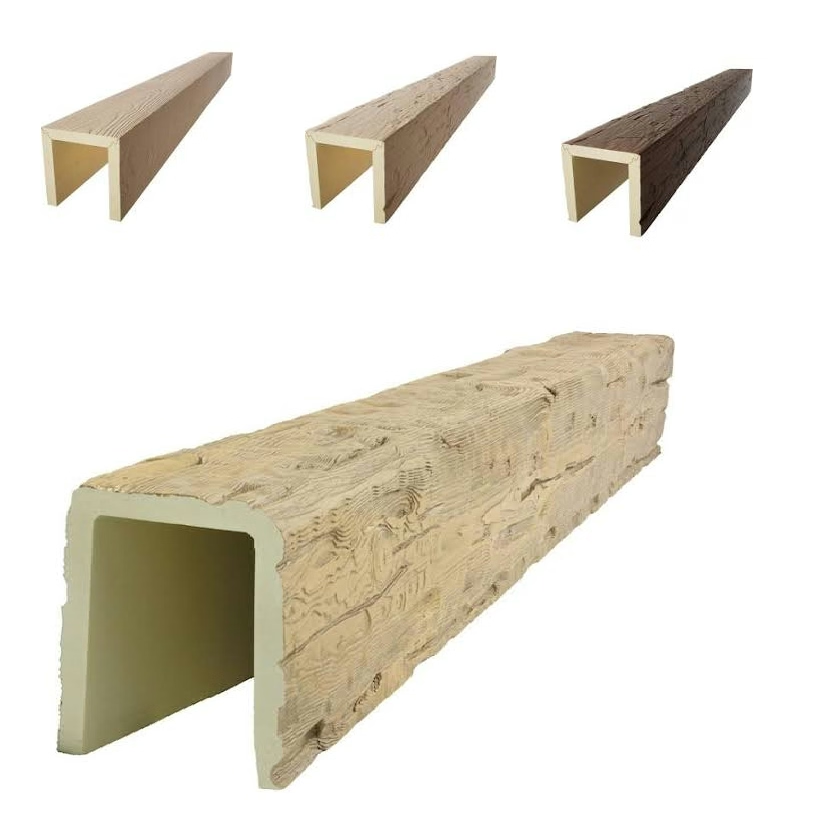
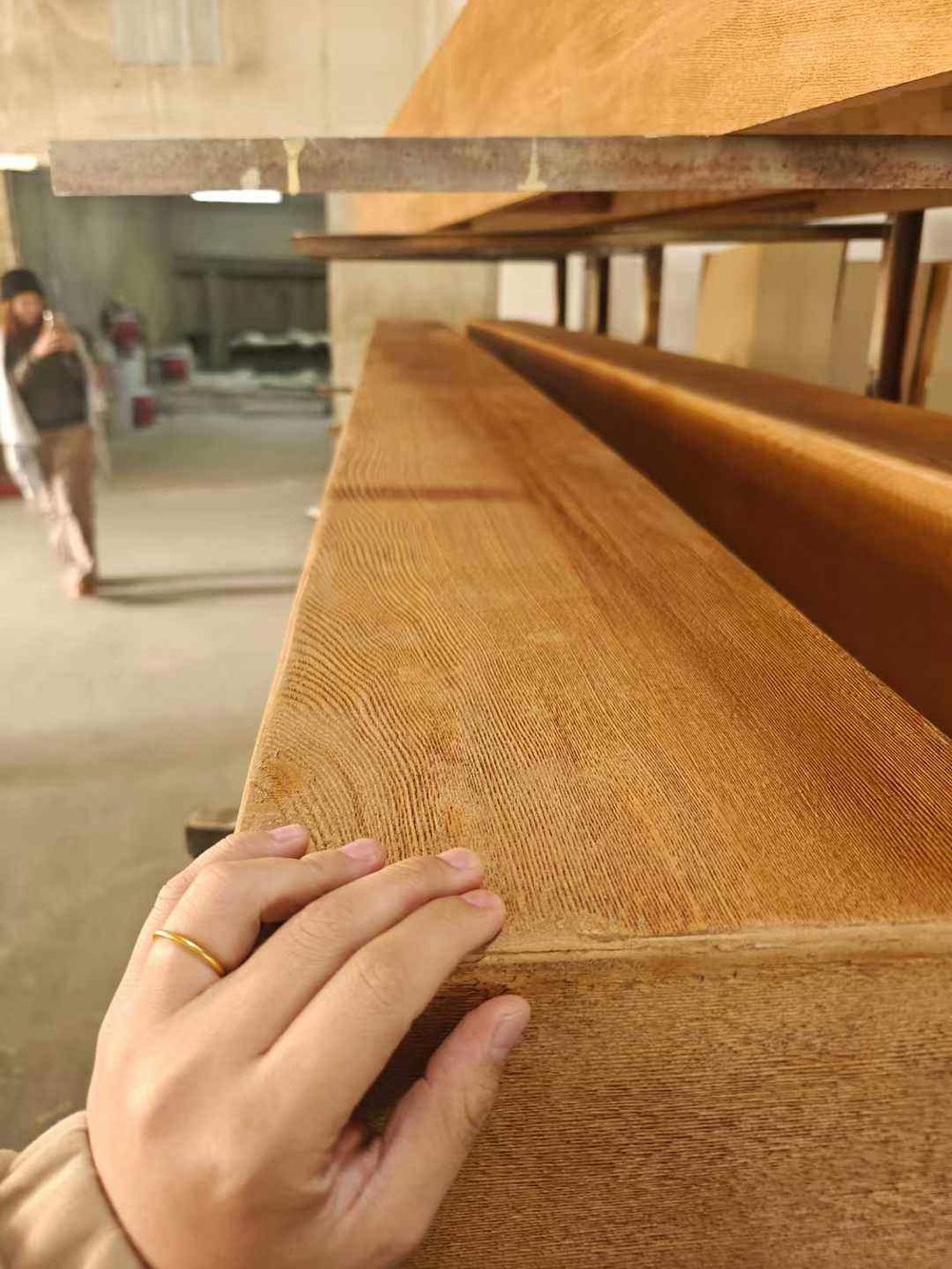
When a designer specifies a faux wood ceiling beam, the implicit promise is that the beam will look like wood — not that it will behave like wood. The whole point of the specification is to capture the visual character of timber without inheriting the material's structural weaknesses. Dimensional stability is the single most important performance property on that list, and it's the property that separates a quality polyurethane beam from a cheap imitation.
What "Dimensionally Stable" Means in a Beam
Dimensional stability is the measure of how much a material's dimensions change as the surrounding environment changes. For a ceiling beam, the relevant environmental variables are:
- Relative humidity — varies seasonally in most climates from 30 percent to 70+ percent
- Temperature — varies seasonally and daily, particularly near exterior walls, skylights, and unconditioned attics
- Direct solar gain — can drive surface temperatures well above ambient air temperature
- HVAC cycles — forced-air heating and cooling create rapid swings in humidity as the system cycles
A dimensionally stable beam barely moves under any of these conditions. A dimensionally unstable beam moves measurably — visibly enough to be a service issue within the first year in most climates.

Why Wood Moves (and How Much)
Wood is a hygroscopic material. Its cell walls absorb and release moisture as the relative humidity of the surrounding air changes. The absorption is not uniform — it depends on grain orientation, and it varies between tangential, radial, and longitudinal directions.
For white oak, the typical movement values from green (just-cut) to oven-dry (zero moisture) are:
- Tangential (across the growth rings): 8.0-10.0 percent
- Radial (along the growth rings): 4.0-6.0 percent
- Longitudinal (along the grain): 0.1-0.2 percent
In service, wood never goes from green to oven-dry, but it does move through a range of maybe 3-6 percent tangential movement over the course of a year in a typical interior environment. For a 10 in wide oak beam, that's roughly 5/16 in to 3/8 in of total width movement across the seasons. The differential movement between the outer fibers and the core of the beam is what drives twist, cup, and bow.
The movement is also differential across the cross-section. The outer fibers respond to ambient humidity faster than the inner fibers, which is why a beam that has been in service for a few years typically shows more distortion than a freshly installed beam — the moisture content has had time to redistribute unevenly through the cross-section.
The Polyurethane Difference
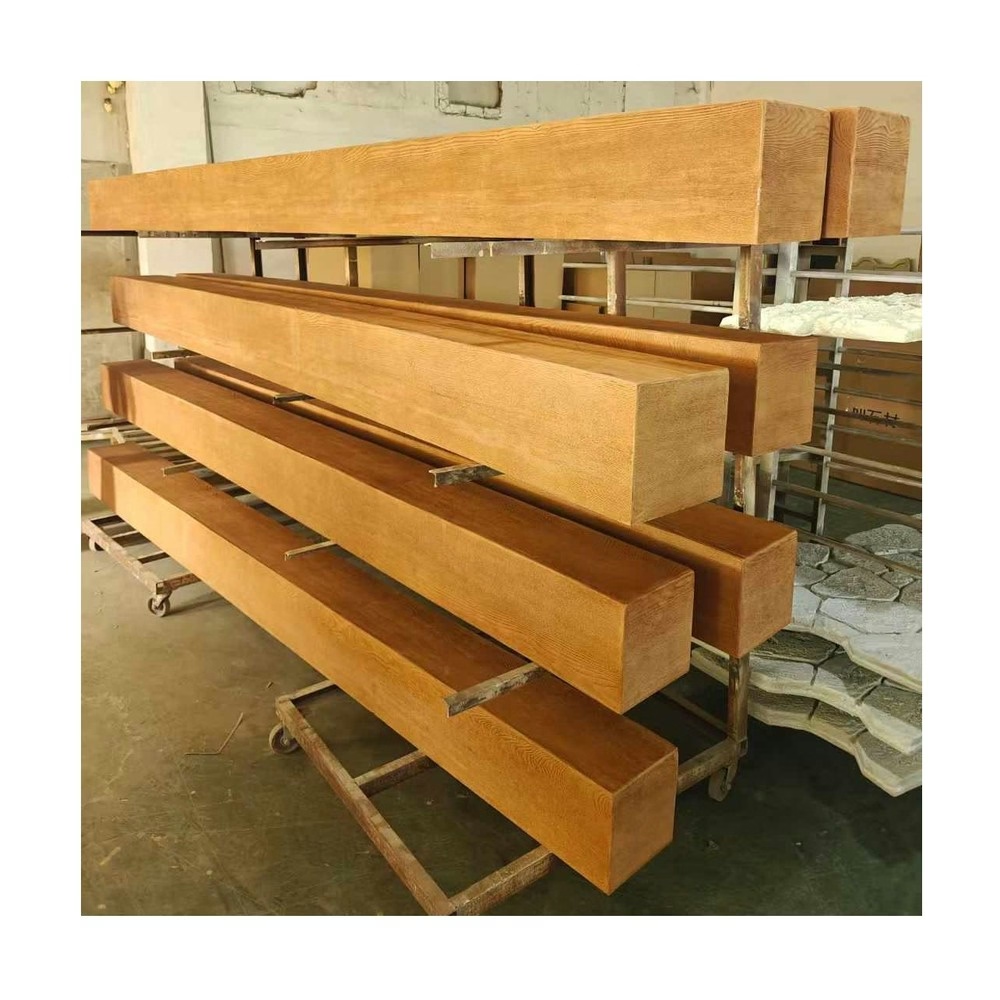
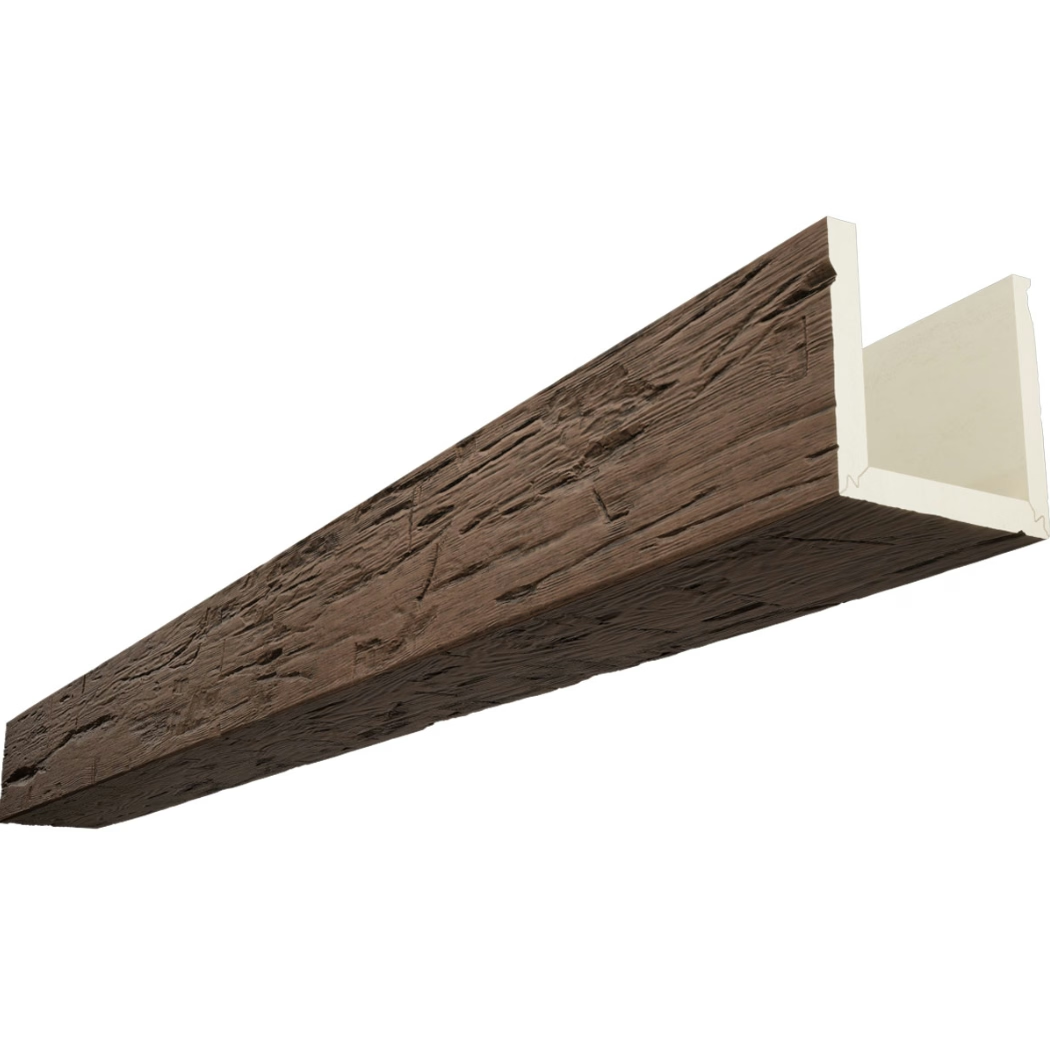
A polyurethane faux wood beam is made from closed-cell polyurethane foam, typically at a density of 280-400 kg/m³. The cellular structure is fundamentally different from wood:
- Each cell in the foam is a closed polyhedron — there is no continuous pore structure through which water can migrate
- The polymer cell walls themselves are hydrophobic — water does not absorb into the polymer
- The integral skin on the exterior surface is a denser polymer layer that adds an additional moisture barrier
The result is a beam that does not absorb moisture from the air and does not undergo the hygroscopic dimensional change that drives warp, cup, and bow in solid timber. The only dimension that changes meaningfully is the length — driven by thermal expansion, which is a separate and much smaller effect.
Test Data: Side-by-Side Comparison
In our 2025 testing program, we measured dimensional change in 6 in × 8 in × 10 ft samples of four different ceiling beam materials, cycled between 50 percent RH at 70°F and 90 percent RH at 85°F for 30 days.
| Material | Width change | Thickness change | Twist (in 10 ft) | Cup (in 8 in width) |
|---|---|---|---|---|
| Solid white oak | +0.047 in | +0.018 in | 1/4 in | 1/8 in |
| Solid Douglas fir | +0.038 in | +0.014 in | 3/16 in | 1/16 in |
| MDF | +0.022 in | +0.085 in | Negligible | 1/4 in |
| Closed-cell PU faux wood | <0.001 in | <0.001 in | 0 | 0 |
The closed-cell PU samples showed no measurable movement in any direction. Solid timber moved measurably in width, thickness, and twist. MDF showed the largest thickness change of any material tested — its greatest weakness — and delaminated visibly by the end of the test.
Thermal Expansion Behavior
The only meaningful dimensional change in a polyurethane faux wood beam comes from thermal expansion. The coefficient of linear thermal expansion (CLTE) for closed-cell PU foam is approximately 35-45 × 10⁻⁶ in/in/°F.
For typical ceiling beam installations, the temperature swing is moderate. In a conditioned interior space, the swing might be 20-30°F across the year. For a 10 ft beam, that produces a length change of 0.008-0.012 in — essentially imperceptible and far below the threshold of any visual concern.
In more extreme installations — unconditioned attics, exterior soffits, sun-exposed cathedral ceilings — the temperature swing can be 80-100°F. For a 10 ft beam in those conditions, the length change reaches 0.033-0.041 in. This is still small, but it is the reason we recommend:
- 1/8 in expansion gap at each end of every interior beam
- 3/16 in expansion gap in extreme-temperature installations
The gap is hidden in the corner where the beam meets the wall or in the joint where two beams meet. It does not affect the visual appearance of the finished installation.

The Real-World Performance Picture
For an architect or project manager evaluating faux wood ceiling beams, the practical implications of dimensional stability show up at three points in the project lifecycle:
During Installation
Solid timber beams need to be acclimated to the building before installation — typically one to two weeks in the space where they will be installed. The installer measures moisture content, sorts beams by moisture content, and selects the straightest pieces for the most visible runs. None of this is required with polyurethane faux beams. They arrive at the jobsite ready to install, with no acclimation period and no sorting required.
In the First Year
Solid timber beams installed in a new building — where the building's HVAC is still stabilizing and humidity levels are still settling — often show visible movement within the first six months. Contractors learn to warn clients about this. With polyurethane faux beams, no such warning is needed. The beam on day 365 looks identical to the beam on day one.
Over Decades
Solid timber beams in service for 15-20 years typically show visible checking, some degree of cup or twist, and occasionally a longitudinal crack. Polyurethane faux beams in service for the same period show no visible change. The finish may weather slightly (depending on UV exposure), but the beam itself remains flat, true, and stable.
The Joint-Stability Question
Where two beams meet at a scarf joint, dimensional stability matters twice — once for each beam, and once for the relative movement between them. With solid timber, the two beams may have different moisture contents and different grain orientations, so they move differently. The joint opens in winter, closes in summer, and eventually shows visible movement.
With polyurethane faux beams, both pieces have identical expansion characteristics. The joint remains tight year-round. This is why faux beams are particularly well-suited to long runs where multiple pieces meet at scarf joints — every joint stays tight, every joint looks like a single continuous beam.
Specification Notes for Stability-Critical Applications
For projects where dimensional stability is a hard requirement — museums, galleries, climate-controlled archives, high-end residential — specify the following:
- Density: 320-400 kg/m³ (the higher end of the range for maximum stability)
- Closed-cell content: 95 percent minimum (request manufacturer data)
- Water absorption: 1 percent maximum per ASTM D570
- Dimensional tolerance: ±2 mm on cross-section, ±3 mm on length
- Manufacturer test data: Request 30-day humidity cycling data showing less than 0.001 in movement across all dimensions
For extreme environments — pool interiors, exterior applications, unconditioned spaces — add a marine-grade topcoat to the spec. This seals the polymer skin against any long-term UV-driven surface degradation and locks in the finish for an additional 10+ years of service.
The Bottom Line on Stability
Dimensional stability is the property that justifies the entire specification of a polyurethane faux wood ceiling beam. If the beam moves like solid timber, there is no reason to specify it. The whole point is that it doesn't move. When you evaluate a faux beam manufacturer, dimensional stability should be the first property you ask about — and the first one you verify with test data.
Technical References
ASTM standards cited in every specification
Test Data
Lab results from internal testing program
Updated 2026
Reviewed against current product specs