
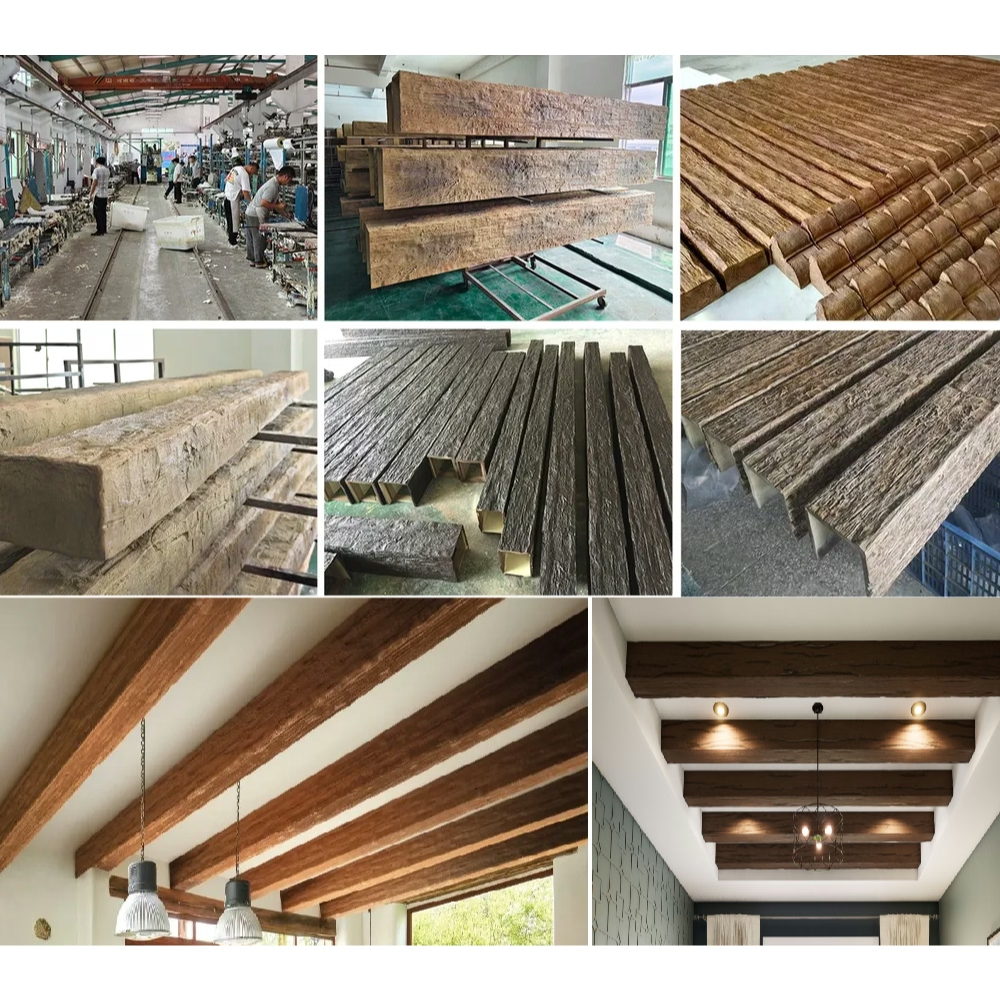
Walk through a faux beam factory in eastern China during peak season and you will see a controlled version of organized chaos. Workers pull castings from molds, hand-finish surface grain, and stack finished beams in long aisles that look more like a lumber yard than a polyurethane workshop. The scale is the first thing that surprises Western buyers visiting for the first time.
China is the dominant production base for premium polyurethane faux wood beams sold into the US, EU, Australia, and the Gulf. The combination of mold-making capability, finishing expertise, and export logistics has built a manufacturing cluster that other regions struggle to match on either price or volume. This article is a frank look at what international buyers actually experience when they buy premium polyurethane faux wood beams direct from China.
Why Chinese factories lead premium faux beam production
The polyurethane faux beam industry did not start in China. It began in North America and Western Europe, where builders first started casting lightweight beams to solve real problems on renovation projects. What shifted over two decades was where the production scaled.
Three factors explain the move. The supply chain for polyurethane raw materials consolidated heavily in Asia, particularly in China and South Korea. Mold-making capacity moved with it. And finishing labor — the part of faux beam production that resists pure automation — became more affordable in regions with deep finishing craft traditions.
A premium Chinese faux beam factory today typically combines high-pressure casting equipment, in-house mold fabrication, hand-finishing lines, and an export logistics desk. The premium segment specifically separates from budget production through more refined grain detail, more consistent color, and stricter quality control on packaging for long-distance shipping.
What "premium" means on a factory floor
A premium polyurethane faux wood beam is not just a heavier or thicker casting. The differences are visible in the details: grain that does not repeat too obviously across a run, color variation that mimics real timber without looking painted-on, and surface texture that takes light realistically rather than reading as plastic.
Factories separate premium from standard on several production details:
- Higher density polyurethane formulations that resist denting during installation
- More color steps applied and wiped back during finishing
- Quality inspections at multiple stages instead of only at packing
- Tighter tolerances on length and squareness, which makes installation cleaner
- Reinforced internal structures on longer box beams for stiffness
A buyer cannot judge premium from a price sheet. They can judge it from a production sample, a conversation with the factory's quality lead, and a willingness on the factory side to ship reference pieces before bulk production begins.
The shape of a typical Chinese factory order
A Western buyer running a commercial project rarely orders from China in isolation. The order sits inside a longer timeline that includes the designer's specification, the contractor's purchasing cycle, and the freight forwarder's booking schedule. The factory has to fit into that timeline without breaking it.
The order sequence tends to follow a stable pattern across most factories.
Sample phase
The buyer sends specifications — profile, finish reference, dimensions. The factory produces a small set of sample beams and ships them by international courier. Sample cost is usually modest, in the range of USD 50 to USD 200 depending on size and quantity, and the sample itself lands in about a week to ten days for most destinations.
A premium factory treats the sample phase seriously. The samples should match the production finish recipe, not be a hand-picked beauty shot. Many factories keep reference samples in a dedicated library so future orders can match against a physical example rather than a photo.
Specification and proforma
Once the sample is approved, the factory issues a proforma invoice with the agreed specification, quantity, pricing, payment terms, and production lead time. For commercial projects, the specification document is also attached or referenced. This becomes the contractual anchor for the order.
For first-time buyers, the payment terms often require a deposit of 30 percent with the balance due against shipping documents. Returning buyers sometimes negotiate better terms, particularly if their order history is solid and the relationship has earned trust on both sides.
Production and quality control
A 20-foot or 40-foot container-load order typically runs four to six weeks in production after deposit. During that window, the factory's export team sends photos or short video clips at agreed checkpoints. The buyer should request these in advance and review them promptly — a delay in feedback can push the production calendar out by days.
Premium factories also keep retained samples from each batch. If a buyer later orders a phase-two batch and wants to match an existing ceiling, the factory can pull the original sample and finish the new run to match.

The packaging phase matters more for China-to-overseas shipments than for domestic orders. Beams travel a long way, often with multiple handling points, and a poorly braced pallet can crack a corner cap or dent a finished surface. Premium factories use reinforced corners, foam wrapping on high-touch areas, and pallet configurations that the buyer's receiving team can unload efficiently.
Export documentation and shipping
For most export destinations, the factory provides a commercial invoice, packing list, and certificate of origin. For some markets — the US, EU, Australia — additional documentation may be required: fire rating certificates, material safety data sheets, or conformity documents for restricted substances.
The factory's export desk coordinates with the buyer's freight forwarder or, in some cases, provides a full-service logistics option. For buyers running their first China-direct order, full-service logistics reduces friction, even at a slightly higher cost.
Common points of friction and how to manage them
Every China-direct order involves friction points. Most are predictable, and most can be resolved before they become problems.
Communication cadence
English-language proficiency varies across Chinese factories. The largest exporters usually have dedicated English-speaking export teams. Smaller workshops may rely on translation tools or one bilingual staff member. For projects that need precise technical discussion, this matters.
Buyers should set a single communication channel — usually email with occasional video calls — and identify the relevant people on both sides by name and role. The export manager is rarely the same person as the production manager or the quality lead, and trying to push all communication through one person slows decisions.
Color and finish consistency
Color drift between the approved sample and the bulk run is the most common source of friction in faux beam orders. The factory handles it through retained samples and batch testing. The buyer handles it by inspecting the production run photos carefully and, where the order is large enough, requesting a pre-shipment batch sample.
For premium orders, requiring the factory to produce a one-meter reference sample from the actual production batch — not the lab sample — is a reasonable ask. Most established exporters accommodate this as standard practice.
Container load planning
Beams are awkward freight. They are long, often box-shaped, and cannot nest in a container the way stacked panels can. Loading plans matter for both shipping cost and damage prevention. A factory with real export experience will provide a loading plan before the container arrives and adjust based on the actual mix of beam sizes.
Buyers should also think about how the container will be received on site. A 40-foot high-cube container full of beams arrives at the same time, and the project needs a laydown area and equipment to unload efficiently.
Dispute resolution
Most international orders go smoothly. When they do not, the difference between a recoverable problem and a damaged relationship usually comes down to a written protocol established before production begins. Premium factories accept pre-shipment inspection on bigger orders, and many offer short payment holds against punch-list items at delivery.
Buyers who skip this step and rely on a verbal understanding are the ones who describe China-direct ordering as risky. Buyers who build the protocol in advance generally describe it as a reliable channel.
Profiles and finishes commonly exported from China
The premium segment of Chinese faux beam production covers an unusually wide range of profiles. The most common include:
- Hand-hewn rustic beams with pronounced surface variation
- Rough-sawn barnwood textures with aged finishes
- Smooth sanded beams with subtle grain for clean modern interiors
- Aged timber beams with multiple color layers and edge wear
- Reclaimed-look box beams with end-cut detail
- Custom profiles built from buyer-supplied reference photos or drawings
Finish families also vary widely. Driftwood grey, warm honey oak, dark walnut, antique chestnut, weathered barnwood, and aged pine cover most of the residential and light commercial demand. Custom color matching is available but adds time and cost.
For commercial projects with a brand-driven palette, custom finish development is a real service that premium factories offer. The fee is usually modest for a one-off, and the recipe stays in the factory's library for future phase orders.
When China-direct is the right call
A homeowner needing eight meters of beam for a vaulted living room is better served by a local stockist. A contractor fitting out a 200-room hotel in the Caribbean, an importer building a regional stock program, or a designer specifying a custom finish across a multi-building development benefits from China-direct ordering.
The right call is usually a question of volume, customization, and timeline. When any of those three points to a specialist rather than a stockist, China-direct production becomes the practical answer. The market has matured enough that the operational infrastructure is solid, the documentation is familiar to freight forwarders, and the factories themselves treat premium export work as their main business rather than a side line.
Technical References
ASTM standards cited in every specification
Test Data
Lab results from internal testing program
Updated 2026
Reviewed against current product specs


