
A wholesale buyer sits at the center of a particular kind of pressure. Upstream, the factory needs clear forecasts and steady orders to keep production lines efficient. Downstream, contractors and retailers expect short lead times and consistent finishes. The buffer between them is inventory, and that buffer is expensive to hold but punishing to run out of.
For polyurethane faux beams, the wholesale channel has matured into something specific over the last decade. Stock profiles, hand-finished premium lines, and container-load direct imports all coexist. This article is written for the buyer sitting in that middle seat, trying to decide what a factory-direct wholesale relationship should look like for bulk PU faux beam orders.
The two main wholesale models
Wholesalers handle polyurethane faux beams in two distinct ways, and the difference matters for unit economics.
The first model is the stock-and-distribute approach. The wholesaler buys container-load quantities of standard profiles and finishes, holds them in a regional warehouse, and breaks bulk to supply contractors and retailers on short lead times. Margins sit on inventory turn, packaging efficiency, and reliability of supply.
The second model is the order-on-behalf approach. The wholesaler acts as the buyer's agent, taking orders for specific projects and routing them through the factory without holding stock. Margins sit on specification management, project coordination, and the value of a single point of contact.
Some wholesalers run both. The mature operations tend to hold a stock core of the fastest-moving profiles and finishes, and route larger or more custom orders through the factory on a project basis.
What changes when volume crosses container thresholds
At low volume — anything under a full container — the wholesale margin is mostly handling. Once the order crosses a full container threshold, the math starts to shift toward factory pricing. The factory still wants the order, but the price-per-meter drops by a noticeable percentage, and the packaging gets configured for export rather than domestic retail.
That threshold is where the factory-direct wholesale relationship gets attractive enough to justify the operational complexity of import logistics.
Pricing structure of factory-direct wholesale orders
Factory pricing for polyurethane faux beams depends on several variables that come up in every negotiation.
Profile complexity. A smooth rectangular box beam is the cheapest profile to produce. A hand-hewn rustic beam with rough surface texture takes more labor per meter and costs more. Custom profiles sit at the top end.
Finish complexity. A single-color wash on a textured beam is the simplest finish. A multi-step aged finish with hand-applied highlights can double the finishing labor per piece and shows up clearly in the unit price.
Order volume. Quantity discounts are real and meaningful. A 500-meter order and a 5,000-meter order of the same specification are not priced the same. The unit price difference often covers most of the buyer's import logistics cost.
Packaging. Bulk packaging on export pallets is the cheapest option. Retail-ready packaging with barcodes, individual sleeves, and consumer-facing labeling costs more. The factory usually offers both, with the price difference spelled out per meter.
Shipping terms. EXW pricing puts the buyer's freight forwarder in control. FOB pricing moves the freight booking but not the cost to the buyer's account until the goods cross the ship's rail. CIF and DDP shift more of the logistics responsibility (and cost) to the factory, which charges accordingly.
Hidden costs to budget for
A wholesale buyer who only watches the factory's unit price misses several real costs that eat margin if they are not accounted for.
- Import duties. Most countries apply duty to faux beams, typically under HS codes that cover plastic articles or articles of plaster. The exact rate varies by market and by any free trade agreements in force.
- Demurrage and detention. A container of beams sitting at port while paperwork clears is a real cost. Pre-clearance of documents before the ship arrives reduces this risk.
- Inbound handling. The container does not unload itself. Forklifts, laydown space, and labor all cost money at the receiving end.
- Damage allowance. Even with good packaging, a small percentage of damage in transit is normal on long international shipments. Budgeting 1 to 3 percent for this is realistic.
- Inventory carrying cost. A regional warehouse stocked with bulk orders is not free. Capital tied up in inventory, insurance, and handling all feed into the margin model.
A factory-direct wholesale buyer who treats these as fixed operational costs — rather than surprises — runs a more stable business.
Order management at scale
A wholesale buyer running multiple container-load orders per year needs a few operational habits in place to keep things smooth.
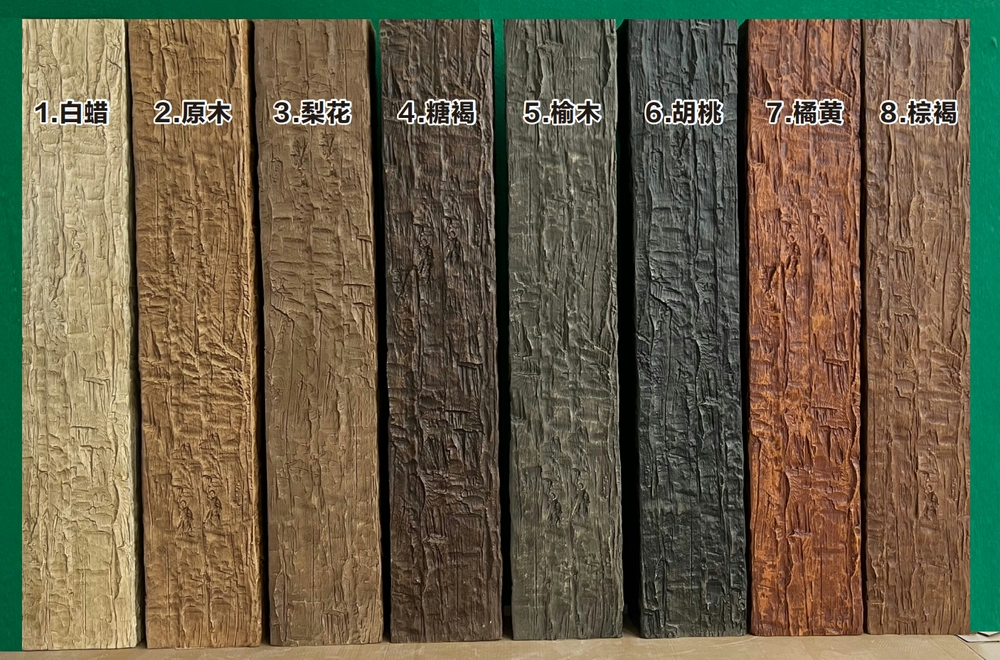
Specifications and finish library
A written finish library is the single most valuable piece of operational infrastructure a wholesale buyer can build. Every finish in stock should have a documented recipe, a retained physical sample, and a reference number that appears on the warehouse label and the buyer-facing literature. When a contractor calls back six months later asking for "the same grey we had last spring," the answer takes minutes, not days.
The factory can keep the same library on its side, and the two should match. A quarterly reconciliation between the buyer's samples and the factory's retained samples catches any color drift early.
Forecast and production planning
Containers that arrive out of cycle with project demand either sit in a warehouse costing money or arrive too late for the project that needed them. Neither outcome is good.
Wholesale buyers who do well at this build rolling 6 to 12 month forecasts with their factory partner. The factory does not need a hard commitment for every meter in the forecast — that is a tool for capacity planning, not contractual obligation. The hard commitments come in smaller windows, usually 60 to 90 days ahead of ship date, with the rolling forecast filling in the broader plan.
Mixed-load configurations
A wholesale buyer rarely orders a single profile or finish in a full container. The shipping economics push toward mixing as many line items as will fit cleanly. A 40-foot container might carry 12 line items across four profiles and six finishes, all destined for different end customers but consolidated into one freight-efficient load.
Managing the mix is part of the wholesale role. The factory's load plan should account for safe packing density, and the buyer's inventory system needs to track which pallets go to which customer.
Quality control on arrival
Every container-load order should open with a quality check at the receiving end. A 10 percent sampling is common practice. Damage rate, finish consistency, and dimensional accuracy are logged against the order and fed back to the factory.
This is not adversarial. Most factories want the feedback because it lets them adjust their packaging or process before the next container. The relationship works best when the quality check is presented as joint operational hygiene rather than a complaint.
Customer service through the wholesale channel
Wholesale buyers sit between the factory and the end customer, and that position carries real service responsibility. Three service tiers come up repeatedly.
Stock items. Standard profiles and finishes held in regional inventory. Lead time is days. The buyer's main job is keeping the warehouse full and pricing competitive against other regional suppliers.
Special order items. Custom finishes or profiles outside the stock range, routed through the factory on a project basis. Lead time is weeks. The buyer's job here is specification management, sample coordination, and timeline tracking.
Damage and warranty. A beam that arrives damaged at the contractor's site needs a fast replacement, not a long discussion. Wholesale buyers usually hold a small emergency stock of fast-moving items specifically for this reason. The factory's role is to replenish quickly when the emergency stock is tapped.
Service quality at the wholesale level is mostly a function of communication. The end customer does not need to know whether the beam in question came from local stock or a container-load from the factory, but they need to know when it will arrive and what it will look like.
When the factory-direct wholesale model breaks down
It is worth saying plainly where this model is the wrong fit. A wholesale buyer whose customer base orders fewer than 50 meters at a time and needs same-week delivery is better served by local stocking distributors upstream of a factory relationship, not by being one themselves. The freight economics do not work.
A wholesale buyer trying to compete purely on price with national hardware chains is also fighting a hard battle. Big-box retailers move volume that justifies stocking deals with regional polyurethane manufacturers. Wholesale importers do better when they serve a customer segment that values project-specific finishes or a particular aesthetic the chains do not offer.
The right customer for a factory-direct polyurethane faux beam wholesaler is a contractor working a steady flow of mid-sized commercial projects, a designer who values consistent finishes across phases, or a regional retailer who wants differentiation from national chains. That customer base rewards the operational investment and supports the inventory carrying cost.
Building a durable wholesale relationship with a factory
A few habits make wholesale relationships last longer and run more smoothly:
- Be precise about specifications in writing, every order
- Pay on the agreed terms. Late payments erode trust faster than almost any other issue
- Share forecast changes with the factory early
- Conduct arrival quality checks and share the data
- Visit the factory periodically. Buyers who have walked the production floor make better long-distance decisions than buyers who have only seen samples
A factory-direct wholesale relationship for polyurethane faux beams is not a static ordering exercise. It is an ongoing operational partnership that gets smoother with shared history. The buyers and factories that treat it that way tend to build the most resilient businesses on both sides of the table.
Technical References
ASTM standards cited in every specification
Test Data
Lab results from internal testing program
Updated 2026
Reviewed against current product specs


