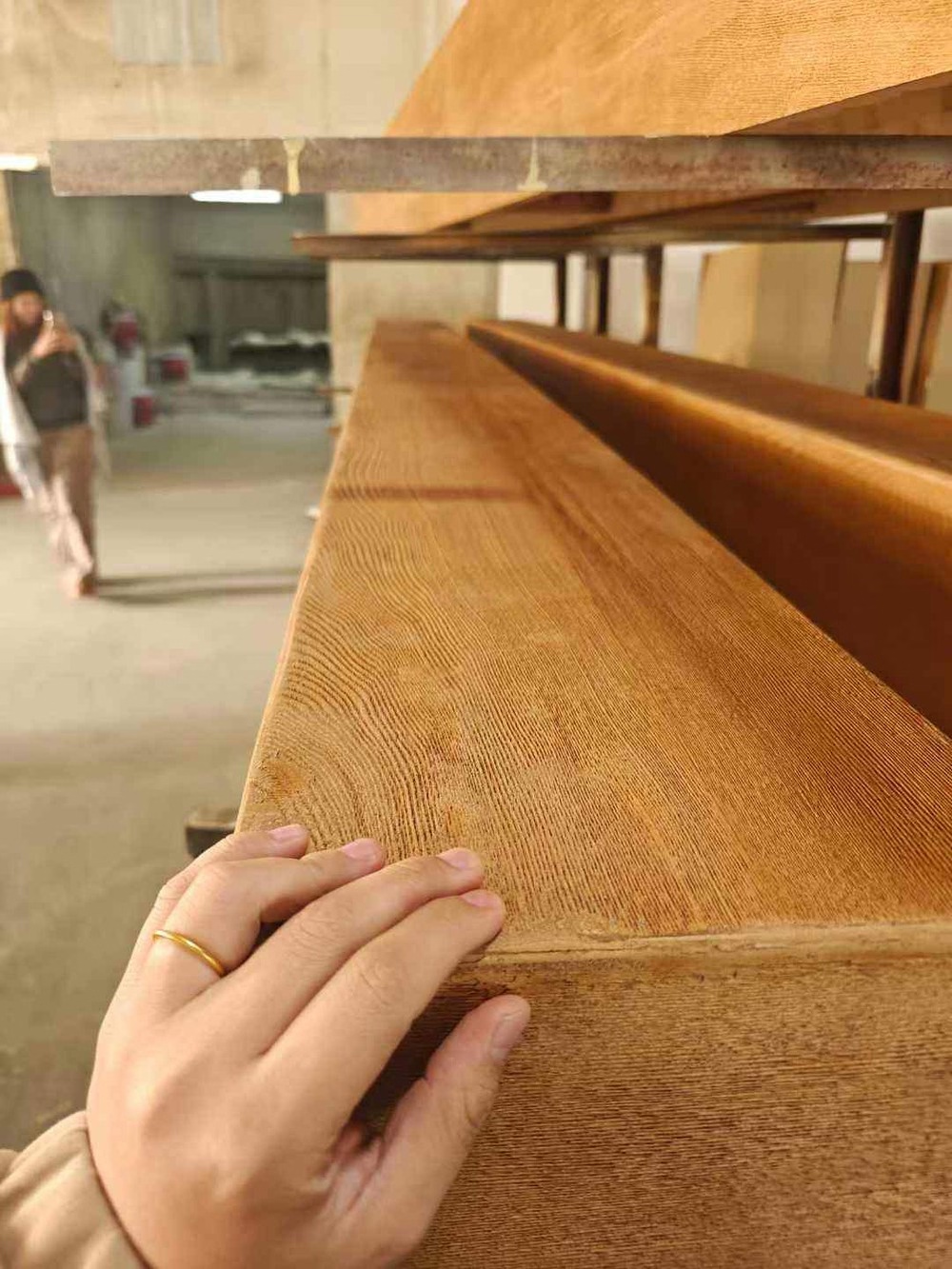
A homeowner in the Pacific Northwest is renovating a great room with a vaulted ceiling and wants the look of reclaimed timber. After researching the project, she realizes solid timber across those spans is structurally difficult and prohibitively expensive. Polyurethane faux beams solve the structural problem at a fraction of the cost. Then she finds a quote from a local retailer that is meaningfully higher than a similar quote from a manufacturer several time zones away.
The gap is the difference between consumer-grade retail pricing and direct-to-consumer factory pricing. That gap exists for a reason, and the answer to whether it is worth closing depends on what the buyer values.
This article is a clear-eyed look at how direct-to-consumer factory pricing for premium polyurethane faux wood beams actually works, including the math, the trade-offs, and where the model fits comfortably versus where it strains.
How pricing differs across the channel
A polyurethane faux wood beam typically passes through several pricing layers between the factory floor and the installed ceiling. The base factory price is the cost of producing the beam — materials, labor, factory overhead, and a modest margin for the manufacturer. As the beam moves through the channel, each layer adds cost and, ideally, value.
The retail layer
A retailer stocking faux beams in a brick-and-mortar store typically applies a 50 to 100 percent markup over factory cost. The markup covers showroom presence, sales staff, sample inventory, returns handling, and the convenience factor of immediate pickup. Many homeowners willingly pay this premium because it removes complexity from their project.
The online retailer layer
An online-only retailer adds a smaller markup, often 30 to 60 percent, because the overhead is lower. Samples may be available by mail. Delivery is to the customer's address, sometimes including professional delivery for large items. This layer suits homeowners who are comfortable specifying and ordering online and want a middle ground between retail showroom and direct factory.
The direct-to-consumer factory layer
Direct-to-consumer factory pricing cuts out the retailer entirely. The buyer deals with the manufacturer directly, often via a quote request through the manufacturer's website. Pricing is closer to the factory cost, usually with a modest markup for consumer-grade handling. The buyer takes on more of the specification, communication, and shipping coordination work, which is the trade for the lower unit price.
Each layer has a real cost and a real value. The right one depends on what the buyer is optimizing for.
What the factory-direct savings actually look like
The savings from going direct vary by order size, profile, finish, and shipping distance. Some real ranges that show up in actual projects:
A single-room project of 8 to 12 meters of standard box beams often sees 25 to 40 percent savings versus retail pricing. The savings are smaller in absolute terms but significant for a smaller project because the retail markup is heavier on smaller orders.
A multi-room project of 30 to 60 meters of premium finished beams in a custom or semi-custom color can see 30 to 50 percent savings. At this volume, the buyer's time investment starts to make sense because the absolute savings justify the specification and communication work.
A whole-home or large renovation project of 100+ meters can see 35 to 55 percent savings, particularly when shipping is consolidated. At this volume, the buyer's time investment is significant, but so are the absolute savings.
These ranges are not promises. They are patterns that show up across enough projects to be useful as planning assumptions.
What the buyer takes on in the direct model
Direct-to-consumer factory pricing is cheaper because the buyer absorbs some work that a retailer would otherwise handle. The work is real, and it is worth knowing about before committing.
Specification work
The buyer needs to arrive at a complete specification before the order goes into production. The specification includes beam dimensions, profile, finish, quantity, packaging, and shipping address. A retailer with a showroom helps the buyer work through this. A direct factory typically expects the buyer to arrive with most of this information decided.
For a homeowner who is uncertain about which profile or finish suits the room, this is the biggest barrier to direct ordering. The solution is usually to order a sample kit first, but a sample kit has its own cost and timeline.
Communication
Direct factory communication goes through email, occasional phone calls, and sometimes messaging platforms. The buyer is communicating with a sales or export coordinator on the manufacturer's side, sometimes through a translation layer. For a buyer who is comfortable with this style of communication, the model works well. For a buyer who prefers to walk into a showroom and talk through options, it does not.
Shipping coordination
The manufacturer's responsibility for the product typically ends at the factory loading dock or, for some Incoterms, the destination port or the buyer's address. The buyer is responsible for unloading the delivery, transporting it to the room where it will be installed, and storing it until installation. For a consumer buyer, this can mean renting a truck, recruiting friends, or hiring labor.
Buyers who underestimate this piece of the cost often end up with a lower factory price offset by higher local handling cost. The all-in comparison with retail pricing should account for the freight and handling on the buyer's side.
Installation support
Retailers and installers often coordinate, and some retailers install the products they sell. Direct factory buyers typically source installation independently. For a homeowner doing the project themselves, this is irrelevant. For a homeowner hiring a contractor, the relationship between the factory-direct pricing and the contractor's mark-up structure matters and is worth sorting out before the project begins.
When direct-to-consumer factory pricing makes sense
The model fits comfortably under specific conditions.
The buyer knows what they want. A clear specification eliminates the showroom-visit step that retailers handle well. A buyer who knows the profile reference, finish name, quantity, and timeline can move through a factory-direct conversation efficiently.
The order size justifies the effort. Single-beam orders rarely make sense direct because the savings do not cover the time cost. Orders in the 8-meter and above range start to make sense, and the larger orders make a lot of sense.
The buyer is comfortable with remote communication. Email-and-call conversations across time zones are normal. The buyer either does not need frequent updates or is comfortable initiating them.
The shipping destination is reasonable. Beams are bulky and expensive to ship relative to their value. Remote destinations can shift the savings to handling cost. Buyers in major markets with affordable freight have the easier math.
The buyer's project has flexibility on timeline. Direct factory orders typically take two to six weeks for production plus shipping. A buyer on a hard, near-term deadline is better served by a local stockist.
When it does not make sense
A few situations push the buyer toward retail even though the unit price is higher.
The buyer is unsure about the specification. Showrooms exist for this reason. Walking through the actual beam samples, seeing them in person, and adjusting the selection on the spot is not something direct ordering replicates. Spending the additional money on a retailer for a smaller, exploratory order is reasonable.
The order is genuinely small. For under 4 meters of beam, retail pricing is often the cheaper all-in answer. The factory's order handling cost may not improve much on a small order, while the freight cost is similar to a larger order on a per-meter basis.
The destination is remote. A buyer in a rural area with expensive last-mile freight can end up paying more all-in for direct pricing than for a retailer's bundled delivery.
The buyer needs installation matching the product. Some retailers offer product-plus-installation packages that simplify the project. A buyer who wants this combined service does not benefit much from sourcing at factory pricing.
How to evaluate a direct-to-consumer offer
For buyers who decide to pursue direct pricing, a few questions sharpen the evaluation.
What is included in the quoted price? Some direct quotes are for the beam only; freight, duties, and handling are extra. Others are delivered prices. The all-in comparison is the meaningful one, not the unit price alone.
What is the manufacturer's return and damage policy? Premium faux beams from a direct factory are typically non-returnable because of the custom production involved. Damage in transit is usually covered by replacement, but the specifics vary. Asking before ordering avoids a surprise later.
Who handles shipping damage claims? A reputable factory provides documentation and coordinates with the carrier. Less rigorous operations leave the buyer to file the claim themselves.
Is the manufacturer set up to handle consumer orders? Some manufacturers prioritize wholesale or project orders and treat consumers as a side line. Others have dedicated consumer-order workflows. The level of service differs significantly.
Can the manufacturer provide references? A direct-to-consumer manufacturer should have happy customers willing to share their experience. Asking for one or two references is reasonable.
The right framing
Direct-to-consumer factory pricing for premium polyurethane faux wood beams is not the cheaper way to do everything. It is the right model for buyers who know what they want, who have a project size that justifies the time investment, and who are comfortable working with a remote supplier. For those buyers, the savings are real, the products are the same as what a retailer would supply, and the trade-off is mostly time rather than quality.
The wrong framing is to treat factory pricing as inherently cheaper and assume the model always wins. For small orders, uncertain specifications, urgent timelines, or buyers who genuinely value the showroom experience, the retail channel earns its markup. Knowing which side of that line a project sits on is the practical starting point.
Technical References
ASTM standards cited in every specification
Test Data
Lab results from internal testing program
Updated 2026
Reviewed against current product specs