
A renovation budget has a way of breaking itself in half somewhere between the demo and the trim-out. Beams are often one of the first line items project managers trim when costs climb, but they don't have to be. Discounted high-quality PU faux wood beams let contractors, designers, and homeowners hold the line on price while keeping the visual standard the rest of the build depends on.
The trick is knowing what "discounted" actually means in the faux beam market, and what separates a real cost-savings opportunity from a corner-cut product that costs more in callbacks.
Where discounted PU beams actually come from
The faux beam market doesn't operate like a clearance bin at a hardware store. Most discounted inventory falls into a handful of predictable categories, and understanding them helps buyers make smarter calls.
End-of-run factory batches
Polyurethane faux beams are poured in molds. Every mold has a cycle life — once a mold wears beyond tolerance, the texture loses resolution and the factory retires it. Beams produced near the end of a mold's useful life still meet spec but get flagged as "B-grade" and priced accordingly. They are not seconds; they are perfectly serviceable pieces that just don't carry the first-tier price tag.
Discontinued finishes
A warehouse stocked heavily on a particular driftwood finish and then the design team shifted to a warmer tone. The earlier finish gets discounted to move inventory. Finish trends in faux beams shift roughly every 18 to 24 months, so discounting on outgoing finishes is routine and predictable.
Overstocked sizes
A distributor over-ordered 8x10 beams in 16-foot lengths for a project that fell through. Those beams sit in the warehouse until the next comparable job shows up. Often, that means months of carrying cost — which the distributor prefers to convert into cash via a discount rather than keep absorbing storage fees.
Mixed-lot palettes
When a buyer combines beams from multiple production runs, the color match is usually close but not perfect. Some suppliers discount mixed-lot pallets when the variance is greater than their standard tolerance (typically ±5 percent shade difference). For projects where beams will be separated by wall, room, or visual break, mixed-lot discounting is one of the cleanest ways to save.
Project cancellation returns
Builders cancel projects. Designers change specs mid-phase. When unopened, full-pallet beam orders come back to the distributor, they frequently get resold at a discount rather than returned to the factory. These are usually first-quality goods in unopened original packaging.
What "high-quality" still means at a discount
A common worry is that discounted beams are somehow defective. That is rarely the case in the PU faux beam market, but it is worth checking the same quality markers you would check at full price.
Density and weight
A high-quality PU faux beam should feel substantial when lifted. Density for premium specification runs 2.0 to 2.5 pounds per cubic foot. If a discounted beam feels unusually light for its size, that is a red flag — it suggests the manufacturer cut the formulation cost and the texture will be thinner and the impact resistance lower.
Texture resolution
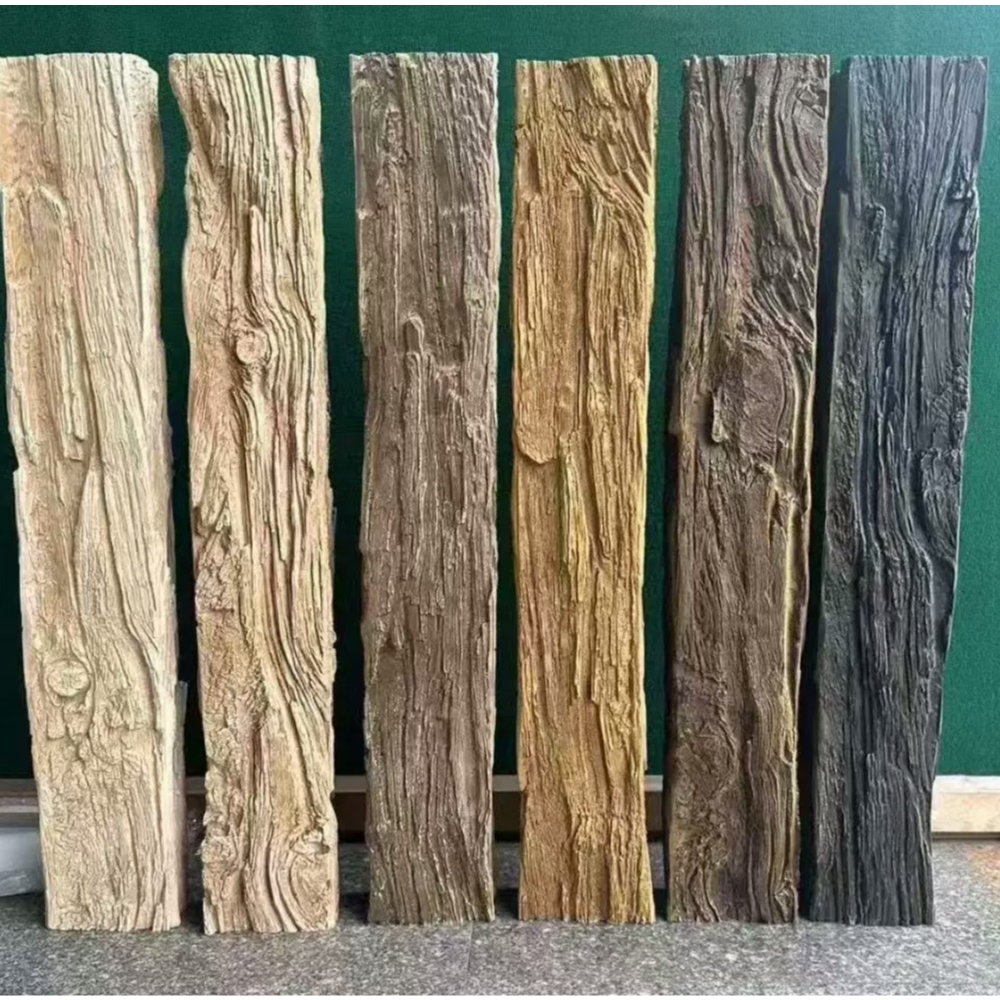
Run a thumb across the grain pattern. Premium beams capture wood grain at 600 to 800 DPI resolution. Lower-grade products run 300 to 400 DPI and the difference is visible at normal viewing distance, especially under raking light. Most discounted beams retain the full factory texture — but verify before you commit to a pallet.
Color consistency within the lot
Even a discounted batch should show tight color matching piece to piece. Lay five or six beams side by side under natural light and look for obvious shade jumps. A two-tone pallet isn't usable in a single room unless you planned for it.
Structural integrity
Flex a short offcut. A high-quality PU beam resists flex and returns to shape. A beam that feels chalky, brittle, or spongy under pressure is a formulation problem, not a discount.
Edge and corner condition
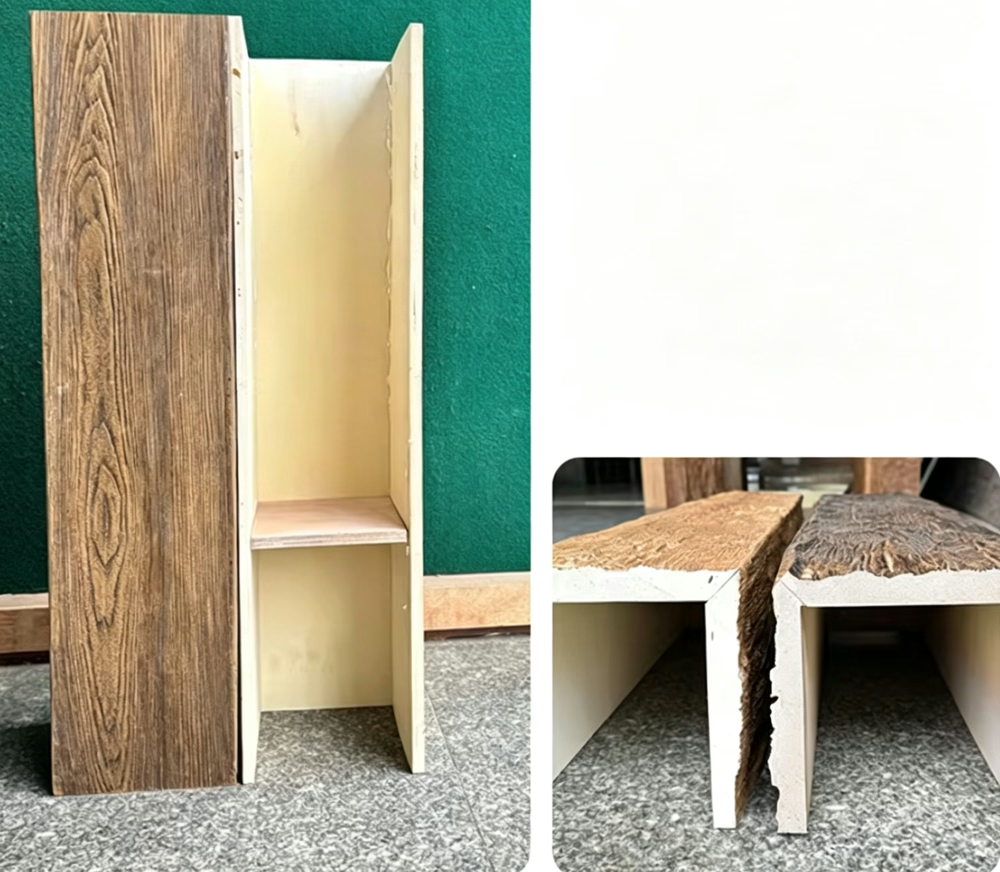
Corners and edges are the first place manufacturing shortcuts show. Look for clean 90-degree edges, intact molding detail at the corners, and no chipping along the length.
How the savings actually break down
Discounts on PU faux beams vary by reason and by supplier, but typical ranges hold steady across the market.
| Discount type | Typical savings | What's affected |
|---|---|---|
| End-of-run B-grade | 15–30% | Texture (slightly lower DPI), no structural change |
| Discontinued finish | 20–40% | Nothing — full quality, just an outgoing color |
| Overstocked size | 25–45% | Nothing — premium spec, slow-moving inventory |
| Mixed-lot palette | 15–25% | Shade variance within the pallet |
| Cancellation returns | 30–50% | Nothing — first-quality, unopened |
For a contractor running a mid-sized renovation with a $4,000 to $6,000 beam allowance, even a 25 percent discount translates to $1,000 to $1,500 back into the project budget. For homeowners, that can mean upgrading the entryway beam from a 6x8 to an 8x10 without touching the rest of the budget.
When discounted beams make sense — and when they don't
The discount opportunity only works if it fits the project. There are clear cases where a buyer should grab the savings and cases where full-price is the better call.
Best fits for discounted inventory
A single-room ceiling where all the beams come from one pallet. A multi-room project where beams are visually separated by walls or partitions. A residential renovation where the beams are decorative rather than structural. A commercial space with high ceilings where the beams are viewed from 8 feet or more away.
Poor fits for discounted inventory
Open-concept floor plans where every beam is visible from one continuous sightline. Designer-specified projects where finish match is contractually bound. Showcase installations where the beam is photographed in close-up for marketing. High-end custom homes where the client expects first-quality goods throughout.
For mixed-lot palettes specifically, the shading variance can be a feature rather than a bug in rustic or reclaimed-look installations where variation is part of the aesthetic.
Sourcing strategies for contractors and importers
For trade buyers, the discount market has its own rhythm. Here is how experienced buyers approach it.
Build relationships with two or three distributors
The discount pipeline is relationship-driven. A contractor or importer with steady volume at one or two distributors will see the discounted inventory first, often before it gets posted publicly. That early access matters when a pallet of overstocked 8x10 beams shows up.
Ask about "irregular" stock directly
Most distributors will not list irregular inventory on their main price sheets. Calling the sales team and asking specifically about overstock, B-grade, mixed-lot, and discontinued-finish pallets will often surface options that the public catalog hides.
Time purchases to distributor fiscal calendars
Distributors with quarterly inventory targets often discount heavily in the final two to three weeks of a quarter to hit their numbers. Building a purchase plan around that calendar — even if it means storing beams for a few weeks — can pull an extra 5 to 10 percent off the already-discounted price.
Bundle mixed product lines
Distributors love a single invoice. If a contractor is buying beams, strapping, corbels, and ceiling planks from the same supplier, asking for a package discount often unlocks beam savings the line-item pricing won't show.

Inspection checklist before committing to a pallet
A discounted pallet is still a purchase. Walk through this list before signing off.
- Pull five random beams and lay them out side by side for color matching.
- Check texture depth at corners and along the full length — not just the center.
- Confirm dimensions match the order. Off-by-a-quarter-inch issues are common in B-grade stock.
- Inspect the ends. End-grain damage is the most frequent issue in returned pallets.
- Ask for the original spec sheet. A reputable supplier will provide the density, fire rating, and formulation data for the actual production run.
If a supplier balks at providing the spec sheet, walk away. Even discounted goods should come with documentation.
Storing discounted beams between purchase and install
Discounted beams often come with shorter lead times and faster delivery expectations, which sometimes means the buyer takes possession before the install date. Storage matters.
Keep beams flat and supported along their full length. Storing them on edge or on uneven surfaces can introduce a slight bow that is difficult to correct at install time. Store them indoors, away from direct sunlight and moisture. Polyurethane is dimensionally stable, but prolonged UV exposure will shift the color on most finishes. Cover with a breathable tarp if storage is longer than 30 days.
Common mistakes to avoid
A few patterns show up over and over in the discount market. Buyers who recognize them save themselves the headache.
Assuming "discounted" means "damaged." It almost never does in the faux beam market. Discounted means excess, retired, or returned — not defective.
Skipping the spec sheet because the price is right. Documentation is what makes a discount a deal rather than a gamble. If the supplier won't provide the spec, the beam is not a deal regardless of the price.
Mixing discounted and full-price inventory in the same room without checking the match. This works only when the discounted lot is first-quality or close to it. Mixed-lot palettes should never be mixed with full-price stock in a single visible space.
Over-buying because the price is low. Discounted inventory is perishable — if the project changes and the beams don't get used, reselling them is harder than reselling standard stock. Buy to the project, not to the price.
The real cost-saving math
A $4,500 beam purchase at a 25 percent discount is a $1,125 saving. That money moves into the project contingency, the finish upgrades, or the contractor's margin — depending on the buyer's priorities. For importers building a wholesale order, the same percentage off a $40,000 container load is a $10,000 margin improvement, which is meaningful whether that flows to the importer, the contractor, or the end buyer.
The reason high-quality discounted PU faux wood beams work for cost-saving renovation is that the underlying product is already engineered to outperform its real-wood competition on install speed, weight, moisture resistance, and finish durability. When the price drops, that performance gap only widens. A real timber beam at full price still weighs three times as much, takes twice as long to install, and needs maintenance the PU version never will. The discount is on top of an already-favorable cost equation.
Discounted high-quality PU faux wood beams let budget-conscious renovations look like full-price installations. The savings are real, the quality holds, and the project gets the visual impact it needed from day one.
Technical References
ASTM standards cited in every specification
Test Data
Lab results from internal testing program
Updated 2026
Reviewed against current product specs


