
There is a persistent idea in the decorative building products market that premium faux wood beams are out of reach for budget-conscious projects. That idea is mostly wrong. The premium tier of polyurethane beams, the kind with hand-finished distressing, multi-tone staining, and dense foam that resists denting, is manufactured in the same factories as the entry-level product. The difference is in the finishing line, not the raw material. Bulk buyers who order factory direct can access that premium line at a price that competes with mid-tier domestic offerings.
Understanding how premium pricing is structured at the factory level is the first step toward capturing the discount. The second is knowing where the factory has flexibility to negotiate and where the price is essentially fixed by input costs.
What "premium" actually adds to a faux beam
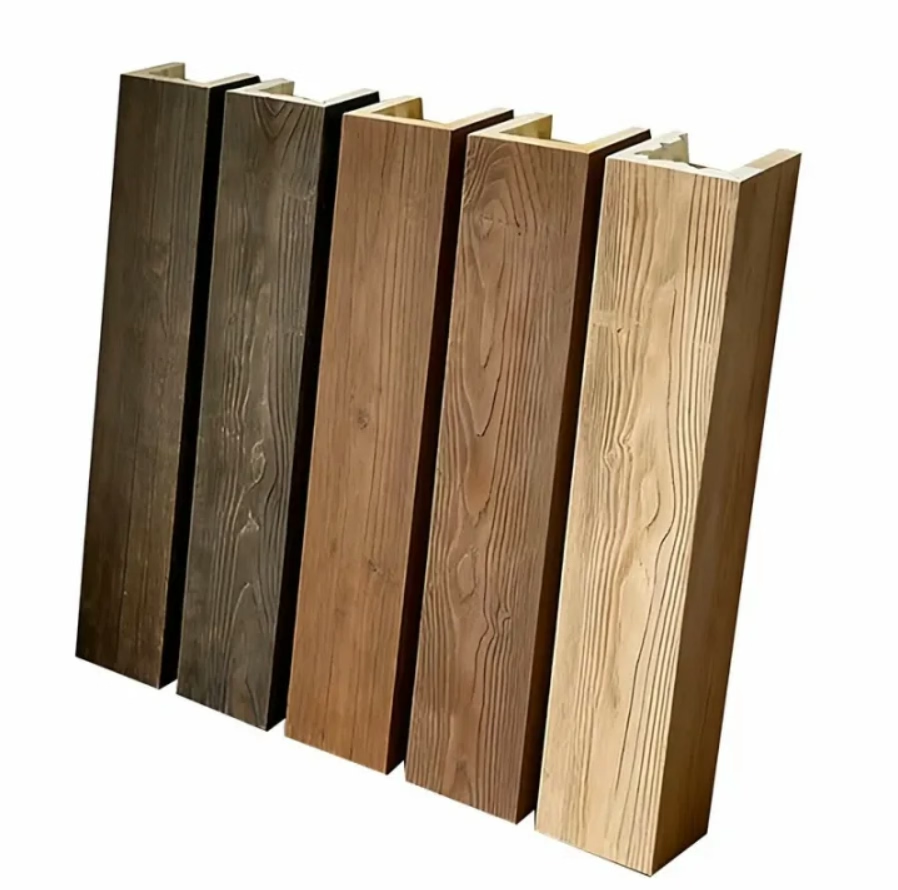
A premium polyurethane faux beam is differentiated in several ways. The foam density is higher, often 250 to 400 kilograms per cubic meter compared to 80 to 150 for economy products. The mold used to cast the beam comes from a higher-resolution master, often taken from a piece of actual aged timber rather than a generic wood pattern. The grain texture, knot placement, and surface variation look more natural because they are.
The finish is where premium beams really separate themselves from the entry tier. A basic beam is sprayed with a single stain color and shipped. A premium beam might receive a base coat, a glaze wash, hand-applied highlights, and a topcoat sealer. Some finishes involve a four or five-step process done by skilled workers, not just a production line sprayer. That labor cost is real, and it is the main reason premium beams retail for more.
The payoff is in the installed appearance. A premium beam reads as authentic from across a room. The economy beam reads as faux under the same lighting. For projects where the beams are a focal point, this difference justifies the premium. For projects where they are a background detail, the economy product can be sufficient.
How factories price premium tiers
Premium pricing at the factory level is driven by labor hours per beam. A basic beam might require 10 minutes of finishing labor; a premium beam might require 45 minutes. Multiply that across a 1000-piece order and the labor cost differential is substantial. Factories also factor in the higher rejection rate on premium finishes, because hand-worked surfaces are harder to QC than spray-only finishes.
The good news is that labor cost is fixed per beam regardless of order size. So the per-beam premium for a 100-piece order is the same as for a 1000-piece order. Bulk discounts on premium beams therefore apply in roughly the same percentage range as on economy beams, typically 10 to 25 percent off the smaller-quantity price. The absolute savings are larger because the base price is higher.
Factories also offer tiered discounts based on annual purchase commitment. A buyer who signs an agreement to purchase $200,000 worth of premium beams over 12 months can usually negotiate a price point 20 to 35 percent below the spot-market quote. This is how importers and large contractors lock in stable supply and predictable margins.
Negotiating bulk discounts that actually hold up
A factory's first quote is rarely its best price. There is usually 8 to 15 percent of room to move on a serious inquiry, more on a first-time order where the factory wants to win the business. The negotiation has to be backed by a credible commitment, though. A buyer who asks for the deepest discount on a 50-piece test order will get a polite no. A buyer who offers a 12-month commitment with monthly releases gets a real conversation.
Successful bulk discount negotiation starts with a clear volume target and timeline. Saying "I want to buy 2000 beams this year, broken into four 500-piece releases, and I want pricing locked for the full year" is a much stronger negotiating position than "what's your best price on 500 beams." The first statement gives the factory predictable production planning; the second is just another spot inquiry.
Pricing structures that protect the buyer
A flat price for the year is convenient but exposes the buyer to input cost spikes. Foam raw material prices fluctuate with petroleum markets. Stain and finish prices follow solvent and pigment markets. Freight rates can swing dramatically on short notice. The most common negotiated structure is a base price with a raw material index clause, so both sides share the risk of input cost movement.
Another structure is a stepped pricing model. The first 500 pieces are at price A, the next 500 at price B (lower), and anything above 1000 at price C (lowest). This rewards the buyer for exceeding forecast while keeping the baseline honest. It also gives the factory an incentive to push production efficiency as volume scales.
Payment terms are another negotiable lever. A 30 percent deposit with 70 percent balance against bill of lading is standard. Some factories offer 20/80 or even 10/90 to established buyers with good credit. A lower deposit frees up the buyer's working capital, but it does shift more risk to the factory, which usually costs a few percentage points in unit price.
Where the factory has room and where it doesn't
Factory cost has rigid components and flexible components. Raw foam is rigid in the short term because the factory has long-term contracts with chemical suppliers. Labor is somewhat rigid because wage structures cannot change quickly. But factory overhead, packaging, and even finish application rates can flex based on order characteristics.
A buyer who orders in standard sizes, standard finishes, and standard packaging gets the most efficient production run and the lowest price. Custom sizes, custom finishes, and unusual packaging all add cost. A buyer who can accept the factory's standard catalog product and only deviate where truly necessary gets the best pricing. A buyer who insists on a unique finish, a non-standard length, and custom retail packaging will pay a meaningful premium even on a large order.
How to align your order with factory efficiency
Talk to the factory's sales engineer about which product configurations are most efficient to run. Often the engineer will suggest a minor adjustment to your spec that produces nearly identical results at lower cost. For example, switching from a 7-inch by 9-inch custom profile to a 6-inch by 8-inch standard profile might save $3 per beam with no visible difference once installed. Choosing a finish that the factory already produces at scale, rather than one that requires a new stain mix, can save setup costs that would otherwise be billed to the buyer.
Factory tours, in person or via video, are the best way to see where efficiency lives. A walk through the production line shows which products are running constantly and which are set up rarely. Ordering the products that are running constantly is the surest path to volume pricing.
The role of finish consistency in premium orders
Premium faux beams rely on visual consistency as much as structural quality. A 500-piece order with 50 different stain shades is a quality control nightmare, and any factory that quotes on that order is building in buffer time and buffer cost. A 500-piece order with one or two stain shades, even if it spans three different beam profiles, is much easier to run.
For large commercial projects that require consistency across hundreds of beams, this is straightforward. For resellers stocking inventory across many customer preferences, the order has to be more diverse, and the unit cost reflects that. Resellers often solve this by holding inventory of standard finishes and placing custom orders only for specific project requirements.


When premium direct pricing makes sense and when it doesn't
The premium factory direct model works for buyers who can commit to volume, accept standard catalog finishes with minor modifications, and arrange their own logistics. It does not work for buyers who need three beams next week, who want a unique finish that only one project will use, or who cannot take delivery of a container-load quantity at a time.
For contractors working on a steady pipeline of residential or light commercial projects, premium factory direct pricing is often the difference between profit and loss on the beam portion of the budget. For homeowners doing a single ceiling, the savings on three or four beams do not justify the logistics, and a domestic premium retailer is the better choice. For importers and resellers, the factory direct premium channel is essentially the only economically viable source.
Practical first steps for accessing premium bulk pricing
Start with a serious inquiry. Send the factory a detailed specification including profile, dimensions, finish codes, quantity, timeline, target port, and packaging. Ask for tiered pricing at multiple volumes so you can see how the discount curve works. Request references from other buyers in your region or market segment.
Order samples before placing the production order. Premium finishes vary between factories even when they use the same name. A "reclaimed oak" from one factory might be lighter and more uniform than another factory's version. Seeing the actual finish on your actual beam profile is the only way to know what you are buying.
Negotiate payment terms that protect both sides. A small deposit with balance against B/L is fair. A 100 percent upfront payment on a first order is a yellow flag, though it is sometimes requested for very small custom runs. A factory that accepts LC at sight for established buyers is showing confidence in its own product and process.
Premium faux beams at bulk discount pricing are not a secret. They are a relationship between a buyer who can commit to volume and a factory that can deliver consistent quality. Build that relationship carefully, and the pricing follows naturally.
Technical References
ASTM standards cited in every specification
Test Data
Lab results from internal testing program
Updated 2026
Reviewed against current product specs


