
Premium faux ceiling beams occupy a specific niche in the decorative building products market. They are not the cheapest option, and they are not the most expensive either. They target buyers who want the visual impact of a heavy timber ceiling without the structural cost, fire risk, or installation labor of real wood. When sourced factory direct at wholesale pricing, premium beams become viable for projects where they would otherwise be cost-prohibitive.
The premium tier covers a wide range of products, and understanding what separates a premium beam from a mid-tier or economy beam is the first step in evaluating wholesale quotes.
What defines a premium faux ceiling beam
The term "premium" is not regulated, so factories and resellers use it to mean whatever sells well. For purposes of comparing products on a like-for-like basis, there are several objective markers of premium quality.
The foam density should be at least 200 kilograms per cubic meter, ideally 250 to 350. Higher density foam resists denting, holds screws better, and maintains its shape over years of thermal cycling. Lower density foam is more easily compressed during installation and shows wear faster.
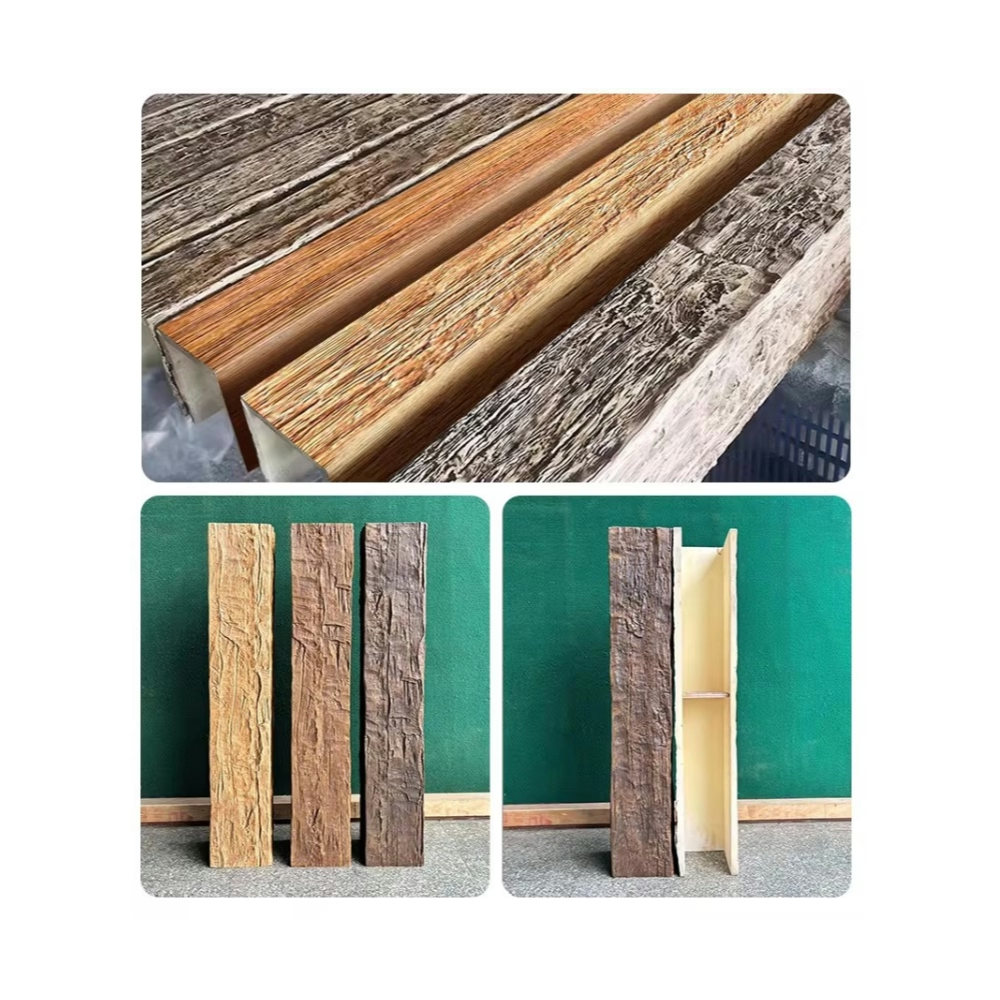
The mold used to cast the beam should originate from a real wood master, not a generic digital pattern. Real wood masters capture subtle variations in grain, knot shape, and surface texture that digital patterns miss. The result is a beam that looks authentic even on close inspection.
The finish should involve multiple steps, not just a single spray coat. A premium beam typically receives a base stain, a glaze wash to add depth, hand-applied highlights to bring out grain detail, and a protective topcoat. Each step adds labor cost but produces a more convincing wood appearance.
The packaging should protect the beam during shipping and storage. Premium beams are often individually wrapped in foam or cardboard, packed in long cartons, and palletized for safe transport. Cheap packaging is a sign that the factory is cutting corners somewhere, even if the beam itself looks good in a showroom.
How factory direct pricing works for premium products
Factory direct pricing for premium faux ceiling beams follows the same general structure as for any polyurethane beam, with some important differences. The factory's cost basis is higher because of the additional finishing labor and the higher raw material grade. The wholesale margin tier is similar to the economy product, but the absolute discount per piece is larger because the base price is higher.
A premium beam might cost a factory $35 to $55 to produce, including materials, labor, and overhead. The factory's wholesale price to a serious buyer might be $60 to $90. The same beam retails domestically for $180 to $280. A buyer purchasing 500 premium beams at factory direct wholesale pricing captures the difference between $60 and $180 per beam, which adds up quickly.
This is the basic math that makes premium faux beams viable for projects where they would otherwise be replaced with cheaper alternatives. A custom home builder who installs 30 premium beams in a great room ceiling captures $3000 to $5000 in savings compared to buying the same beams from a domestic premium retailer. That budget can fund upgraded lighting, better flooring, or simply a stronger project margin.
The wholesale tiers and how they work
Most factories offer three or four wholesale pricing tiers. The entry wholesale tier usually starts at a relatively small quantity, perhaps 50 to 100 pieces of a single SKU. The middle wholesale tier starts around 500 pieces. The bulk wholesale tier starts at 1000 to 2000 pieces and includes the deepest discounts.
Above the bulk tier, some factories offer annual commitment pricing. A buyer who signs an agreement to purchase $250,000 worth of premium beams over a 12-month period can negotiate pricing 5 to 10 percent below the bulk tier. This is the pricing reserved for the largest resellers and importers.
The tier pricing is usually quoted per SKU rather than across the whole order. A buyer ordering 1000 pieces split across 10 different profiles pays the bulk tier on each profile, not the bulk tier on the whole order. This matters because buyers who can consolidate their order onto fewer profiles get better pricing per profile than buyers who spread the order across many SKUs.
What changes at each wholesale tier
At the entry wholesale tier, the buyer gets a modest discount off the factory's "small order" price, often 5 to 15 percent. Lead times are typically standard. Packaging is usually standard. Payment terms might require a higher deposit, perhaps 40 or 50 percent, because the factory is taking more risk on a smaller buyer.
At the middle wholesale tier, the discount widens to 15 to 25 percent. Lead times might be slightly shorter because the factory can prioritize a confirmed larger buyer. Packaging options open up, including the ability to request custom retail-ready packaging. Payment terms often loosen to 30/70.
At the bulk tier, the discount reaches 25 to 40 percent off the small order price. Lead times are usually shortest because the factory schedules production around the buyer's confirmed orders. Packaging is whatever the buyer wants, subject to a reasonable cost. Payment terms are most flexible, sometimes extending to LC at sight or even net-30 for established buyers.
Common wholesale pricing structures buyers encounter
The most common structure is a published price list with quantity breaks. The buyer references the list, calculates the discount based on their order quantity, and the factory confirms. This is straightforward but offers little flexibility for negotiation. The published price is the published price.
A more flexible structure is a quote-based system where the factory provides custom pricing for each inquiry based on the specific SKUs, quantities, and delivery requirements. This is the norm for serious wholesale buyers because every order has different variables that affect the price.
Some factories offer a hybrid model with a published base price list and a negotiated discount tier for committed buyers. The base list provides transparency and a starting point, while the negotiated tier rewards the buyers who commit to ongoing business. This structure works well for buyers who want to benchmark the factory's pricing against the market while still benefiting from relationship-based discounts.
Why pricing transparency matters in wholesale
A factory that provides detailed pricing breakdowns is signaling confidence in its product and process. A factory that quotes only a single all-in number is signaling that it does not want the buyer to see where the costs come from, which can be a red flag.
Trade buyers should insist on pricing that breaks out the unit price, packaging cost, inland freight to port, and any setup charges for custom finishes. A factory that resists this kind of transparency is usually one that has built margin into the unit price in a way the buyer cannot evaluate.
What to look for in a wholesale supplier
The most important quality of a wholesale supplier is consistency. A factory that ships consistent product over time is far more valuable than a factory that occasionally produces outstanding product but has unreliable QC. Wholesale buyers need predictability, not surprises.
Communication speed is the second most important quality. A factory that responds to inquiries within 24 hours, provides accurate lead times, and updates proactively when something changes is a pleasure to work with. A factory that takes three days to respond to a simple question is a constant source of friction, even if its product is excellent.
Financial stability matters more than many buyers consider. A factory that is undercapitalized might cut corners on raw materials when cash gets tight, or might delay production to chase higher-paying orders. A financially stable factory pays its workers on time, buys its raw materials in volume, and plans production schedules with margin for error.
The role of certifications and standards
For premium faux ceiling beams, the certifications that matter most are ISO 9001 for quality management, fire ratings for the specific foam grade, and any country-specific environmental certifications like CARGO Phase 2 for California. Factories that maintain these certifications are usually investing in long-term quality rather than cutting corners for short-term savings.
Buyers should ask for copies of current certificates, not just claims of certification. Certificates have expiration dates and audit requirements that factories neglect when no one is watching. A certificate issued two years ago with no evidence of recent renewal is not the same as a current certificate.
Common pitfalls in wholesale premium beam purchasing
The most common pitfall is ordering a custom finish that the factory is not set up to produce efficiently. Custom finishes require setup time, color matching work, and often small-batch production that breaks the efficiency of the main line. The factory might absorb some of this cost to win the order, but the result is often delayed production and inconsistent color across the batch.
Another pitfall is underestimating the lead time. Premium beams with hand-finished surfaces take longer to produce than economy beams. A factory that quotes 30 days for an economy order might need 45 to 60 days for the same quantity of premium beams. Buyers who do not adjust their planning around this difference end up with delayed projects.
A third pitfall is ignoring the after-sales cost. A premium beam that arrives damaged, off-color, or out of spec is expensive to replace through the wholesale channel. Buyers should build buffer stock into their initial order and should arrange for inspection before shipment. The inspection cost is real but small compared to the cost of receiving a container of unusable premium product.

The wholesale premium market in 2026
The premium faux beam market has matured significantly in the past five years. The factories producing the best premium product are increasingly well-known, and the buyers who source from them are increasingly sophisticated. Pricing has come down slightly as competition has grown, but quality at the top of the market has held steady.
New entrants continue to appear, particularly in Vietnam and Mexico, where labor costs are lower than in coastal China. Some of these new factories produce excellent product; others are still building the systems and skills needed for premium finishing. Buyers evaluating a new factory should ask for extensive references and consider placing a smaller initial order to test the relationship before committing to large volume.
The trend toward direct buyer-factory relationships is also accelerating. More importers are bypassing the traditional Hong Kong or Shanghai trading companies and dealing directly with the production facilities. This cuts another layer of margin and gives the buyer more direct influence over product development and quality control.
How to start a premium wholesale relationship
Begin with a clear definition of your target market and product positioning. Are you selling to luxury custom home builders, mid-range contractors, or retail consumers? Each segment has different price sensitivity, different finish preferences, and different volume patterns. The factory's product range, MOQ requirements, and finishing capabilities should align with your positioning.
Next, identify two or three candidate factories based on reputation, certification, and past buyer reviews. Visit them in person if possible, or at least request detailed video walk-throughs. Ask each for pricing on a realistic first order based on your target market volume. Compare the quotes, request samples, and evaluate the products against your specification.
Place a small initial order with the factory that best balances price, quality, and reliability. Use this order to validate the entire chain, from production to QC to freight to delivery. Once you have confidence in the factory, expand the relationship with larger orders, more SKUs, and eventually annual commitments that unlock the deepest pricing tiers. The relationship itself becomes a competitive advantage that compounds over time.
Technical References
ASTM standards cited in every specification
Test Data
Lab results from internal testing program
Updated 2026
Reviewed against current product specs


