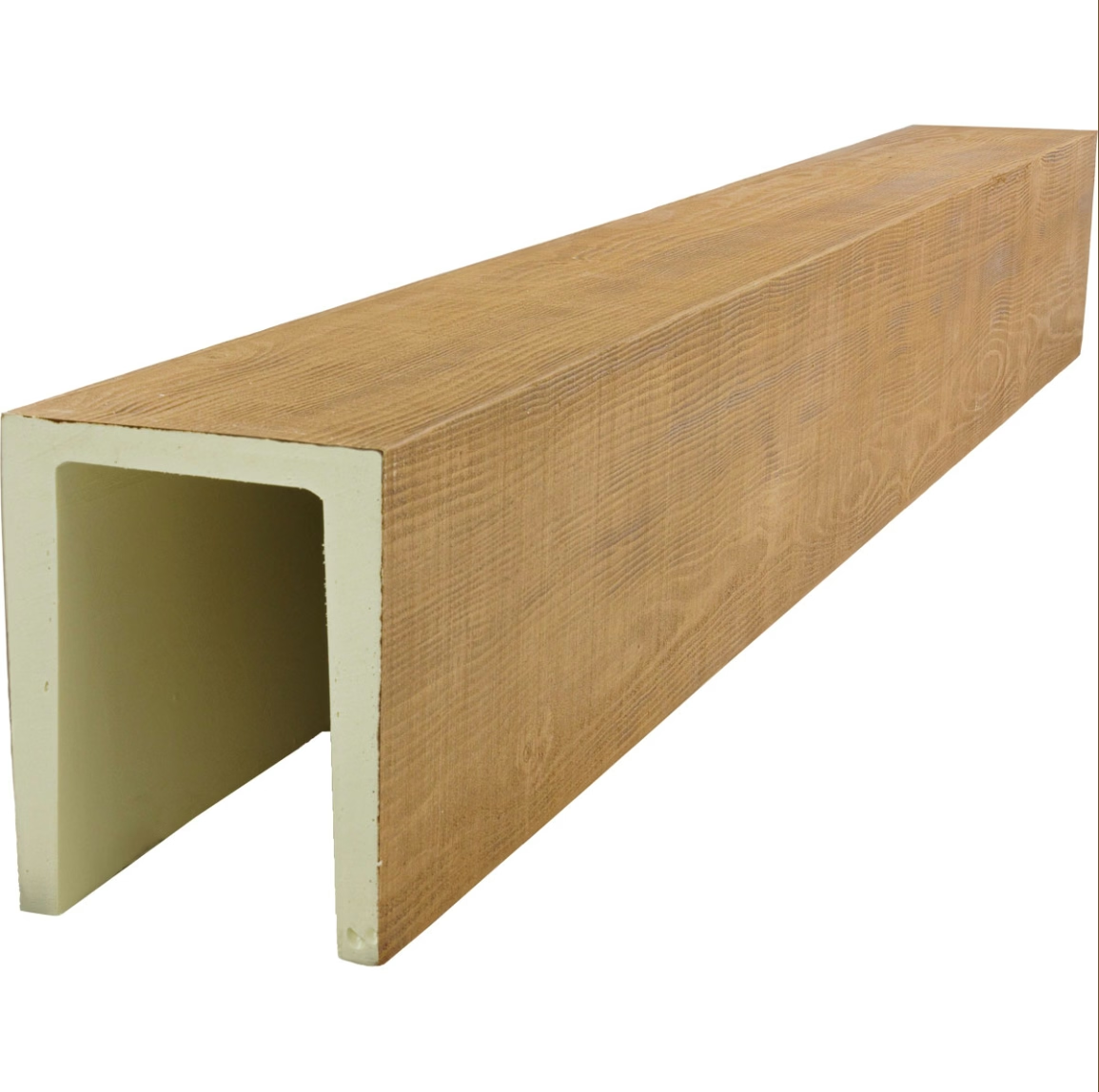
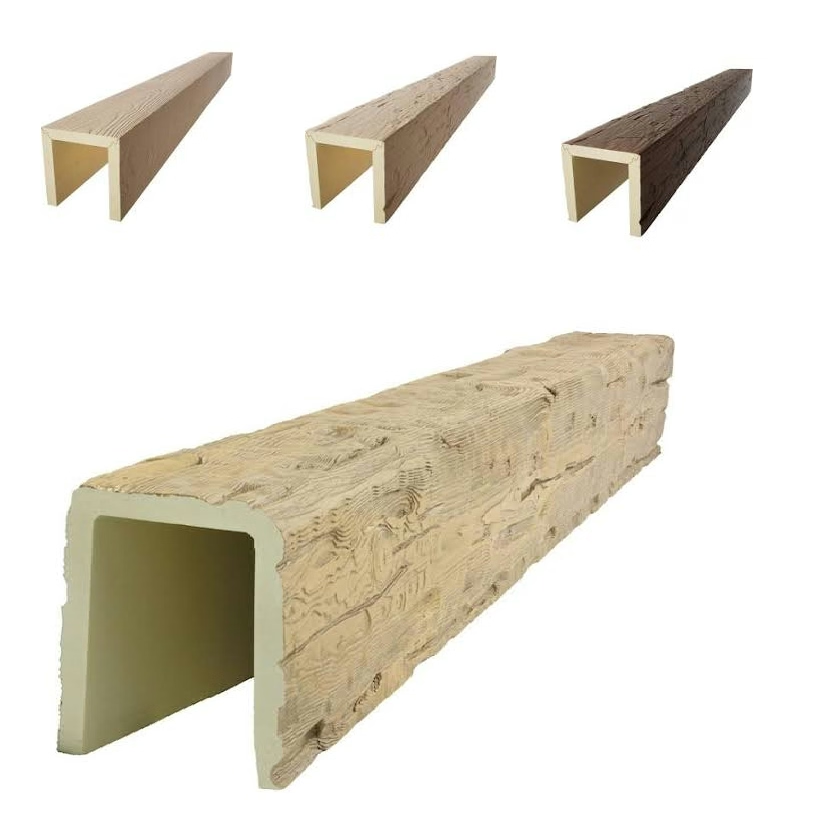
The promise of long-term stability sounds simple until you examine what it actually requires of a building material. Stability means that the product looks the same in year fifteen as it did on installation day. It means that joints stay tight, surfaces stay intact, and finishes stay adherent through the temperature swings, humidity cycles, and structural movements that every building experiences. For real timber, these requirements are impossible to guarantee because wood is a living material that responds to its environment. For polyurethane material faux beams, stability is a design characteristic built into the resin formulation and verified through decades of real-world performance.
Buyers who specify faux beams for commercial projects have learned to ask the right questions about long-term stability. They want test data, warranty terms, and references from comparable installations. They want to know what the beam is made of, how it was tested, and what happens if it fails. The answers to these questions determine whether the product will deliver the stable, maintenance-free performance that the project requires.
Engineered Resin Chemistry for Stability
The stability of PU material beams begins with the chemistry of the resin itself. Polyurethane is a thermosetting polymer, meaning that once it cures, it cannot be melted or reshaped by heat. This property is critical for long-term stability because it prevents the beam from softening or deforming as temperatures rise in summer or as the building's HVAC system cycles on and off.
The cross-link density of the polymer network determines the material's balance of rigidity and flexibility. A higher cross-link density produces a harder, more rigid material that resists indentation and impact. A lower density yields a more flexible material that accommodates building movement without cracking. The optimal formulation for faux beams sits at a cross-link density that provides enough rigidity to maintain shape and enough flexibility to absorb movement without damage.
Additives incorporated during the mixing stage further enhance long-term stability. UV stabilizers protect the surface from the chalking and color shift that can develop in beams exposed to sunlight. Fire retardants allow the material to meet building code requirements for flame spread and smoke development. Impact modifiers improve resistance to the sudden loads and impacts that occur in busy commercial environments. Each additive contributes to the overall stability of the finished product.
Hollow Shell Construction and Load Distribution
The hollow shell construction of these beams contributes to stability in ways that are not immediately obvious. A solid beam, whether made of wood or polyurethane, concentrates stress at the point of impact or load application. A hollow beam distributes that stress across its cross-section, reducing the peak stress at any single point and increasing the overall resistance to damage.
The shell geometry also creates a natural thermal buffer. The air inside the cavity provides insulation between the hot or cold outer surface and the mounting substrate, moderating the temperature extremes that the beam experiences. This passive thermal regulation reduces the thermal cycling stress that contributes to fatigue and surface degradation in other materials.
Internal ribs or stiffeners, when present, add further stability without significantly increasing weight. These molded features run along the inside of the beam at regular intervals, reinforcing the cross-section against ovalization or flattening. The ribs are particularly valuable in longer spans where the beam might otherwise sag under its own weight or flex excessively when loads are applied from below.
Resistance to Environmental Stressors
Real timber beams face a constant assault from environmental factors that degrade their appearance and structural integrity over time. Humidity causes swelling and shrinking. Temperature changes cause expansion and contraction. UV light breaks down the lignin that holds wood cells together. Biological organisms consume the cellulose that gives wood its strength. Each of these factors contributes to the cracking, checking, and deterioration that characterize aging timber.
PU material beams resist all of these stressors simultaneously. The closed-cell structure prevents moisture absorption. The uniform thermal expansion of the polymer network eliminates differential movement. UV inhibitors in the surface formulation prevent photodegradation. And the synthetic chemistry of the resin provides no food source for mold, mildew, or insects. The result is a material that remains stable across the full range of environmental conditions it encounters in service.
Humidity resistance deserves special attention because it is the factor most responsible for real wood's long-term deterioration. In humid environments, wood absorbs water vapor from the air, swelling across the grain and increasing in weight. When the humidity drops, the water leaves, and the wood shrinks. Over hundreds of cycles, these dimensional changes accumulate damage that manifests as checking, splitting, and surface roughness. PU material beams have no moisture to absorb, no cells to swell, and no shrinkage cracks to develop. They remain dimensionally stable regardless of the humidity conditions.
Joint Performance Over Time
The joints where beams meet are often the first places where long-term problems become visible. In real timber, differential movement between adjacent pieces causes gaps to open and fasteners to loosen. In PU material beams, joints stay tight because the material responds uniformly to environmental changes.
Flexible connectors designed for use with PU beams accommodate the small movements that occur at joints without cracking or delaminating. The connectors are molded from the same resin formulation as the beams, ensuring that they expand and contract at the same rate. Adhesive bonds between the connector and the beam remain intact through temperature cycles because both materials have similar thermal coefficients. The result is a joint that looks as good in year ten as it did on installation day.
Field experience confirms what the material science predicts. Installations of PU material beams that are now fifteen to twenty years old show no evidence of the joint failures, surface checking, or finish deterioration that would be expected in real timber beams of the same age. Property managers who have replaced real timber beams with PU equivalents report that the new beams require no maintenance beyond occasional dusting, while the old beams required regular touch-up and repair.
Lifecycle Cost Analysis
When comparing PU material beams to real timber alternatives, the lifecycle cost analysis consistently favors the polyurethane option. The initial purchase price of PU beams is typically higher than that of solid timber, but the comparison reverses dramatically when ongoing maintenance costs are factored in.
Real timber beams in commercial environments require periodic refinishing to maintain their appearance. The refinishing interval depends on the environment and the quality of the initial finish, but five to seven years is typical for beams in average-use spaces. Each refinishing cycle involves sanding, staining or painting, and sealing, with associated labor costs that quickly exceed the original material price differential.
PU material beams require no refinishing under normal conditions. The finish remains intact because the material beneath it does not crack, check, or separate. Any accidental damage that does occur can be repaired with touch-up materials rather than full refinishing, keeping maintenance costs low throughout the product's service life.
For projects with fifteen to twenty year horizons, the lifecycle cost advantage of PU material beams typically ranges from thirty to fifty percent compared with real timber alternatives. The advantage grows larger in challenging environments where real timber would require more frequent maintenance, and it shrinks in mild environments where real timber performs well. Either way, the stability advantage of PU material translates into economic advantage over the life of the installation.

Technical References
ASTM standards cited in every specification
Test Data
Lab results from internal testing program
Updated 2026
Reviewed against current product specs