Freight is the line item that decides whether a faux beam import actually makes money. The factory price is easy to compare across suppliers. The delivered cost is harder, because it depends on how efficiently the product fits into a container, how the Incoterms split responsibilities, and whether the buyer has done the work to plan loads properly.
This article is for wholesale buyers, importers, and project procurement managers who want a practical framework for squeezing cost out of the supply chain without compromising on product or lead time.

Understanding the real cost per cubic meter
The first mistake most buyers make is comparing per-piece price. The correct comparison is per delivered cubic meter in the warehouse. Two factories can quote similar per-piece prices and have wildly different delivered costs because of how they pack.
Polyurethane faux beams are bulky but light. A 6-meter beam in a 200×200 mm profile has a volume of about 0.24 m³ but weighs around 15 kg. A 40-foot high-cube container has roughly 76 m³ of usable volume and a payload limit of around 26,000 kg. Most faux beam loads hit the volume limit long before they hit the weight limit.
That gap between volume and weight is where the optimization opportunity lives. If a supplier can pack the container to 90 percent of volume utilization instead of 60 percent, the freight cost per cubic meter drops by a third.
Standard container utilization rates
For finished beams in standard lengths, well-planned loads typically achieve 70 to 80 percent volume utilization in a 40HC. Lower utilization (50 to 65 percent) is common for mixed orders with many short lengths, because the nesting is less efficient.
Custom-length beams can be even less efficient if the order has a wide spread of lengths. A typical problem is an order with a few 7-meter beams, a few 3-meter beams, and a lot of 5-meter beams. The container either wastes space on the long beams or has to be packed in two layers with extra dunnage.
The best way to improve this is to standardize lengths as much as possible across an order or across multiple orders shipped in the same window. Stock lengths of 3, 4, 5, and 6 meters pack efficiently. A 2.4-meter length packs even better because beams can be nested three-high in some configurations.
Flat-pack and nested options
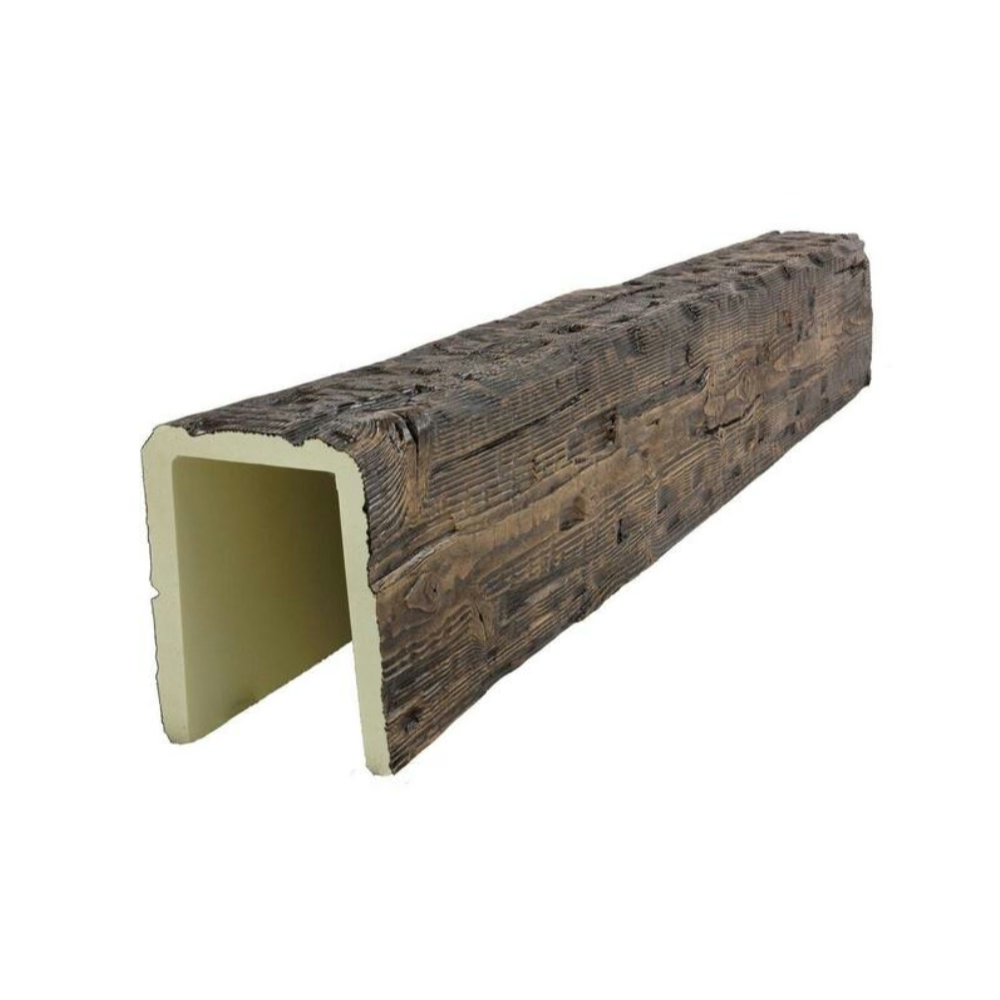
Some manufacturers ship beams flat-packed in halves or thirds that are assembled on site. This approach reduces the longest dimension dramatically and improves container utilization by 20 to 40 percent in many cases.
The trade-off is assembly labor on site and the cost of the spline or glue joint hardware. For projects with on-site labor available at reasonable cost and where the longest beam is under 5 meters, flat-pack rarely makes economic sense. For projects with 7- or 8-meter beams, where standard containers cannot fit the finished product, flat-pack becomes the only viable option other than special containers.
Nesting is another approach. A 300×300 mm beam nests inside a 400×400 mm beam. Stacking different profiles within the same order can tighten the load significantly. A mixed order of three profiles can often pack to 80 percent utilization when a single-profile order of the smaller profile only achieves 60 percent.
Packaging choices that affect load efficiency
Packaging is more than protection. It is also a volume and weight consideration. Common options include:
- Kraft paper wrap with edge protectors. Lowest cost, lowest protection, light weight.
- Corrugated carton sleeves. Better protection, modest cost, modest volume penalty.
- Wooden crate or pallet base. Best protection for rough handling, but adds significant weight and uses volume.
- Shrink-wrap bundles. Common for short beams shipped in volume, very efficient on volume.
For most wholesale shipments, a hybrid approach works best. Outer kraft wrap with cardboard sleeves on the visible faces, bundled in groups of four to six, stacked on standard pallets or slip-sheets. This protects the product, keeps weight reasonable, and loads cleanly.
Avoid over-packaging. Every kilogram of packaging is a kilogram that could have been a beam, and every cubic centimeter of protective foam is a cubic centimeter the freight bill is charging for.
Choosing the right Incoterm
The Incoterm you negotiate with the supplier has a real impact on the cost structure. The most common options for faux beam shipments:
EXW (Ex Works) puts the entire burden on the buyer. You arrange pickup, export clearance, freight, insurance, and import clearance. This gives you maximum control over routing and cost, but requires logistics capability on your end.
FOB (Free On Board) is the most common middle ground. The supplier handles export clearance and loads the container. You take over from the port of origin. This works well for buyers who have a forwarder relationship but do not want to manage factory pickup.
CIF (Cost, Insurance, Freight) puts more responsibility on the supplier. The supplier arranges ocean freight and insurance to your destination port. You handle import clearance and last-mile delivery. This is convenient but the supplier's freight markup is often hidden in the per-piece price.
DDP (Delivered Duty Paid) is the most expensive on paper but simplest for the buyer. The supplier handles everything, including duties and last-mile delivery. The convenience comes at a real premium, typically 8 to 15 percent above what you could achieve with DAP plus your own broker.
For a buyer with steady volume and a forwarder relationship, FOB is usually the best balance. For a smaller or first-time buyer, DDP can be worth the premium because mistakes in import paperwork are expensive.
Route and carrier selection
Faux beams are a commodity that ships well by ocean in standard containers. Air freight is almost never economic unless the order is a small emergency restock and the customer will pay a serious premium for speed.
Within ocean freight, the main variables are transit time and cost per FEU (forty-foot equivalent unit). Direct routes from major Asian ports to major US or EU ports are usually cheapest per container but may involve longer transit times.
Transshipment routes through Singapore, Hong Kong, or Klang can sometimes be cheaper but add 7 to 14 days and a small risk of damage from extra handling.
Rail options from China to Europe have matured significantly and offer a good middle ground on time and cost. For shipments of 20 to 60 FEU per month, rail can be competitive on price and faster than ocean.
Customs and HS code considerations
Faux wood beams typically classify under HS code 3925.90 (builders' ware of plastics) or 3926.90 (other articles of plastics) depending on the country. The classification affects the duty rate, which can range from zero to over 8 percent depending on the destination.
Get a binding ruling from your customs authority before the first large shipment. Reclassification mid-contract is expensive and disruptive. Some countries offer preferential duty rates under free trade agreements, particularly for products with a certain percentage of regional value content. Polyurethane beams rarely qualify, but it is worth checking.
Anti-dumping duties have hit some Chinese building products in recent years. Confirm with your customs broker that PU faux beams are not currently subject to any additional duties in your destination market.
Negotiation levers with the freight forwarder
Volume commitments matter. A forwarder quoting a one-off shipment has limited room to move on price. A buyer committing to 50 to 100 FEUs per year gets serious leverage and usually access to better rates and fixed-space allocations.
Flexibility on timing helps. A shipment that can sail within a one- to two-week window can take advantage of whatever space is cheapest that week. Rigid timing forces the most expensive space.
Consolidation with other building products is possible if the freight forwarder handles other building materials. A 40HC with faux beams, flooring underlayment, and decorative moldings from different factories can sometimes achieve a higher utilization than any single product line.
A short optimization checklist
Before placing a large order, review these points with your supplier:
- What is the actual container utilization on a sample load plan, not a brochure estimate?
- Are there flat-pack or split-beam options for the longest lengths?
- Can the order be standardized to fewer length options?
- What is the packaging weight as a percentage of total shipment weight?
- Are there current anti-dumping or additional duties at the destination?
The answers usually save 10 to 25 percent on delivered cost for an order that is otherwise similar in product and price to the competition.

Technical References
ASTM standards cited in every specification
Test Data
Lab results from internal testing program
Updated 2026
Reviewed against current product specs