When a buyer is moving a full container load of polyurethane faux wood beams from a manufacturer in one continent to a warehouse in another, the sea shipment is the workhorse of the journey. Air freight is faster but prohibitively expensive for bulky decorative products. Rail and road work for neighbouring regions but cannot cross oceans. The container ship remains the default choice for international bulk trade in faux beams, and the right sea shipment service makes the difference between an efficient supply chain and a frustrating one.
The economics of sea shipment reward buyers who plan their orders carefully. A buyer who fills a forty-foot container efficiently, books the shipment on a reliable vessel, and handles the destination logistics smoothly will land their beams at a per-unit cost that supports a healthy margin. A buyer who underfills a container, accepts a slow transit, and lets the destination logistics drift will pay significantly more for the same product.
Why Sea Shipment Dominates the Category
The cost of shipping polyurethane faux beams by sea is roughly one-tenth to one-twentieth of the cost of shipping them by air, on a per-kilogram basis. For a product that is relatively low in value per kilogram compared to its volume, that cost differential is decisive. No importer of decorative building products can absorb air freight costs and remain competitive.
The transit time is the trade-off. A sea shipment from East Asia to the US West Coast takes about fourteen days. The same shipment to the US East Coast takes about twenty-eight days, and to Europe about thirty-two days. Add to that the time for inland transportation, customs clearance, and final delivery, and the total door-to-door transit can run to six or seven weeks. Buyers who plan their inventory around this transit time, rather than reacting to it, run much smoother operations.
Choosing the Right Container
The two main container sizes for faux beam shipments are the twenty-foot equivalent unit (TEU) and the forty-foot equivalent unit (FEU). A TEU holds about thirty-three cubic metres of cargo, while an FEU holds about sixty-seven. The FEU is more cost-efficient per cubic metre, and it is the right choice for any order above roughly twenty cubic metres of beams.
For oversized beams, a high-cube container (which adds an extra foot of height) provides more vertical room and can be useful for very long beams that need to be packed standing up. Open-top containers are occasionally used for beams that are too long to fit through the door of a standard container, but they require special handling and are not the default.
Reefer containers (refrigerated containers) are not needed for faux beams, but they are sometimes used because they are more available on certain trade lanes during peak season. The refrigeration unit is simply turned off, and the container functions as a standard dry box.
Loading the Container Efficiently
The way a container is loaded has a direct impact on the landed cost per beam. A well-loaded container squeezes the maximum amount of product into the available space, which means fewer containers per shipment and a lower per-unit shipping cost. A poorly loaded container wastes space, and the buyer ends up paying to ship air.
A good loading team plans the load before the container arrives. They consider the dimensions of each beam, the way the cartons stack, the weight distribution, and the need to keep heavy items low and light items high. They use the corners, the spaces between pallet loads, and the area under the ceiling to fit extra cartons that a less careful loader would leave empty.
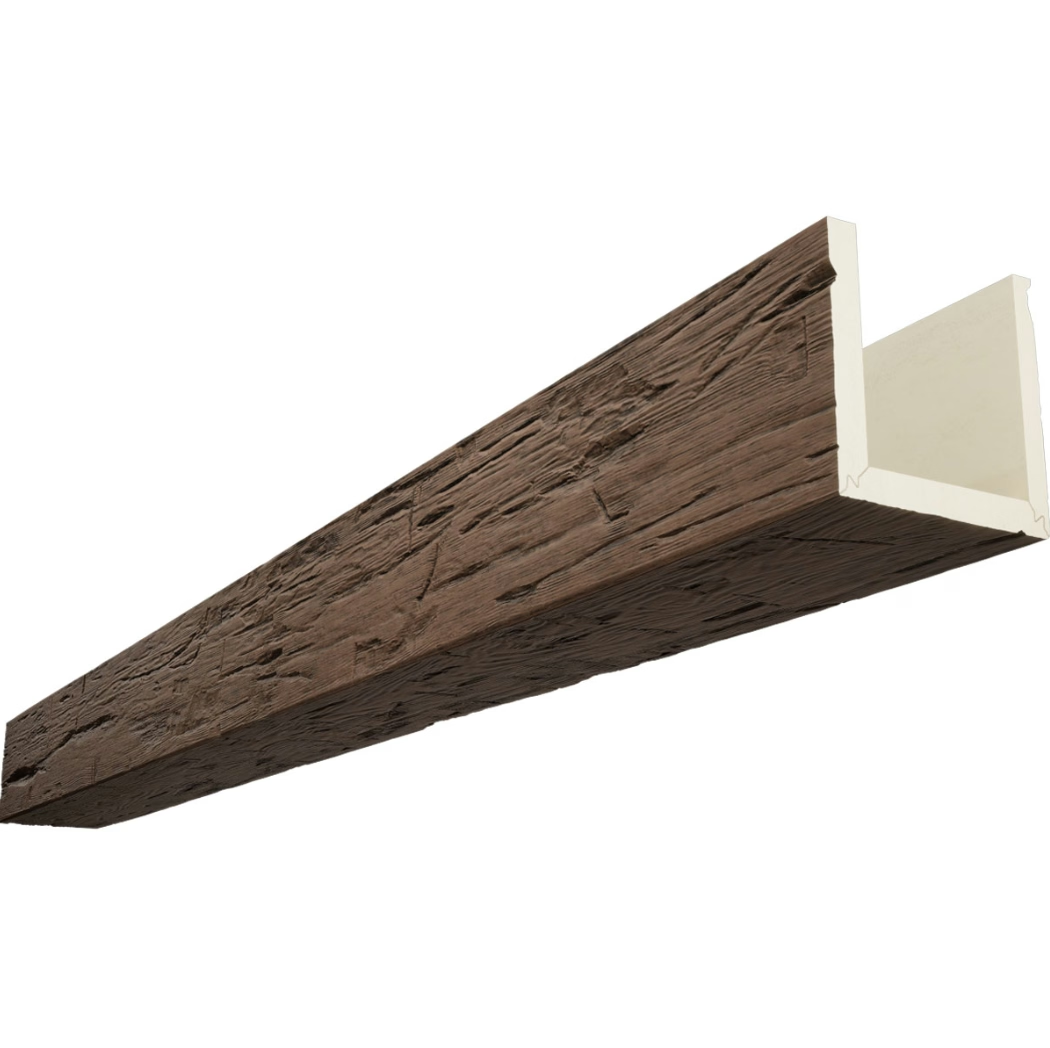
The beams themselves are usually packed in flat cartons that stack efficiently. Some shipments use nested beam halves that compress in transit, which is the most space-efficient way to ship faux beams. Other shipments use pre-assembled three-sided boxes that take more space but arrive ready to install without on-site assembly.

Schedule Reliability
The most frustrating part of international sea shipment is the uncertainty. A container that was supposed to sail on a Tuesday sometimes sails on Friday. A vessel that was supposed to arrive on a Monday sometimes arrives on a Thursday. The transit time estimates are averages, not promises, and the variance can be significant.
Reliable carriers manage this variance by sailing on schedule the vast majority of the time. The most reliable carriers publish their schedules months in advance, maintain them with discipline, and provide real-time vessel tracking that lets the buyer see exactly where their cargo is at any moment.
A good sea shipment service works with these reliable carriers, prioritises them when booking space, and steers the buyer toward sailings that are likely to depart on time. The service also builds buffer time into the schedule, so a one-week delay does not cascade into a project-stopping crisis on the buyer's end.
Protecting the Cargo in Transit
A container at sea is exposed to motion, temperature variation, and humidity. A well-prepared shipment accounts for all three. The cartons are strapped or shrink-wrapped to pallets to prevent shifting. The container is lined with kraft paper or moisture-absorbing desiccant to protect against condensation. The cartons themselves are sized to prevent the beams from moving inside, and the foam inserts protect the surface finish from contact damage.
For particularly long voyages or for shipments that cross tropical waters, container desiccant bags are a worthwhile addition. They absorb moisture that would otherwise condense on the inside of the container walls and potentially damage the cartons or the product.
Insurance for the Voyage
Even with good preparation, sea shipments occasionally suffer loss or damage. A container can be lost at sea, dropped during handling, or opened by customs for inspection. Cargo insurance protects the buyer against these rare but real risks.
The insurance premium is typically a fraction of one percent of the cargo value, which is a small cost for the peace of mind. A good sea shipment service includes insurance as a standard part of the quote, and the policy covers the full replacement value of the cargo. The buyer can also arrange their own insurance if they prefer, but the supplier's policy is usually the most convenient option.
The Total Cost of Sea Shipment
The cost of a sea shipment is more than the freight rate. The buyer also pays for the origin terminal handling, the destination terminal handling, the customs clearance, the inland transport from the port to the warehouse, and any duties or taxes. A complete landed cost calculation adds all of these together, and the freight rate is usually less than half of the total.
A sea shipment service that quotes only the freight rate without these other costs is not giving the buyer the full picture. A good service provides a complete landed cost estimate upfront, so the buyer can plan their budget accurately and avoid surprises when the container arrives.
Technical References
ASTM standards cited in every specification
Test Data
Lab results from internal testing program
Updated 2026
Reviewed against current product specs