Salt air does strange things to wood. Any homeowner in the Caribbean, Southeast Asia, or the Gulf Coast can tell you that an untreated timber beam starts checking and curling within a year of installation. The beachfront villa with the gorgeous exposed beam ceiling that looked so inviting in the architect's render becomes a maintenance liability the moment the first humid season arrives.
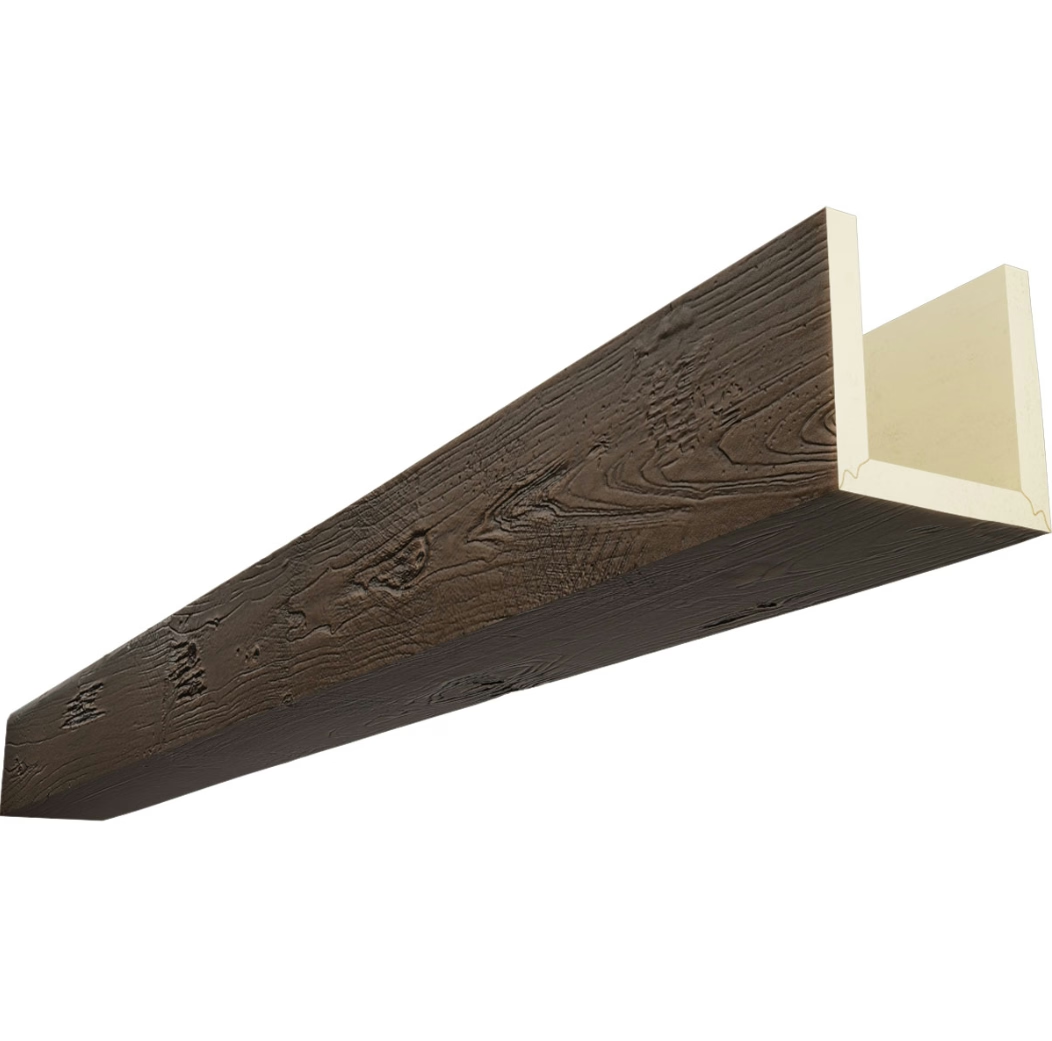
Tropical-grade polyurethane faux wood beams solve the problem without sacrificing the look. They are formulated specifically for environments where ordinary materials fail — humidity above 70 percent year-round, ambient temperatures that swing between air-conditioned 20°C and outdoor 35°C, salt-laden breezes, and the occasional monsoon downpour finding its way through an open window.
What makes a beam "tropical grade"
The term gets used loosely in the industry. A genuine tropical-grade polyurethane beam is not just a regular PU beam shipped to a tropical destination. It is a formulation choice made at the mold stage and verified through accelerated aging tests.
Closed-cell foam density. Tropical-grade beams use a higher density closed-cell polyurethane, typically 320 to 380 kg/m³ compared to 200 to 240 kg/m³ for a standard residential product. The closed-cell structure means moisture cannot migrate through the foam matrix. The higher density reduces the expansion and contraction that comes with thermal cycling.
UV-stabilized topcoat. Standard topcoats will chalk and yellow within six to twelve months of direct tropical sun exposure. Tropical-grade beams use a UV-absorber package combined with a clear aliphatic polyurethane topcoat that resists both yellowing and surface degradation. The topcoat is rated for 3000 hours of accelerated UV exposure (roughly equivalent to five to seven years of direct tropical sunlight).
Antimicrobial additive. A biocide is incorporated into the foam formulation to prevent mold and mildew growth on the surface and within the closed-cell structure. This is particularly important in air-conditioned interiors where condensation can form on cool ceiling surfaces.
Salt-spray resistance. For coastal applications, the topcoat system is tested to ASTM B117 (salt spray test) for 1000 hours without visible degradation. Standard topcoats typically fail at 200 to 400 hours.

Where tropical-grade beams make sense
The investment in a tropical-grade product is only worth it if the installation environment actually demands it. Several scenarios justify the upgrade.
Beachfront residences and resorts. Direct ocean exposure means constant salt air. Even with closed windows, salt finds its way inside through air handling systems. A standard beam will show surface degradation within two years. A tropical-grade beam should look identical at year five.
Indoor pools and spa areas. Chlorinated water vapor, temperatures consistently in the 28 to 32°C range, and humidity that hovers at 80 percent. Nothing organic survives here long-term, and most non-tropical synthetic materials struggle as well.
Open-air pavilions and verandas. Covered outdoor spaces where the beam is exposed to ambient tropical conditions but not direct rain. The thermal cycling and humidity are the main challenges, not direct water contact.
Commercial kitchens in tropical climates. The combination of cooking steam, grease vapor, and high ambient humidity creates a punishing environment. Tropical-grade beams with antimicrobial additives and stain-resistant topcoats perform well where standard products deteriorate.
Yacht interiors and cruise ship public spaces. Salt air, vibration, and humidity in a confined space. Tropical-grade PU beams are essentially the standard material in this market segment for good reason.

Comparison with traditional materials in tropical climates
The case for tropical-grade polyurethane is strongest when compared against the alternatives that designers have historically used in these environments.
Solid tropical hardwoods. Genuine teak, merbau, or balau will survive a tropical environment better than pine or oak. They also cost three to five times as much as a tropical-grade faux beam, require periodic oiling or sealing, and still show checking and color change over time. The sustainability concern is also worth noting — many tropical hardwoods come from old-growth sources that are increasingly regulated.
Cedar. Performs reasonably in humid environments but will silver significantly in salt air and requires regular maintenance. The initial cost is comparable to tropical-grade PU, but the lifetime cost is much higher.
PVC beams. Cheaper than tropical-grade PU but with a fundamentally different aesthetic. PVC beams tend to look plasticky and cannot replicate the texture and color depth of a quality faux beam. They also expand and contract more than PU with thermal cycling.
Standard PU beams with marine-grade topcoat. A compromise approach that works in less demanding environments but does not match the integrated formulation of a true tropical-grade product.
Installation considerations in tropical climates
The beam itself is only part of the equation. Installation details matter more in a tropical environment than in a temperate one.
Ventilation gaps. Even closed-cell foam expands and contracts with temperature. Leave 3 to 5 mm expansion gaps at the ends of beams longer than 4 meters. The gap is hidden by the end cap or by the adjacent beam in a splice.
Stainless steel fasteners. In coastal environments, standard zinc-plated screws will corrode within months. Specify 316-grade stainless steel for all mounting hardware, including brackets, screws, and connector straps.
Vapor barrier at the ceiling. In air-conditioned spaces below a tropical roof, condensation can form on the underside of the ceiling deck and drip onto the beam. A continuous vapor barrier between the ceiling and the beam prevents this.
Adhesive selection. Standard polyurethane construction adhesive softens in sustained 40°C+ temperatures. Specify a high-temperature-rated adhesive (3M 5200 or similar marine-grade) for any adhesive application in tropical conditions.
Lifespan expectations for tropical installations
A well-formulated tropical-grade beam in a coastal installation should deliver 12 to 20 years of service before any visible degradation. The topcoat may need refreshing at the 10 to 15-year mark depending on exposure, but this is a relatively simple maintenance task compared to re-oiling or replacing real timber.
For indoor applications — spa areas, interior commercial spaces, hotel rooms with air conditioning — the lifespan extends to 25+ years because UV exposure is minimal and humidity is controlled.
The honest comparison is not "faux versus real wood." It is "a properly specified tropical-grade faux beam versus a tropical hardwood that will still need maintenance and eventual replacement." On lifetime cost, the tropical-grade PU beam usually wins decisively.
When tropical-grade is overkill
Not every project needs a tropical-grade beam. Several scenarios do not justify the additional cost.
Climate-controlled interior in a non-tropical climate. A standard PU beam performs perfectly in a heated or air-conditioned space in a temperate climate. The tropical-grade formulation is overkill.
Covered exterior with no direct weather exposure. A standard beam with a quality exterior topcoat will perform well under a deep overhang where direct weather never touches the beam.
Short-term or temporary installations. Pop-up commercial spaces, model homes, and seasonal venues where the beam will be replaced in five to seven years anyway. Standard product makes more economic sense.
For everything else — the beachfront villa, the tropical resort lobby, the indoor spa, the coastal restaurant — a tropical-grade polyurethane faux beam is the right specification.
Technical References
ASTM standards cited in every specification
Test Data
Lab results from internal testing program
Updated 2026
Reviewed against current product specs


