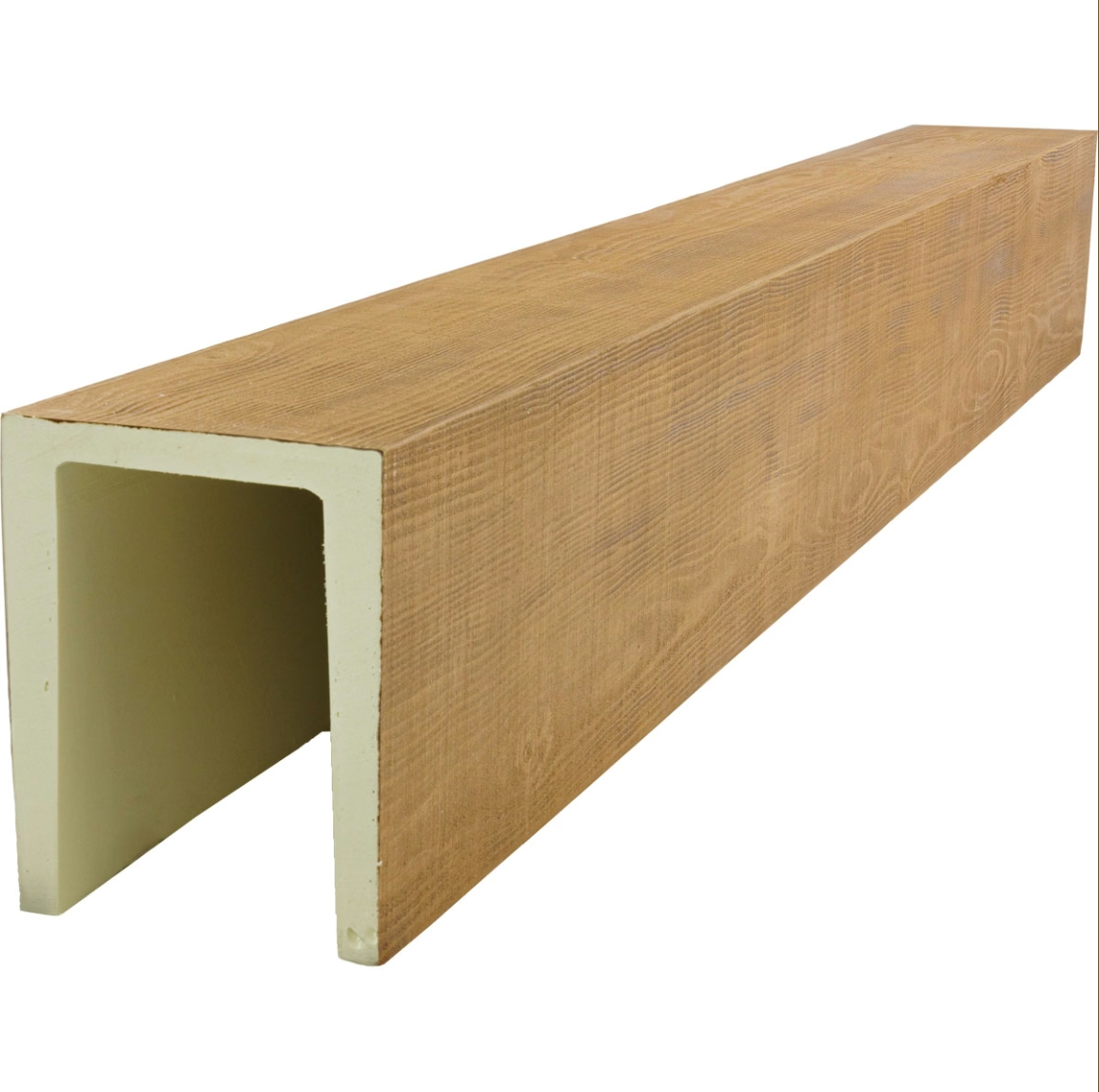
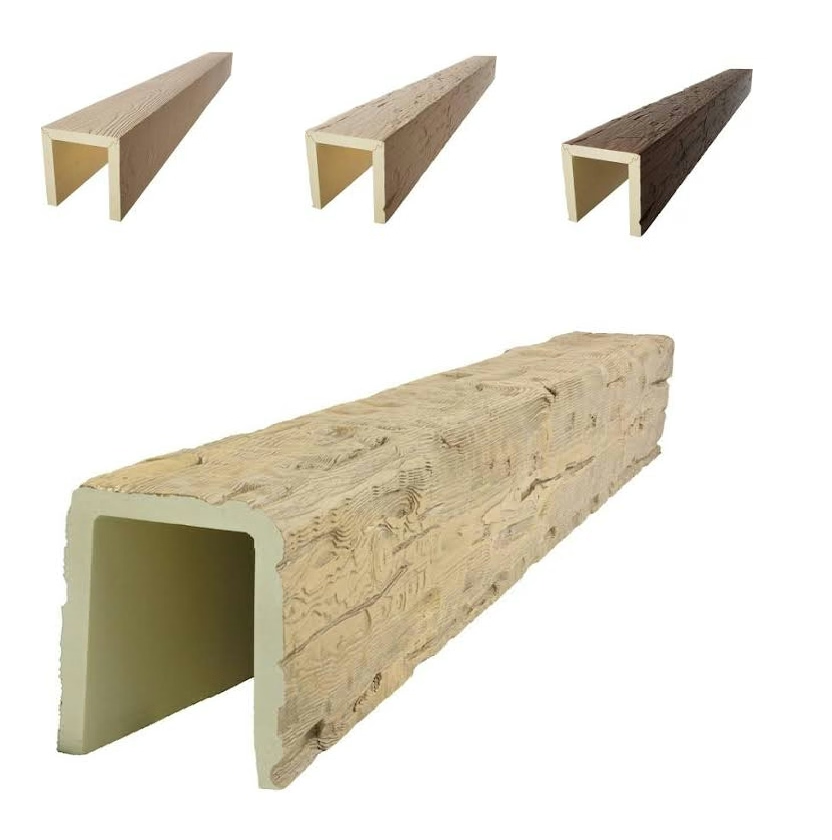
The development of high-density polyurethane as a material for architectural decorative elements represents one of those quiet advances in manufacturing technology that has had an outsized impact on how interior spaces are designed and built. Unlike more dramatic material innovations that generate headlines and controversy, the refinement of polyurethane beam technology has been incremental and steady, each generation of products building on the achievements of its predecessors to deliver incrementally better performance, more convincing aesthetics, and broader application scope. The current generation of lightweight hollow polyurethane faux wood ceiling beams represents the culmination of this process, offering a level of product maturity and design flexibility that makes them a default consideration for any ceiling beam project, whether the priority is aesthetic authenticity, installation efficiency, cost effectiveness, or all three in combination.
Understanding what makes these beams distinctive requires moving beyond the simple description of "fake timber" that sometimes serves as shorthand for polyurethane faux wood products. The reality is considerably more nuanced: these are engineered products whose performance characteristics have been optimized over years of development, whose surface appearance has been refined through advances in mold technology and pigmentation science, and whose installation properties have been systematically improved to meet the demands of real-world construction practice. The result is a product category that stands on its own merits rather than merely as a substitute for something else.


The Material Science Behind Hollow Polyurethane Beams
Polyurethane, in its broad chemical classification, encompasses a vast range of formulations with properties spanning from flexible foams used in cushioning to rigid structural materials used in industrial applications. The specific polyurethane formulations used in architectural decorative beams occupy a carefully defined position in this spectrum, optimized for the combination of surface quality, dimensional stability, weight, and durability that ceiling beam applications demand.
The density of the polyurethane formulation is the primary determinant of the beam's mechanical properties. Higher-density formulations produce beams with improved impact resistance, better surface detail reproduction, and superior dimensional stability under temperature stress. For ceiling beam applications, formulations in the range of two hundred to four hundred kilograms per cubic meter strike an effective balance between these performance attributes and the weight considerations that distinguish hollow beams from solid alternatives. Below this density range, the material may be too soft to hold fine surface detail or too susceptible to impact damage during handling and installation. Above it, the weight advantage over solid timber diminishes significantly.
The cellular structure of the polyurethane determines many of the beam's practical performance characteristics. Closed-cell formulations, where the tiny bubbles that constitute the foam are entirely enclosed within solid polymer walls, provide better moisture resistance and thermal insulation than open-cell formulations where the bubbles are interconnected. For ceiling applications, where beams may be exposed to humidity variations, temperature differences between the ceiling void and the occupied space, and the occasional humidity spike from cooking or bathing, closed-cell formulations offer superior long-term performance.
Profile and Dimension Standards
The dimensional standards for hollow polyurethane faux wood beams have evolved to encompass a range that serves the full spectrum of ceiling applications from modest residential rooms to grand-scale commercial spaces. Understanding this dimensional range helps in selecting appropriately proportioned beams for specific project contexts.
Standard beam widths range from approximately one hundred millimeters for slim contemporary profiles to three hundred millimeters or more for substantial traditional profiles. The depth, which determines the beam's visual projection from the ceiling plane, typically ranges from one hundred millimeters in slim profiles to four hundred millimeters in the most substantial profiles available. Lengths of up to four meters are commonly available as standard, with longer spans achievable through jointing techniques or custom manufacturing for larger-scale applications.
The relationship between beam dimensions and the ceiling conditions should guide specification decisions. In rooms with standard ceiling heights of approximately 2.4 to 2.7 meters, medium-profile beams in the one hundred fifty to two hundred millimeter depth range are generally appropriate, providing visual presence without overwhelming the space. In rooms with higher ceilings, the beam dimensions should increase proportionally to maintain the intended visual relationship between the beam and the ceiling plane. A beam that looks appropriately scaled in a room with a 2.7-meter ceiling may appear trivial in a room with a 4-meter ceiling, which is why dimensional scaling is one of the most important considerations in beam specification.
Performance Characteristics That Matter in Practice
The practical performance of hollow PU faux wood ceiling beams encompasses several characteristics that are directly relevant to their behavior in real building environments. These characteristics are well-documented through industry testing standards and can be evaluated against project requirements to confirm the suitability of the material for specific applications.
Dimensional stability under temperature and humidity variation is one of the most practically significant performance characteristics. Unlike natural timber, which expands and contracts with changes in ambient moisture content, polyurethane beams maintain their dimensions within very close tolerances across the range of conditions encountered in normal building environments. This stability means that joints remain tight, beam spacing stays consistent, and the overall appearance of the installation does not change with the seasons. In regions with significant seasonal humidity variation, this dimensional stability represents a meaningful advantage over natural timber alternatives.
Impact resistance determines how well the beams tolerate the knocks and collisions that occur during installation and, occasionally, during the life of the building. While polyurethane is not as hard as materials like fiberglass or glass-reinforced cement, it offers adequate impact resistance for ceiling applications where the risk of collision is low. The primary risk of impact damage occurs during site handling and installation, when beams may be bumped against ladders, scaffolding, or other equipment. Careful handling practices and the use of protective packaging during transport minimize this risk.
Fire performance is a regulatory requirement in many jurisdictions and should be verified against local building codes before beam specification. Standard polyurethane formulations will melt and burn when exposed to direct flame, but fire-retardant formulations are available that meet the requirements of major building code classifications. For commercial applications, multi-residential buildings, or any project where fire performance is regulated, beams with appropriate fire-retardant properties should be specified. These formulations achieve fire resistance through the incorporation of chemical flame retardants that inhibit combustion, reduce flame spread, and limit smoke development.
Environmental Considerations and Sustainability
The environmental profile of hollow PU faux wood beams is a topic that merits honest assessment rather than either dismissal or overstatement. Polyurethane is a petroleum-derived material, and its production involves chemical processes with associated energy consumption and emissions. However, a complete environmental assessment must also consider the service life performance of the material, the maintenance requirements it eliminates, and the alternatives that it displaces.
Compared to genuine timber from sustainably managed forests, polyurethane production carries a higher initial environmental cost in terms of embodied energy and carbon. However, this comparison must be balanced against the fact that sustainably sourced timber also carries environmental costs, and that the long-term performance requirements of the building may result in different lifecycle impacts than a simple initial carbon comparison suggests. Timber beams may require replacement after decades of service due to decay, insect damage, or physical degradation, each replacement carrying a fresh environmental cost. A well-manufactured polyurethane beam with appropriate fire-retardant properties can remain in service for the life of the building without replacement, potentially achieving a favorable lifecycle environmental assessment.
The lightweight of hollow PU beams also contributes to their environmental profile through reduced transport emissions. Because the beams weigh a fraction of their solid timber equivalents, more beam length can be transported per vehicle journey, reducing the number of transport movements required. For internationally traded products, where shipping distances are substantial, this weight advantage represents a meaningful reduction in the transportation carbon footprint of the installed beam system.

Selecting the Right Beam for Your Project
The process of selecting hollow PU faux wood ceiling beams for a specific project involves consideration of multiple factors that interact with each other in ways that are unique to each project context. The primary selection criteria include the desired visual aesthetic, the dimensional constraints of the space, the performance requirements of the application, and the budget parameters of the project.
The visual aesthetic is typically the starting point for selection, establishing the design direction that informs all subsequent decisions. Within this direction, the beam profile, finish, and configuration must all be specified in a way that is internally consistent and appropriate to the space. Seeking samples from manufacturers or suppliers and evaluating them in the actual project space under the actual lighting conditions is the most reliable way to verify that the selected specification will achieve the intended result.
Performance requirements should be assessed honestly rather than assumed. In most residential interior applications, standard-grade hollow PU beams provide adequate performance without the additional cost of specialty formulations. In humid environments such as swimming pool areas or spa facilities, enhanced moisture resistance may be advisable. In commercial applications with public access, fire-retardant formulations may be a regulatory requirement. Identifying these requirements at the specification stage prevents costly late-stage changes and ensures that the installed beams will perform appropriately for the full life of the installation.
The procurement process for hollow PU beams typically involves a supplier consultation to confirm availability of the desired specification, lead time for production and delivery, and pricing for the beam quantity and configuration required. Custom specifications — non-standard profiles, custom colors, or unusual configurations — may require longer lead times and should be confirmed as early as possible in the project program. Standard products are typically available with shorter lead times, sometimes from stock, which can be advantageous for projects with tight completion schedules.
Technical References
ASTM standards cited in every specification
Test Data
Lab results from internal testing program
Updated 2026
Reviewed against current product specs