When building professionals specify materials for architectural projects, they rightly ask about expected service life. Unlike finish selections that change with design trends, structural and architectural elements like ceiling beams typically remain in place for decades. Understanding how long polyurethane faux wood beams last under various conditions helps architects, designers, and property owners make informed decisions about their use.
The honest answer is that polyurethane faux wood beams can provide decades of beautiful service with minimal maintenance, but their actual longevity depends on several interacting factors. This analysis examines those factors in detail, providing the information you need to set realistic expectations and maximize beam service life in your applications.

Material Composition and Its Relationship to Longevity
Polyurethane itself is a broad category of materials rather than a single compound. The properties of any polyurethane product—including its resistance to environmental degradation—depend heavily on the specific formulation used. Quality manufacturers control their formulations to optimize for specific performance characteristics, including UV resistance, thermal stability, and mechanical durability.
The density of polyurethane foam affects both appearance and durability. Higher-density formulations generally provide better impact resistance and more stable dimensional characteristics over time. Low-density foams might save weight and cost but can show dents or compress slightly under sustained pressure. Premium beam manufacturers typically use medium to high-density formulations that balance these concerns effectively.
Surface coatings add another layer to longevity considerations. Many faux wood beams feature applied finishes that provide the final color and texture visible in the installed product. These coatings might be urethanes, acrylics, or other polymer systems formulated for specific performance characteristics. The quality and type of surface coating significantly affects how the beam resists scratches, stains, and environmental degradation over its service life.
Additives incorporated into the base polyurethane or surface coatings can enhance specific properties. UV stabilizers help resist degradation from sunlight exposure. Flame retardants improve fire performance characteristics. Anti-microbial additives reduce biological growth in humid environments. Understanding what additives are included in your beams helps predict their performance in specific applications.
Environmental Factors That Influence Degradation
Sunlight exposure represents the most significant environmental challenge for polyurethane faux wood beams in many installations. UV radiation breaks down chemical bonds in polymer materials, causing surface chalking, color fading, and eventual structural degradation. Beams installed in rooms with significant natural light exposure will experience these effects more rapidly than those in darker spaces.
The degree of UV exposure matters enormously. A beam in a north-facing room with limited direct sunlight might show negligible UV effects after many years. The same beam installed near a skylight or in a sunroom with floor-to-ceiling windows could show measurable degradation within a few years. In commercial spaces with prolonged operating hours under artificial lighting that includes UV components, similar effects occur albeit more slowly.
Temperature extremes affect polyurethane differently depending on the specific formulation. Most quality products perform adequately across typical indoor temperature ranges. However, beams installed near heat sources—above wood-burning stoves, adjacent to kitchen equipment, or in unventilated attic spaces with poor thermal isolation—might experience elevated temperatures that accelerate degradation. Industrial-grade formulations designed for extreme temperature exposure cost more but provide better performance in challenging applications.
Moisture affects polyurethane differently than it affects wood. Polyurethane does not absorb water, so it won't rot, warp, or swell from humidity exposure. This represents a significant advantage over natural wood in many applications. However, sustained moisture exposure can affect surface finishes and might create conditions favorable for mold growth on adjacent materials. Beams installed in consistently humid environments benefit from adequate ventilation and, in some cases, periodic cleaning to prevent surface contamination.
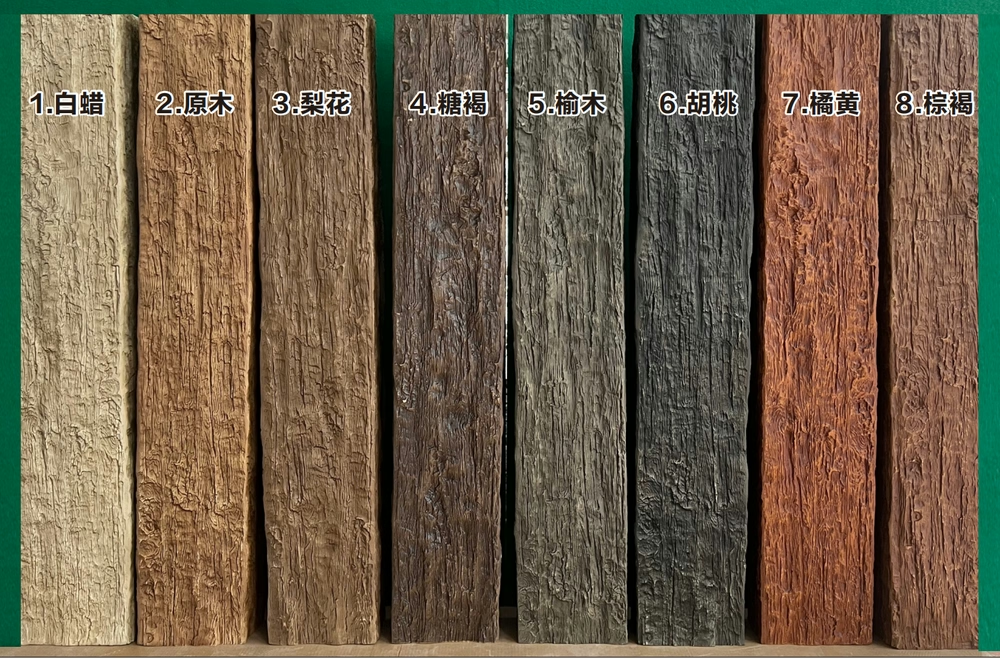
Installation Quality and Its Impact on Service Life
How beams are installed affects their longevity in ways that aren't always immediately obvious. Proper mounting ensures that beams are adequately supported without being over-constrained. Beams that experience stress concentrations from improper mounting might develop cracks or deformations over time, even if the stress remains below the level that would cause immediate failure.
Thermal expansion and contraction occur in response to temperature changes. While polyurethane's coefficient of thermal expansion is relatively low, beams that are rigidly constrained at both ends cannot accommodate movement naturally. This creates internal stress that might not cause immediate problems but can lead to fatigue failure over many thermal cycles. Quality installations include provisions for thermal movement—flexible mounting systems, expansion joints, or sufficient clearance at connection points.
Vibration can affect beam integrity over time. Buildings experience constant low-level vibration from HVAC systems, foot traffic, wind loads, and various mechanical equipment. Beams that vibrate at natural frequencies corresponding to building vibration might experience resonance effects that accelerate fatigue. While this is rarely a problem in typical residential installations, commercial spaces with significant vibration sources warrant attention to mounting methods and beam selection.
The quality of preparation work at installation points matters for long-term performance. Beams mounted to dirty, unstable, or incorrectly prepared surfaces may develop loose connections over time. Wall or ceiling surfaces should be clean, dry, and structurally sound before beam installation. In some cases, backing materials or structural reinforcement might be needed to provide adequate mounting surfaces for heavy beams.

Maintenance Requirements for Extended Service
One of polyurethane's advantages over natural wood is its minimal maintenance requirement. Unlike timber, polyurethane beams do not need periodic refinishing, sealing, or treatment to maintain their appearance and structural integrity. For most indoor applications, regular dusting and occasional cleaning with mild soap and water provides adequate maintenance.
However, maintenance does affect longevity, particularly for beams in challenging environments. In kitchens or other areas where grease or cooking residues might accumulate, periodic cleaning prevents surface contamination that could eventually affect finish adhesion. In high-traffic commercial spaces, regular cleaning maintains appearance and prevents buildup that might trap moisture or create conditions favorable for degradation.
Minor damage can be repaired more easily than many people expect. Small scratches or chips in the surface finish can often be touched up with appropriate repair compounds or paints. Dents in the beam surface might be filled with flexible wood fill and refinished to match the surrounding area. While significant damage might require beam replacement, routine wear and tear can typically be addressed without major intervention.
Inspection on a periodic basis helps catch developing problems before they become serious. Annual visual inspection of installed beams—looking for cracks, loose mounting points, finish deterioration, or other issues—provides opportunity for preventive maintenance. Addressing small problems promptly typically costs less than waiting until repairs become more extensive.
Expected Lifespan in Various Applications
Under typical indoor conditions with standard quality products and proper installation, polyurethane faux wood beams commonly provide service lives of 20 to 30 years or more. Many manufacturers warranty their products for periods ranging from 5 to 15 years, which reflects confidence in the material's durability while acknowledging that real-world conditions vary beyond what warranties can reasonably cover.
Residential applications in climate-controlled homes typically represent the most favorable environment for beam longevity. Constant temperatures, moderate humidity, and limited UV exposure create conditions where beams age very slowly. Homeowners who install quality beams and provide basic care often find their beams remain attractive and structurally sound for the life of their home.
Commercial environments present more variable conditions. High-traffic areas might experience more physical contact and potential impact damage. Extended operating hours might mean more time under artificial lighting that includes UV components. Restaurants and hospitality venues face elevated humidity and potential chemical exposure from cleaning products. In these applications, beams might show more wear over time but still commonly provide a decade or more of service before replacement becomes desirable for aesthetic rather than structural reasons.
Outdoor applications push the limits of what polyurethane can reliably provide. Direct sun exposure, temperature extremes, precipitation, and biological factors create challenges that reduce expected service life. Premium products specifically formulated for outdoor use might provide 10 to 15 years of service in protected outdoor installations. Fully exposed installations in harsh climates might show significant degradation within 5 to 10 years. For outdoor applications where longevity is critical, other materials might prove more appropriate despite their own limitations.
Comparing to Alternative Materials
Natural wood beams offer the advantage of genuine material and potentially very long service life for premium species with proper maintenance. However, wood requires ongoing care including refinishing, pest treatment, and attention to moisture conditions. In environments unfavorable to wood, such as high-humidity spaces or areas with pest pressure, polyurethane's resistance to these factors provides meaningful practical advantages.
Metal beams, whether steel or aluminum, provide excellent durability and structural capability but lack the warmth and aesthetic appeal of wood in most design contexts. When the goal is achieving a wood aesthetic, metal beams require covering or finish treatments that add cost and complexity. For applications where structural support is the primary concern, metal makes sense; for purely aesthetic applications, polyurethane provides wood's visual qualities without metal's thermal conductivity or condensation issues.
Composite materials occupy a middle ground between polyurethane and natural products. Wood-plastic composites offer some of wood's aesthetics with enhanced durability, but they typically lack the realistic texture and detail that high-quality polyurethane achieves. For applications prioritizing authentic wood appearance above other factors, quality polyurethane typically outperforms composites.
Maximizing Your Beams' Service Life
Several practices help ensure your polyurethane faux wood beams provide the longest possible service. Specify products from manufacturers with established reputations and demonstrated quality control. The difference in formulation and manufacturing quality between premium and economy products often becomes apparent only over time.
Ensure installation by qualified professionals with experience specific to faux beam products. General carpentry skills don't automatically transfer to this specialized work. Installers unfamiliar with the products might make mistakes that affect long-term performance even if the immediate result looks acceptable.
Match beam selection to application conditions honestly. If your installation will involve significant UV exposure, specify products formulated for that environment rather than assuming all polyurethane products perform identically. If moisture exposure is likely, select products with appropriate resistance characteristics and ensure adequate ventilation.
Finally, maintain reasonable expectations. All materials age over time; the question is whether that aging occurs gracefully. Polyurethane beams that have been in service for 15 years might show subtle signs of age—a slightly faded color, a few surface marks—but should still provide attractive and functional service. When appearance degrades to the point that replacement becomes desirable, the beams have still provided years of maintenance-free enjoyment that more than justifies the original investment.
Technical References
ASTM standards cited in every specification
Test Data
Lab results from internal testing program
Updated 2026
Reviewed against current product specs


