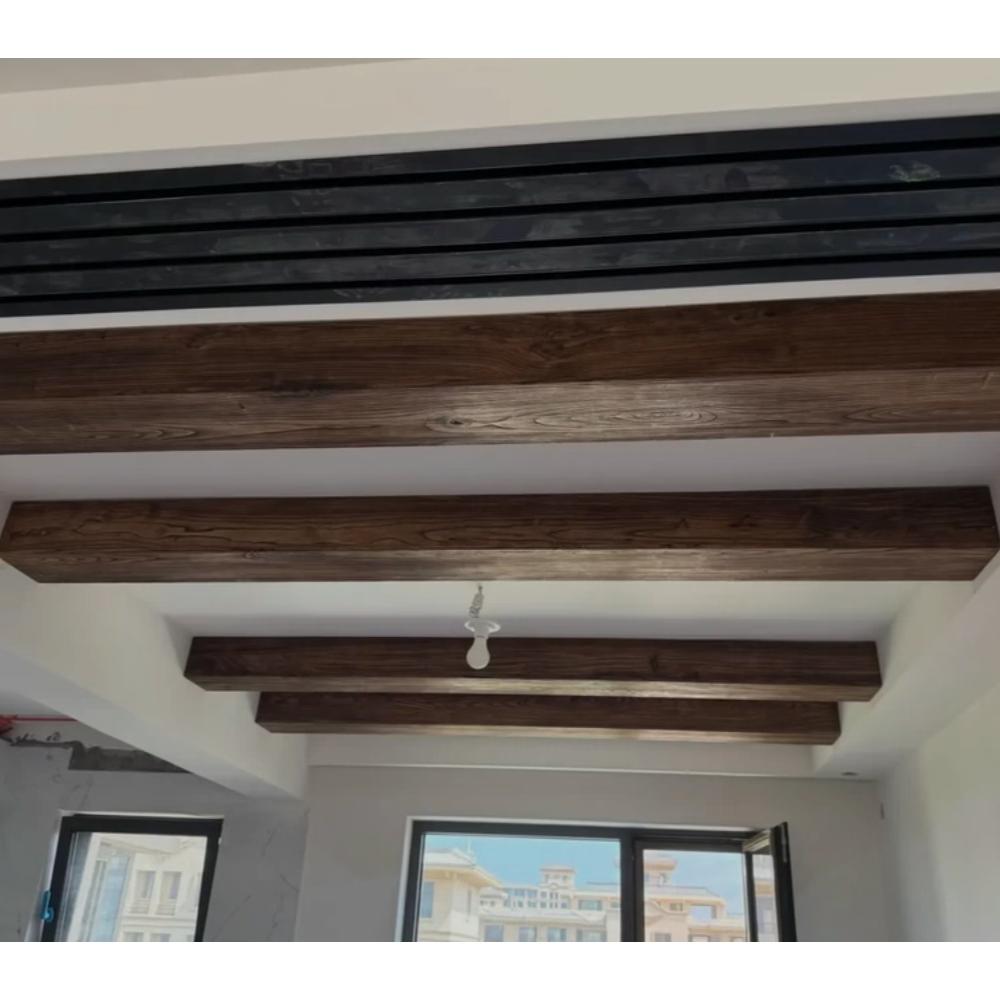
Volatile organic compound emissions from building materials affect indoor air quality in enclosed spaces, influencing occupant health, comfort, and productivity. Green building certification programs increasingly require VOC emission documentation for installed products. Polyurethane faux timber beams, while significantly lower emitters than many finishing materials, benefit from emission certification supporting use in environmentally conscious projects.
Understanding VOC Emissions
Volatile organic compounds encompass thousands of chemical substances that evaporate at room temperature, potentially affecting air quality when concentrations build up in enclosed spaces. Common indoor sources include adhesives, sealants, paints, cleaning products, and personal care items. Building material emissions contribute to total indoor VOC loads that health authorities monitor for occupant safety.
Formaldehyde receives particular attention among VOC emissions due to documented health effects at elevated concentrations. While polyurethane formulations generally do not contain added formaldehyde, some raw materials or additives may release trace amounts during curing or aging. Testing protocols specifically measure formaldehyde alongside total VOC emissions.
Emissions testing measures chemical release rates under standardized conditions, typically expressed as micrograms per square meter per hour (μg/m²·h) for surface emissions. These measured values enable calculation of indoor air concentrations under specified ventilation conditions, comparing results against health-based limits and certification thresholds.
Testing Standards and Protocols
CDPH/EHLB Standard Method (formerly CA 01350) provides the primary testing protocol for interior finish materials in North American markets. This method measures emissions of formaldehyde and 22 specific VOCs under controlled chamber conditions simulating typical indoor environments. Results are evaluated against chronic reference exposure levels established by California Office of Environmental Health Hazard Assessment.
ASTM D5116 addresses small-scale chamber testing for emissions characterization, providing methodology for measuring VOC emissions from products at realistic indoor air exchange rates. This standard supports both regulatory compliance and research applications requiring emissions data.
EN 16402 provides European emissions testing methodology aligned with European construction product regulations. This standard addresses the same health concerns as CDPH/EHLB while using different chamber conditions and evaluation criteria appropriate for European building standards.
Emission Ratings and Certification Tiers
FloorScore certification, administered by SCS Global Services, evaluates products against CDPH/EHLB Standard Method requirements and issues certificates for compliant materials. Certified products appear in the FloorScore public database and may use the FloorScore mark in marketing materials. This certification provides widely recognized proof of low-emission performance.
GREENGUARD certification from UL Environment applies more stringent limits than FloorScore, with separate thresholds for standard and children/family products. The GREENGUARD mark indicates products suitable for sensitive environments including schools and healthcare facilities. Testing frequency and quality control requirements exceed FloorScore levels.
CDPH Section 01350 compliance directly addresses California regulatory requirements, particularly for public procurement and state-funded construction. Products claiming compliance should provide test reports demonstrating specific emission measurements below listed limits. Documentation should identify the testing laboratory and confirm testing currency.
Green Building Program Requirements
LEED (Leadership in Energy and Environmental Design) certification incorporates indoor air quality requirements that affect material selection. EQ Credit 4.1 (Low-Emitting Materials) awards points for products meeting VOC limits specified by category. Ceiling and beam products may contribute when they replace higher-emitting materials or when projects pursue enhanced indoor air quality approaches.
WELL Building Standard addresses similar concerns through feature requirements covering air quality, thermal comfort, and acoustic performance. Material restrictions in WELL Feature 26 (VOC Reduction) and Feature 97 (Material Transparency) affect product selection for WELL-certified projects. Documentation requirements include emissions testing and content disclosure.
Living Building Challenge represents the most stringent requirements, prohibiting certain chemical classes entirely through its Red List program. Polyurethane materials face scrutiny under Red List provisions, though specific formulations may avoid listed substances. Projects pursuing Living Building Certification require manufacturer disclosure and verification of Red List compliance.
Documentation Requirements for Certification
Emissions test reports provide the foundation for all certification claims. Reports should identify tested products by exact formulation and production batch, enabling correlation between tested and supplied products. Testing laboratories should hold ISO 17025 accreditation confirming measurement validity.
Certificates of compliance from manufacturers declare conformance to specified emission limits. These declarations supplement test reports by committing manufacturers to ongoing production compliance. Certificate validity periods should be verified; expired certificates require renewal testing.
Safety Data Sheets contribute to total picture of chemical emissions, though SDS does not provide quantified emission rates suitable for air quality modeling. SDS Section 11 (Toxicological Information) addresses acute hazards rather than chronic exposure from low-level emissions. Emission testing provides the specific data needed for green building compliance.
Emission Control Through Formulation
Modern polyurethane formulations have reduced VOC content through reformulation eliminating high-emission solvents and catalysts. Water-based finishes have largely replaced solvent-based alternatives in factory-applied coatings. Adhesive systems have evolved from solvent-borne to water-based or reactive formulations with minimal emissions.
Raw material selection influences emissions through component volatility differences. High-purity diisocyanates and polyols produce fewer secondary emissions than lower-grade alternatives. Responsible manufacturers specify raw materials to minimize residual monomer content and volatile byproducts.
Post-manufacturing curing allows volatile emissions to dissipate before product installation. Factory storage periods before shipping enable emission reduction through natural off-gassing. Accelerated curing protocols reduce storage requirements while achieving similar emission reductions for production efficiency.
Maintaining Certification Validity
Product modifications may void existing emissions certifications if changes affect emission characteristics. Formulation adjustments, new raw material sources, or process changes warrant re-evaluation against certification requirements. Maintaining certification requires documentation control and change management procedures.
Production consistency verification confirms that manufactured products maintain emissions performance equivalent to tested formulations. Quality control testing programs sample production output for emissions verification. Statistical process control identifies drift before certification violations occur.
Supply chain management ensures that component materials continue meeting original specifications. Raw material supplier changes may affect final product emissions even when no formulation changes occur. Approved supplier programs and incoming material testing support consistent emissions performance.
Technical References
ASTM standards cited in every specification
Test Data
Lab results from internal testing program
Updated 2026
Reviewed against current product specs


