
Polyurethane foam density specifications represent the most fundamental quality indicator available to faux wood beam purchasers, yet this specification receives insufficient attention compared to more visible characteristics like surface finish, color selection, or dimensional availability. Density—expressed as weight per unit volume—reflects the concentration of polymer material that determines performance across virtually every metric that matters for ceiling beam applications. Understanding how density variations translate to practical performance differences enables smarter purchasing decisions that align product selection with actual application requirements.
The foam density range commercially available spans roughly 2 to 8 pounds per cubic foot, with products clustered at low-end, mid-range, and premium density tiers. Each tier serves different market segments and application requirements, with optimal selection depending on factors including installation environment, expected traffic levels, budget constraints, and performance expectations. No single density represents the universally correct choice—context determines which specification provides best value for specific project types.
Cell Structure and Material Composition
High-density polyurethane foam forms with smaller, more uniformly distributed cell structures than lower-density alternatives. The concentrated polymer matrix creates a smoother, more consistent material that resists the compression and deformation that plague lighter formulations. When viewed in cross-section, high-density foam displays fine, regular cell patterns visible under magnification, while low-density foam shows larger, irregular cells with significant void spaces between polymer strands.
This microscopic structural difference cascades through all macroscopic performance characteristics. The tight cell structure of high-density foam resists water infiltration, providing better moisture resistance than the open-cell structure of low-density alternatives. Thermal insulation values improve with density due to reduced thermal bridging through the polymer matrix. Acoustic dampening increases as sound energy encounters more numerous cell boundaries during transmission through the material.
The chemical composition also varies between density levels beyond simple concentration differences. High-density formulations typically incorporate more sophisticated polymer chemistries with enhanced UV stabilizers, impact modifiers, and surface bonding agents that improve overall performance. These additive packages increase material costs but contribute significantly to the performance premium that distinguishes high-density products from commodity alternatives.
Compression Resistance and Load Bearing
The compressive strength of polyurethane foam correlates directly with density specification, determining how beams perform under point loads, accidental impacts, and sustained weight exposure. High-density foam formulations resist compression deformation that would permanently damage lower-density alternatives, maintaining original dimensions and surface contours through years of challenging service conditions.
Point load performance becomes critical in installations where beams might encounter impacts from ladders, furniture, or building maintenance activities. A storage item accidentally bumped against a high-density beam creates no visible damage, while identical impact against low-density foam may leave permanent dents or crushing that compromise appearance and require repair. Commercial environments with elevated impact probability particularly benefit from high-density compression resistance that protects installation appearance through demanding daily use.
Sustained load conditions—though ceiling beams rarely face significant structural loading—test the long-term creep behavior of foam materials. Under continuous compression stress, lower-density foams may gradually compress over months or years, potentially creating visible sag in beam profiles. High-density formulations resist creep deformation due to more robust polymer cross-linking, maintaining original dimensions indefinitely under normal ceiling installation conditions.
Surface Detail Reproduction
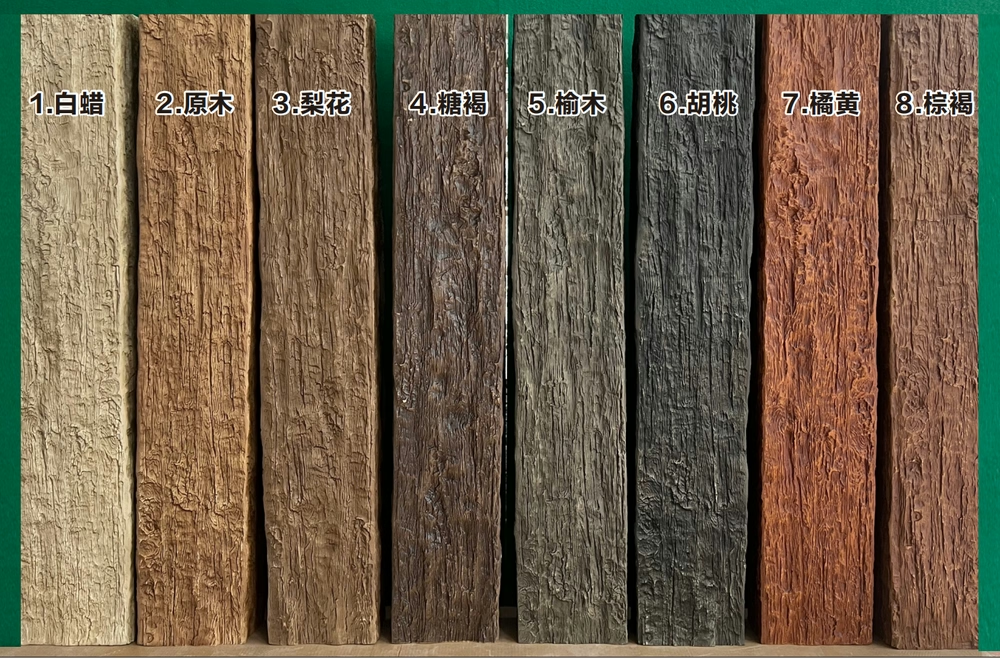
The ability to accurately reproduce fine architectural details during manufacturing depends partly on foam density formulation. High-density materials flow more readily into mold crevices, capturing subtle wood grain patterns, weathering marks, and edge details with greater fidelity than lower-density alternatives that may skip or fill incompletely during the expansion process. This reproduction quality directly affects visual authenticity—beams with crisp, detailed surfaces appear more convincingly like genuine timber than those with softened or missing detail elements.
The surface skin characteristics also vary with density. High-density foam formulations develop smoother, more consistent surface skins during manufacturing that accept staining, painting, and finishing more uniformly than low-density alternatives. The skin thickness and integrity influences how well beams tolerate handling during installation, shipping, and finishing without surface damage that reveals the underlying foam structure.
For premium applications where beams receive close inspection—museums, high-end residential installations, architectural photography subjects—high-density formulations deliver the surface quality that justifies premium pricing. For applications where beams remain overhead with limited viewing proximity—basement ceilings, commercial storage areas, temporary installations—lower-density products provide adequate appearance at more accessible price points.

Dimensional Stability and Temperature Tolerance
Polyurethane foam behavior under temperature extremes differs between density levels, with implications for installations in challenging thermal environments. High-density formulations maintain dimensional stability across wider temperature ranges without the softening, expansion, or contraction that may affect lower-density alternatives. This thermal stability proves important for exterior applications, sunroom installations, or interior spaces with significant temperature variation.
Cold temperature exposure creates particular challenges for polyurethane foam materials. Low-density foams may become more brittle in cold conditions, increasing susceptibility to impact damage during winter months. High-density formulations retain more flexibility at low temperatures, continuing to absorb impacts without cracking or chipping that would damage surface appearances. For properties in colder climates where ceiling temperatures may drop substantially during heating season, high-density specifications provide important cold-weather performance advantages.
Thermal cycling—the repeated expansion and contraction that occurs as environments shift between heating and cooling—tests dimensional stability over time. High-density formulations resist the cumulative micro-damage that can accumulate through repeated thermal cycling in lower-density materials. While neither material type typically fails catastrophically from thermal cycling alone, the long-term appearance retention advantages favor high-density specifications for demanding thermal environments.

Cost-Effectiveness Across Application Types
The value proposition between high-density and low-density polyurethane beams shifts dramatically depending on application requirements. For decorative residential applications in low-traffic areas—formal living rooms, master bedroom ceilings, dining rooms—low-density beams often provide adequate performance at lower initial cost. The risk of damage in these typically low-activity spaces is minimal, and the cost savings from lighter-density specifications can be significant for budget-conscious projects.
Family rooms, children's bedrooms, and active household spaces warrant high-density investment despite higher initial prices. The durability advantages prevent damage from accidental impacts while the improved appearance retention maintains aesthetic quality through years of demanding use. When calculated against potential repair costs, replacement expenses, and the disruption of fixing damaged beams, the high-density premium becomes clearly economical.
Commercial applications—hospitality venues, retail environments, office common areas—should default to high-density specifications without exception. The ongoing traffic patterns, elevated impact probability, and professional image requirements in these settings demand the performance level that only high-density formulations reliably deliver. The cost premium becomes trivial against the backdrop of professional installation fees, business disruption during repairs, and reputation implications of visibly damaged ceiling elements.
Technical References
ASTM standards cited in every specification
Test Data
Lab results from internal testing program
Updated 2026
Reviewed against current product specs


