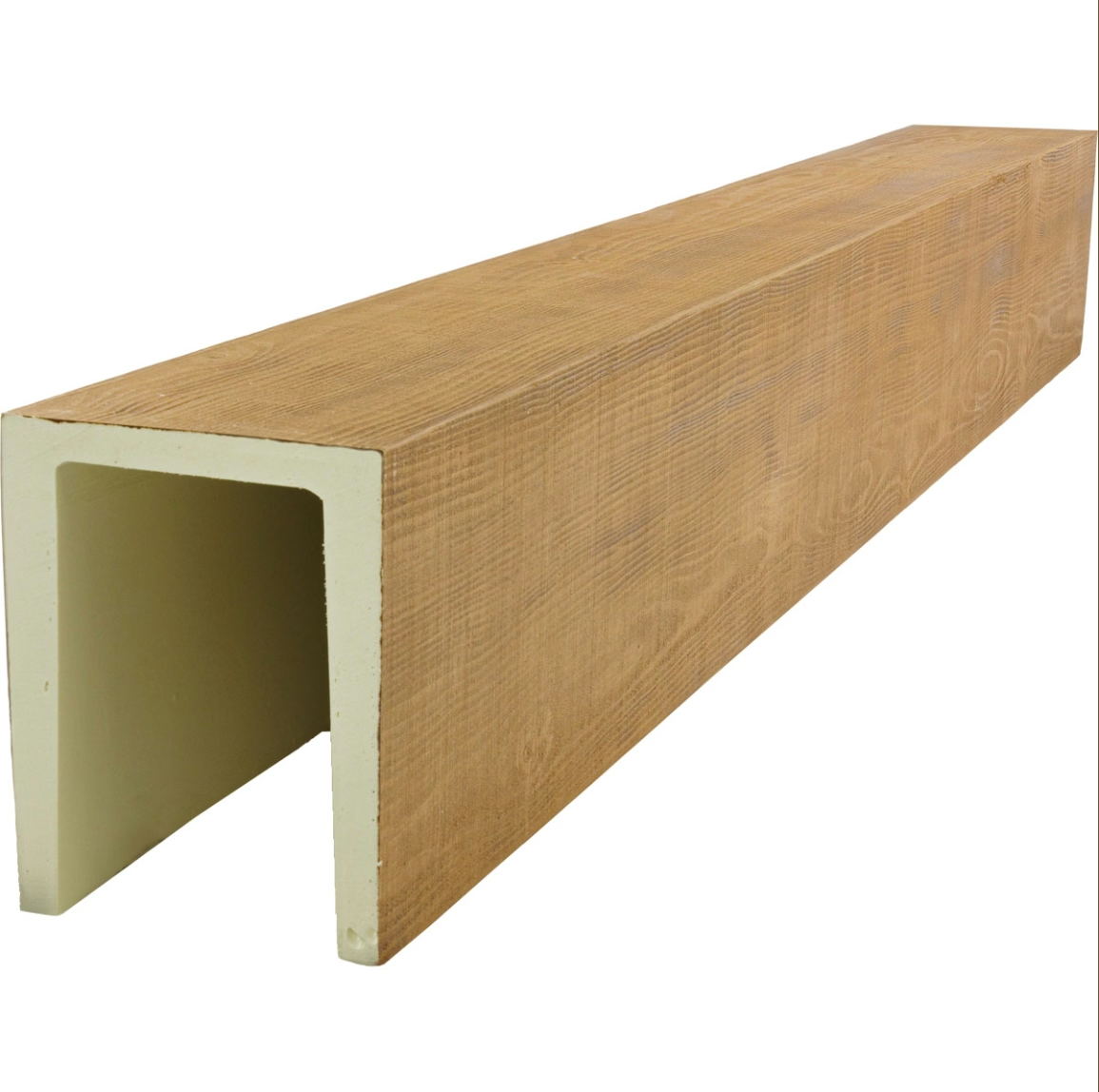
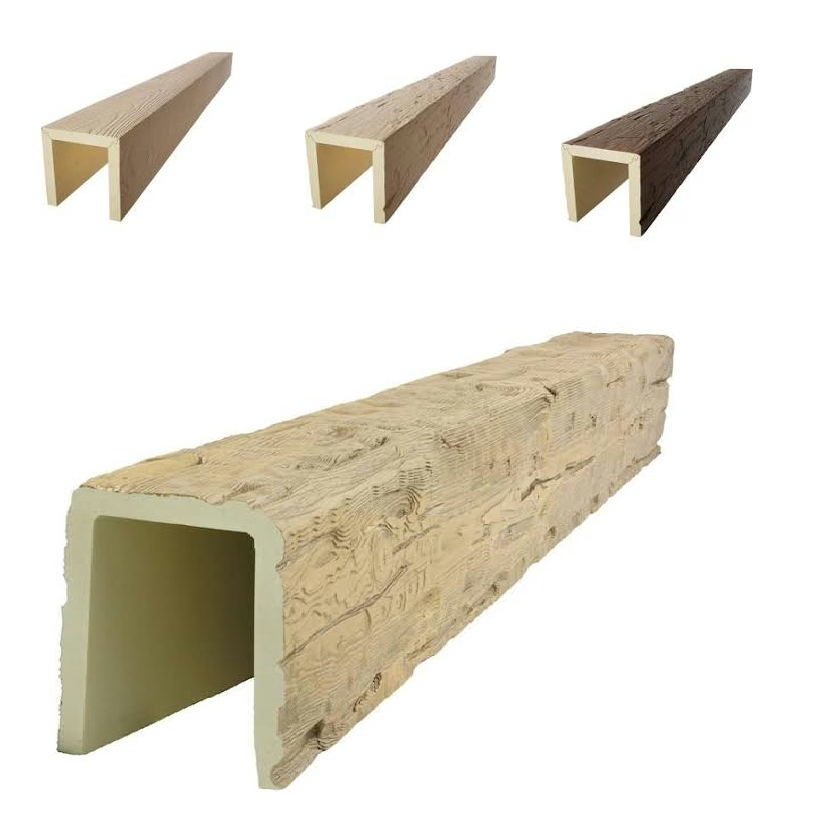
Standard beam lengths exist because manufacturing efficiency favors certain dimensions, and most projects can accommodate slight variations from ideal measurements through strategic placement of joints or by accepting a small gap at one wall. But when a project demands perfection—when the client expects beams that terminate exactly at wall intersections, when a fireplace surround requires precise beam lengths to match surrounding millwork, or when an architect specifies tolerances that allow no deviation—custom cutting services become essential rather than optional.
The precision of custom cutting begins with the measurement process. Unlike estimating lengths based on room dimensions from a floor plan, custom cutting requires actual field measurements taken at the installation location. This means measuring the actual span between mounting points, accounting for any obstructions, and recording the exact length needed for each individual beam rather than assuming all beams in a run are the same length. In older homes especially, walls settle and ceilings shift, so beams that should be identical often vary by a quarter inch or more.
Factory cutting using CNC equipment achieves tolerances measured in fractions of a millimeter. A beam ordered at 142.5 inches will be cut to exactly 142.5 inches plus or minus the specified tolerance, typically plus or minus one millimeter or better. This precision eliminates the slight variations that accumulate when cutting beams individually on job-site saws, where blade deflection, measurement errors, and operator technique all introduce uncertainty. The factory approach also uses carbide-tipped blades appropriate for polyurethane, minimizing tear-out and delivering clean cuts on the first pass.

Ordering custom-cut beams requires providing clear, unambiguous length specifications. The most reliable approach specifies the length from point to point of the finished installation—so the length the beam will measure after mounting rather than the length of raw material needed. Include any relevant notes about end conditions: square cuts, mitered ends, or specialized shapes. When ordering multiple beams of slightly different lengths, label each length clearly and cross-reference with a dimensioned drawing if the geometry is complex.
The cost structure for custom cutting typically includes a tooling or setup charge plus a per-beam cutting fee. This structure reflects the manufacturing reality: changing from one length to another requires stopping production, adjusting equipment, and restarting. For long production runs of identical custom lengths, this setup cost amortizes across many beams, making custom cutting economical. For single beams or small quantities, the setup cost dominates, which is why many suppliers establish minimum order quantities for custom cutting services.
End cap considerations affect how custom lengths are specified. If the beam will receive an end cap accessory, the length measurement must account for how far the cap inserts into or over the beam end. Ordering a beam at exactly the visible length needed, without accounting for the cap depth, results in a beam that is slightly too short once the cap is installed. Reviewing the cap installation instructions before specifying lengths prevents this common error.

Shipping and handling of custom-cut beams requires attention to packaging. Beams should arrive individually wrapped or bundled with protective material at the contact points to prevent surface damage during transit. Each beam should carry a label indicating its length and position in the installation sequence, especially when beams are cut to different lengths for the same project. This identification prevents the frustrating and time-consuming process of measuring each beam upon arrival to determine its length.
The time savings on the job site from custom-cut beams often exceed the added cost of the cutting service. Imagine a twelve-beam ceiling installation where every beam is cut exactly to length. The crew lifts each beam, slides it into position, secures the mounting brackets, and moves on. There is no measuring, no marking, no trial fitting, no trim cuts to chase the perfect reveal. The entire installation proceeds with the efficiency of assembly rather than the uncertainty of fabrication. For contractors pricing work, this predictable labor requirement makes custom-cut beams competitive with field-cut options despite the higher per-beam material cost.
For homeowners and designers, custom-cut beams deliver the satisfaction of a finished installation that looks exactly as designed. No gaps requiring caulking, no visible splices where two shorter pieces meet, no improvised solutions to hide measurement errors. The beams arrive as finished components that slot into the design intent without compromise. That level of precision transforms what could be a source of anxiety into a source of pride.
Technical References
ASTM standards cited in every specification
Test Data
Lab results from internal testing program
Updated 2026
Reviewed against current product specs