The foam core at the heart of faux wood beams determines their fundamental performance characteristics. Not all foam is created equal, and the density specification that manufacturers choose fundamentally shapes product capability across impact resistance, durability, and aesthetic quality. Premium high-density foam construction distinguishes beams that serve faithfully for decades from those that disappoint within years of installation.
Understanding foam density and its implications enables informed purchasing decisions that protect investments and ensure satisfaction. This technical detail, often overlooked in marketing materials, represents the most significant differentiator between premium and economy products.
Understanding Foam Density Specifications
Foam density measures the mass of polymer material per unit volume, typically expressed in pounds per cubic foot. This specification indicates the amount of actual structural material present in the beam core, directly correlating with performance characteristics.
Higher density foams contain more material in the same volume, creating more robust internal structure. The cellular architecture of foam materials consists of gas-filled cells supported by polymer walls. Greater wall thickness and smaller cell sizes in higher density products provide improved structural properties across virtually every relevant metric.
Premium faux wood beams typically achieve densities exceeding five pounds per cubic foot, representing substantial material investment that economy products avoid. This density level provides the performance characteristics that premium applications require, including impact resistance, dimensional stability, and fastener-holding capacity.
Economy alternatives often fall below three pounds per cubic foot, sometimes substantially so. These reduced densities save manufacturing cost but compromise every performance characteristic that matters in ceiling applications. The initial price savings evaporate when considering reduced service life and earlier replacement requirements.
Performance Benefits of High-Density Construction
The practical advantages of high-density foam construction manifest across handling, installation, and long-term service. Each benefit reinforces the value proposition that justifies premium product selection.
Impact resistance scales directly with density, as the increased material content provides more robust cellular structure. High-density beams absorb accidental impacts without denting, cracking, or surface damage that would compromise appearance. This resilience proves particularly valuable during installation, when handling damage causes substantial frustration and expense.
Dimensional stability improves with density, reducing the thermal expansion and contraction that can stress mounting systems over seasonal temperature cycles. Premium beams maintain their dimensions and appearance through years of temperature variation without the warping or distortion that plagues lesser products.
Fastener-holding capacity increases with density, providing secure attachment that resists the loosening that can develop over time in lesser products. This characteristic ensures that mounting systems remain secure throughout the beam's service life, eliminating the maintenance attention that looser connections would require.
The structural integrity of high-density beams supports modifications and additions that lower-density products cannot accommodate. Light fixtures, ceiling fans, and other suspended items require secure mounting points that premium beams provide reliably.


Aesthetic Implications of Foam Density
Surface quality in faux wood beams depends substantially on the foam core that supports finished surfaces. High-density construction provides the stable foundation that enables premium surface treatments.
Surface detail reproduction requires stable backing that holds fine impressions without deformation. Low-density foams compress under molding pressure, losing detail definition that high-density materials maintain. This compression also affects finished dimensions, potentially causing fit problems during installation.
Finish adhesion improves on high-density surfaces where the cellular structure provides mechanical bonding opportunities for applied coatings. Low-density materials may allow finishes to separate from the substrate over time, leading to peeling, flaking, and appearance degradation that premium products avoid.
Texture depth in premium surface treatments requires consistent support throughout the beam surface. High-density cores maintain the slight surface variations that catch light realistically and create authentic wood appearance. Lower density materials may compress unevenly, creating surface irregularities that telegraph manufacturing quality issues.
Manufacturing Quality and Density Control
Premium manufacturing maintains tight density control across production runs, ensuring consistent quality that economy production cannot match. This consistency separates professional-grade products from commodity alternatives.
Raw material selection determines baseline density and consistency before manufacturing begins. Premium manufacturers source consistent polymer formulations from qualified suppliers, avoiding the batch-to-batch variation that affects lesser materials. This consistency ensures that every beam meets quality specifications.
Production process control maintains density throughout beam sections without thin areas or voids that compromise structural integrity. Premium manufacturing employs monitoring and quality control procedures that identify and reject non-conforming product before it reaches customers.
Aging stability ensures that density specifications remain valid throughout the product's service life. Premium formulations resist the degradation that can reduce density over time, maintaining performance characteristics from installation through decades of service.
Making Informed Density Decisions
Purchasing decisions based on density specifications require understanding how these technical parameters translate to real-world performance. Several approaches help ensure appropriate product selection.
Published density information provides the foundation for comparison shopping. Premium manufacturers publish these specifications openly, recognizing that informed customers ultimately become satisfied customers. Reluctance to provide density data often indicates below-specification products that manufacturers prefer to obscure.
Physical samples enable density assessment through weight comparison and tactile evaluation. Holding samples from different manufacturers reveals density differences immediately, with premium products demonstrating substantially greater mass than economy alternatives.
Warranty coverage often correlates with density and overall quality. Manufacturers confident in their products provide extended warranties that economy producers cannot profitably offer. Warranty terms therefore provide indirect density and quality indication.
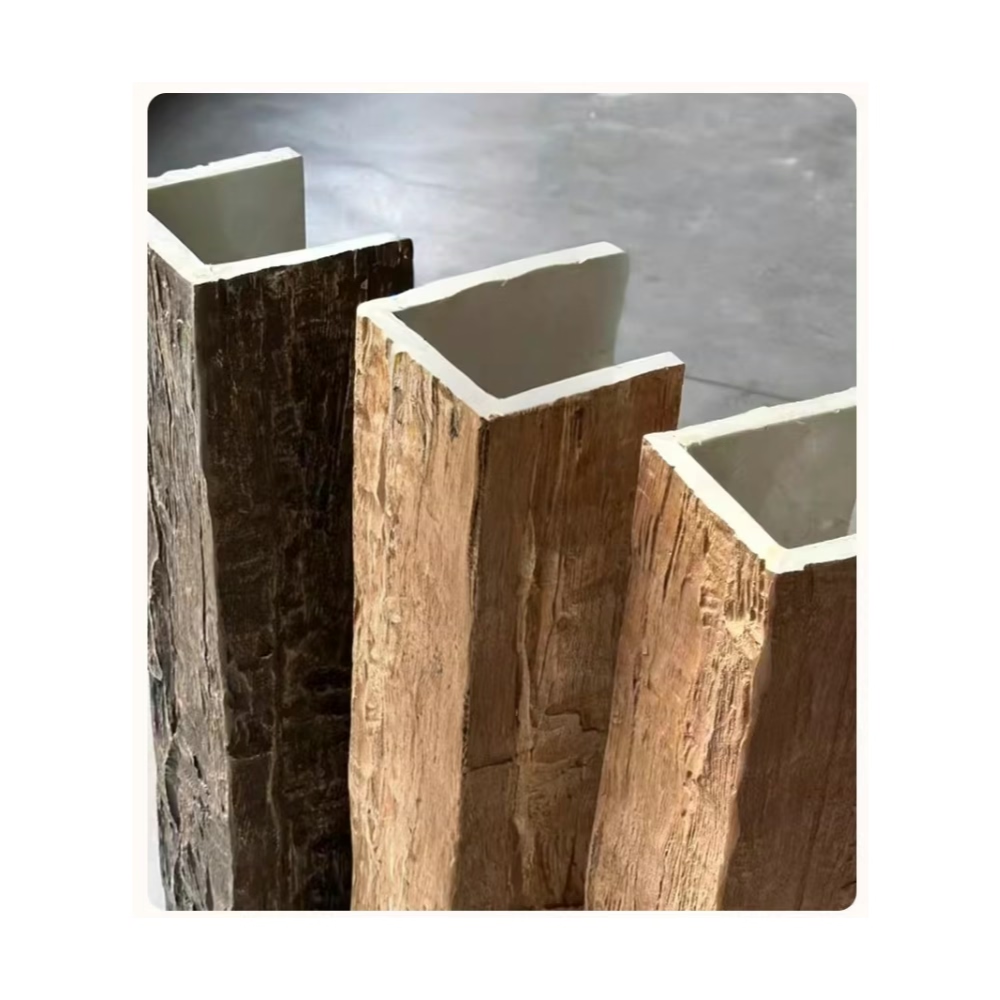
The premium high-density foam construction faux wood ceiling beams represent material quality that translates directly to performance excellence. Their superior density provides the foundation for all the characteristics that distinguish premium products: durability, aesthetics, and long-term satisfaction. Understanding this fundamental relationship helps ensure that purchasing decisions deliver the value that premium specifications promise.
Technical References
ASTM standards cited in every specification
Test Data
Lab results from internal testing program
Updated 2026
Reviewed against current product specs


