The term "faux beam" appears frequently in interior design discussions, but its meaning is not always understood clearly, and the specific properties of polyurethane-based faux beams are even less widely known. Before selecting any building material, it is worth understanding exactly what it is, how it is made, what it does well, and where its limitations lie. This guide provides that understanding for purely decorative non-load-bearing polyurethane faux beams.
Defining the Faux Beam Concept
A faux beam is a decorative architectural element designed to replicate the appearance of a structural beam without performing any load-bearing function. The term "faux," derived from the French word for false, indicates that the beam imitates the visual characteristics of real structural timber while serving a purely aesthetic purpose.
This distinction is fundamental. A genuine timber beam in a building performs a structural task: it carries loads from the roof, upper floors, or ceiling and transfers those loads to the walls or columns that support them. A faux beam carries nothing. Its purpose is entirely visual: it creates the impression of architectural richness, structural honesty, and material warmth that real timber beams convey, but it does so in contexts where real structural beams would be impractical, unnecessary, or impossible.
Faux beams can be made from many materials, including wood, plaster, fiberglass, and polyurethane resin. Each material brings different properties to the finished product, affecting its weight, durability, installation requirements, and aesthetic qualities.
What Polyurethane Resin Is
Polyurethane resin, in the context of architectural products, refers to a family of rigid foam materials produced by the chemical reaction of polyol and isocyanate components. This reaction produces a closed-cell foam with a density that can be precisely controlled during manufacturing, resulting in products that range from lightweight packaging foam to dense, rigid structural materials.
For architectural trim and beam applications, manufacturers use medium to high-density formulations that provide sufficient rigidity for structural-feeling installations while remaining light enough to handle without mechanical equipment. The foam is mixed, poured or injected into precision-engineered molds, and allowed to expand and cure. The mold surface is designed with the negative of the desired surface texture, so the finished piece emerges with the correct profile and surface finish.
The resulting material is homogeneous throughout its cross-section. Unlike wood, which is composed of cellulose fibers arranged in a natural structure, polyurethane foam consists of countless tiny closed cells packed uniformly together. This uniformity gives the material consistent properties in all directions, unlike wood, which behaves differently along and across the grain.

The Manufacturing Process for PU Faux Beams
The production of quality PU faux beams involves several critical stages. Mold design is the foundation of the process, and it is typically created using computer-aided design software that translates the desired beam profile into tooling specifications. The mold itself is usually made from aluminum or high-density polymer, materials that can withstand the exothermic heat of the foam reaction and the repeated production cycles required for commercial manufacturing.
Foam formulation is where different manufacturers differentiate their products. The ratio of polyol to isocyanate, the presence of catalysts, surfactants, and blowing agents, and the addition of reinforcement materials such as glass fibers all affect the final properties of the beam. A high-quality formulation produces a foam with consistent cell structure, good surface definition, and minimal thermal expansion during curing.
Surface finishing occurs either in the mold, where a skin forms against the mold surface during expansion, or through post-molding operations such as sanding, priming, and painting or staining. Some manufacturers apply wood-grain texture during the molding process by texturing the mold surface, while others apply texture through post-molding machining or hand tooling.

Key Performance Characteristics
Understanding the performance characteristics of PU faux beams requires setting aside assumptions derived from other materials and evaluating the product on its own terms.
Weight is perhaps the most immediately apparent property. A hollow PU faux beam weighs roughly one-tenth to one-fifteenth of a comparably sized solid wood beam and one-fiftieth to one-hundredth of a comparably sized steel beam. This dramatic weight reduction affects every aspect of handling, installation, and mounting hardware selection.
Dimensional stability refers to the material's resistance to changes in shape and size in response to environmental conditions. Polyurethane foam has very low moisture absorption, meaning it does not swell when exposed to humidity. Its thermal expansion coefficient is low and consistent, so the beam does not warp, twist, or cup as temperature changes. This stability means that gaps, which are a common problem with real wood beams as they expand and contract seasonally, are largely eliminated.
Impact resistance varies with density and formulation. Higher-density PU foam is more resistant to impact damage than lower-density alternatives, but even standard-density beams are generally more resistant to chipping and cracking than plaster alternatives. The material flexes slightly under load rather than shattering, which gives it an advantage over rigid brittle materials in applications where accidental impact is possible.
Chemical resistance is another important characteristic. PU resin is resistant to most common building chemicals, including paint, primer, adhesive, and caulk products, which simplifies finishing and installation. It is not resistant to certain solvents, particularly aromatic hydrocarbons, which should be avoided during finishing.
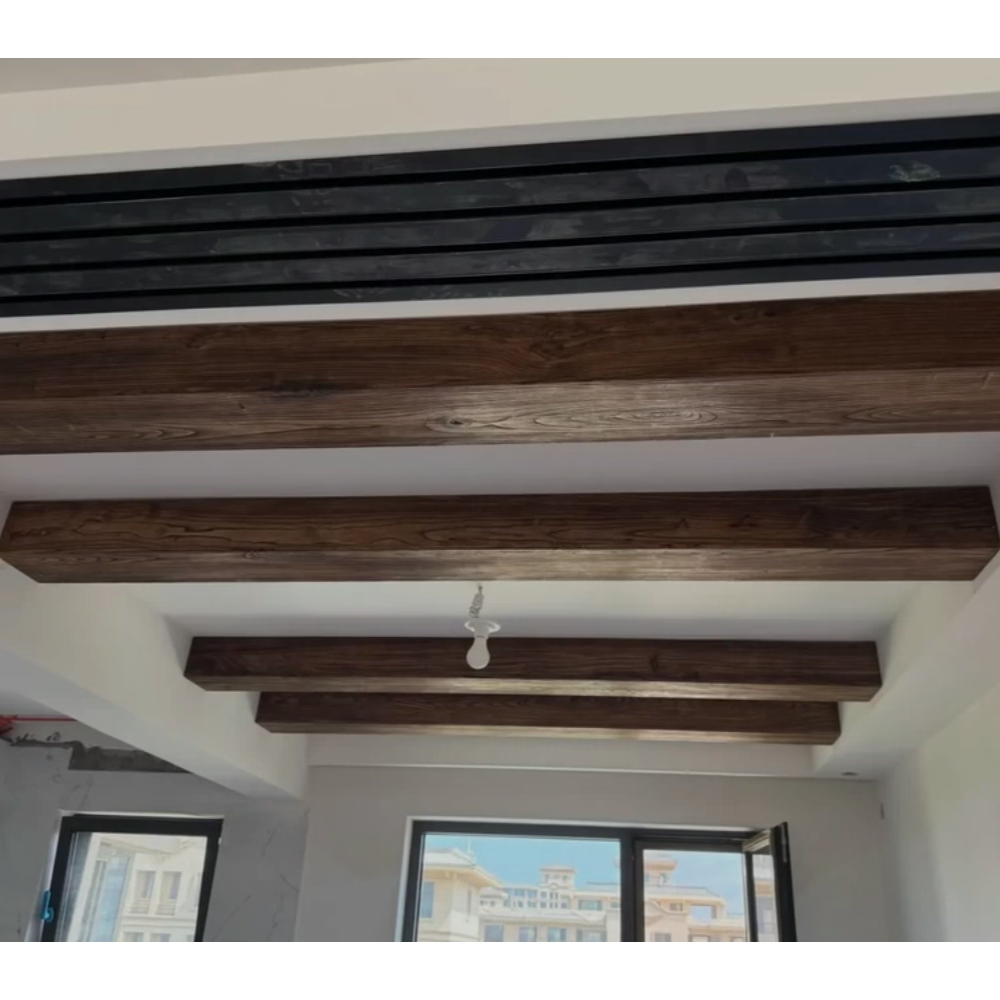
Appropriate and Inappropriate Applications
Purely decorative non-load-bearing polyurethane faux beams are appropriate anywhere that a visual enhancement to the ceiling or wall plane is desired without the structural or practical implications of real timber. They are particularly well suited to residential living rooms, bedrooms, and dining areas; hospitality venues such as restaurants and hotels; retail environments; and exterior covered spaces such as porches and porticos.
These beams are not appropriate as substitutes for genuine structural elements. No matter how convincingly a PU beam mimics the appearance of heavy timber, it cannot bear meaningful structural loads and should never be used where structural capacity is required. Similarly, while PU beams are highly water-resistant, they are not designed for applications where they will be continuously submerged or exposed to standing water.
Comparing PU Beams to Other Decorative Beam Materials
Against real wood, PU beams offer superior moisture resistance, dimensional stability, and insect resistance, with lower weight and installation complexity. They require no ongoing sealing or staining maintenance. The trade-off is that they lack the unique natural variation and authenticity of genuine timber grain, though high-quality reproductions are increasingly difficult to distinguish at normal viewing distances.
Against plaster beams, PU beams offer superior impact resistance and lighter weight. Plaster beams can chip or crack under impact, and their weight requires more robust mounting systems. PU beams are more flexible in profile options and easier to cut and modify on site.
Against fiberglass beams, PU beams offer better detail reproduction and a wider range of surface textures. Fiberglass is stronger and more suitable for applications requiring high physical durability, but the manufacturing process limits the complexity of profiles available and the surface finish tends to be smoother and less convincingly wood-like.
Understanding these distinctions allows designers and specifiers to select the appropriate material for each application based on the specific requirements of the project rather than on generalizations or assumptions.
Technical References
ASTM standards cited in every specification
Test Data
Lab results from internal testing program
Updated 2026
Reviewed against current product specs


