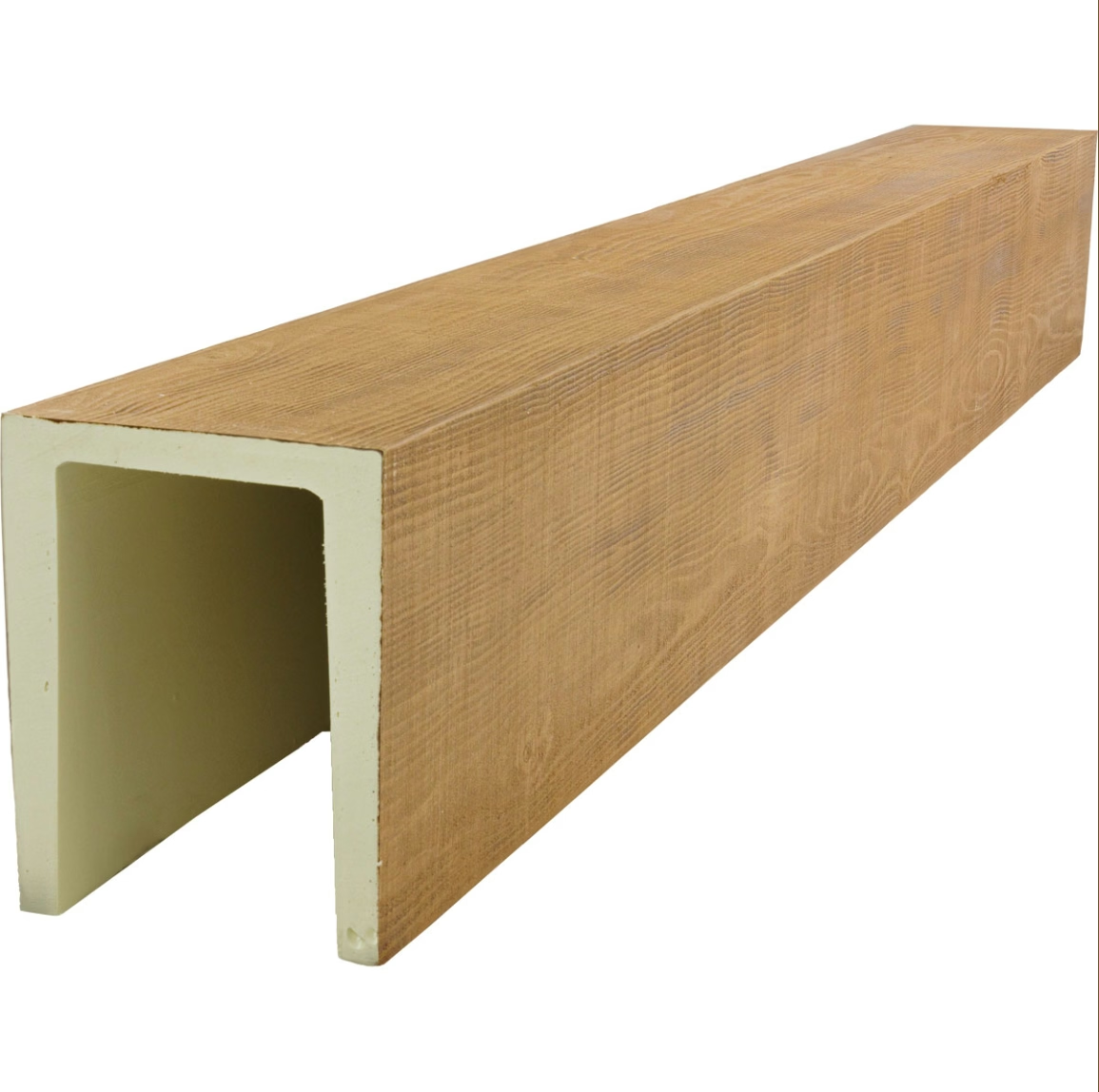
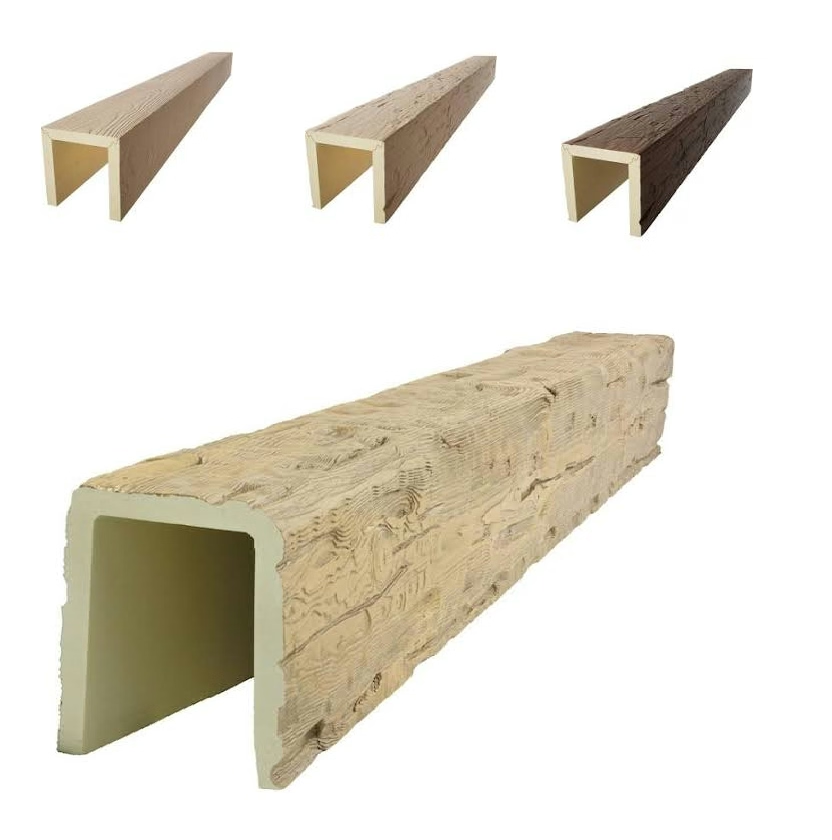
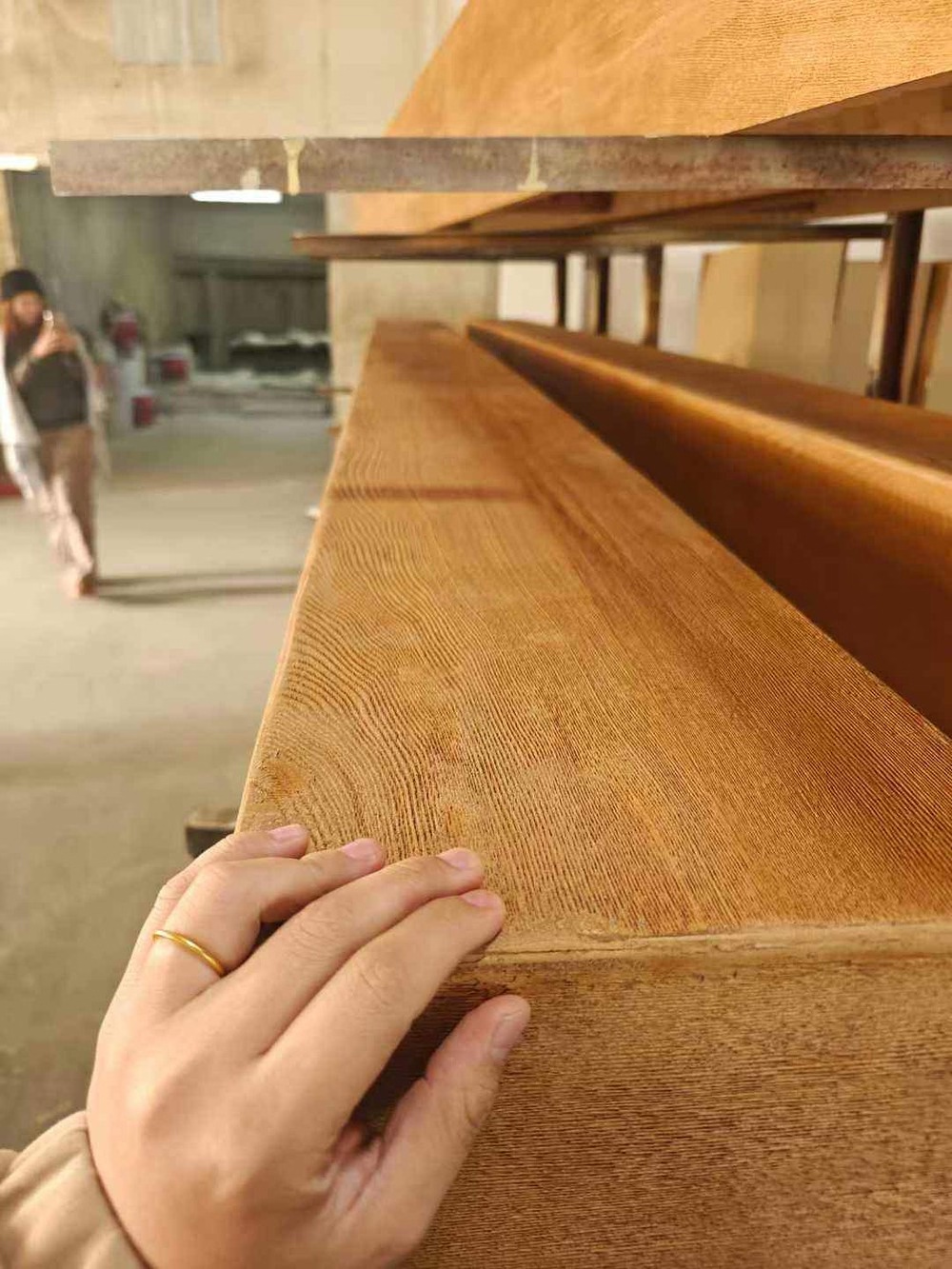
The question of whether polyurethane faux beams look like real timber deserves an honest answer rather than either uncritical enthusiasm or reflexive dismissal. The truth is nuanced and depends on several interacting factors: the quality of the specific product, the conditions of observation, the observer's familiarity with genuine timber, and the context in which the beams are installed. This realism assessment aims to provide a transparent evaluation that helps specifiers and buyers set accurate expectations.
Modern premium PU faux beams achieve a level of visual realism that would have been difficult to imagine two decades ago. The combination of high-resolution surface texturing, carefully matched color formulation, and consistent finish application produces beams that read as timber to the casual observer in virtually any installed condition. The grain patterns, surface textures, and color tones are sufficiently convincing that visitors to rooms with these beams commonly assume they are genuine timber unless told otherwise. This is not marketing exaggeration — it is a statement of observable fact about the current state of the manufacturing art.

The most successful aspects of current PU beam realism are the surface texture and grain pattern reproduction. Quality manufacturers employ multi-stage texturing processes that create physical depth and variation in the beam surface — not merely an image printed on a smooth substrate, but actual dimensional texture that catches light and creates the same visual complexity as genuine wood. Grain lines are reproduced with sufficient variation and natural irregularity that they do not present the tell-tale pattern repetition that would immediately signal a manufactured surface. The texture extends to the small details that distinguish one wood species from another: the fine pores of oak, the interlocking grain of ash, the straight even grain of pine, each reproduced with species-appropriate characteristics.
The finish quality on premium PU beams contributes substantially to the realism equation. Factory-applied finishes are applied in controlled conditions with proper surface preparation, consistent application technique, and adequate cure time — the same factors that distinguish professional shop finishing from field finishing in the genuine timber world. The result is a surface that has the depth and variation of a properly finished piece of real wood rather than the flat, uniform appearance of a poorly finished one. Light interacts with this surface in ways that are similar to how it interacts with genuine timber — reflecting differently from the peaks and valleys of the textured surface, creating subtle highlights and shadows that define the grain relief.
Where PU beams fall slightly short of perfect timber realism, the deviations are specific and generally subtle. The weight of the beam is the most immediately noticeable difference — lifting a PU beam reveals its hollow construction in a way that a solid timber beam of equivalent visual mass does not. For observers who handle the beam, this difference is conclusive. For observers who only see the beams installed overhead, this discrepancy is irrelevant since the ceiling plane is not accessible for lifting. In most residential and commercial applications, the installed beam is viewed from below, at a distance, under ambient lighting conditions where the weight difference is invisible.
The thermal behavior of PU versus timber produces subtle visual differences that become apparent under specific conditions. Genuine timber responds to temperature changes with microscopic expansion and contraction that can manifest as slight surface movement in response to ambient temperature shifts. PU, being a more dimensionally stable material, does not exhibit this behavior. In practice, this difference is not visually detectable in installed beams under normal conditions — it is the kind of difference that would require laboratory instrumentation to observe, not casual visual inspection. However, in environments with extreme temperature cycling, a discerning observer might notice that the beams never develop the fine checking or surface stress patterns that genuine timber accumulates over thermal cycles.
End grain presentation is one area where PU beams sometimes reveal their synthetic nature. The end grain of a genuine timber beam shows the annual ring structure of the wood, with the characteristic pattern of early wood and late wood visible as alternating bands. While quality PU beams attempt to reproduce this end grain detail, the reproduction is necessarily an approximation — the actual ring structure of a tree cannot be perfectly replicated in a molded or formed surface. Close inspection of beam ends, particularly in beams with prominent end-grain exposure, may reveal that the ring pattern lacks the organic irregularity of genuine timber. In most installations, however, beam ends are either concealed by mounting hardware, corbels, or wall intersections, making this a minor consideration.
The consistency of PU beams across a beam set can be identified as either an advantage or a limitation depending on perspective. A set of genuine timber beams will exhibit natural variation — slightly different grain patterns, color variations, and surface characteristics — that is part of the beauty of natural material. A set of PU beams from the same production run will be more consistent in grain pattern, color, and surface quality, which some observers find slightly less interesting and others find more reassuring. Neither position is objectively correct; it is a matter of design philosophy and personal preference. Designers who value the natural variation of genuine timber may find PU beam consistency less appealing, while those who prefer predictable outcomes will find it an advantage.
In actual installed conditions — under normal lighting, viewed from below, in the context of a fully decorated room — quality PU beams present as convincingly timber-like to the vast majority of observers. The key qualifier is "quality" — products from established manufacturers with well-developed texturing and finishing processes achieve a level of realism that is genuinely difficult to distinguish from genuine timber under casual observation. Products from less sophisticated manufacturers may exhibit surface uniformity, pattern repetition, or finish flatness that makes them more readily identifiable as synthetic. The variation in quality within the PU beam category is substantial, and prospective buyers should evaluate physical samples from the specific manufacturer they are considering rather than making judgments based on products from different sources.
The practical implication of this realism assessment for specifiers is that PU beams are a viable substitute for genuine timber in the majority of applications where the aesthetic intent is to introduce warm, textural, organic character into a space. The visual quality of premium products is sufficient that the substitution will not compromise the design intent in most contexts. The applications where genuine timber may still be preferred — where the specific authenticity of antique material is part of the design narrative, or where the weight and thermal behavior of genuine material are structural requirements rather than mere preferences — are more specialized and represent a smaller segment of the overall market for exposed timber aesthetics.
Technical References
ASTM standards cited in every specification
Test Data
Lab results from internal testing program
Updated 2026
Reviewed against current product specs