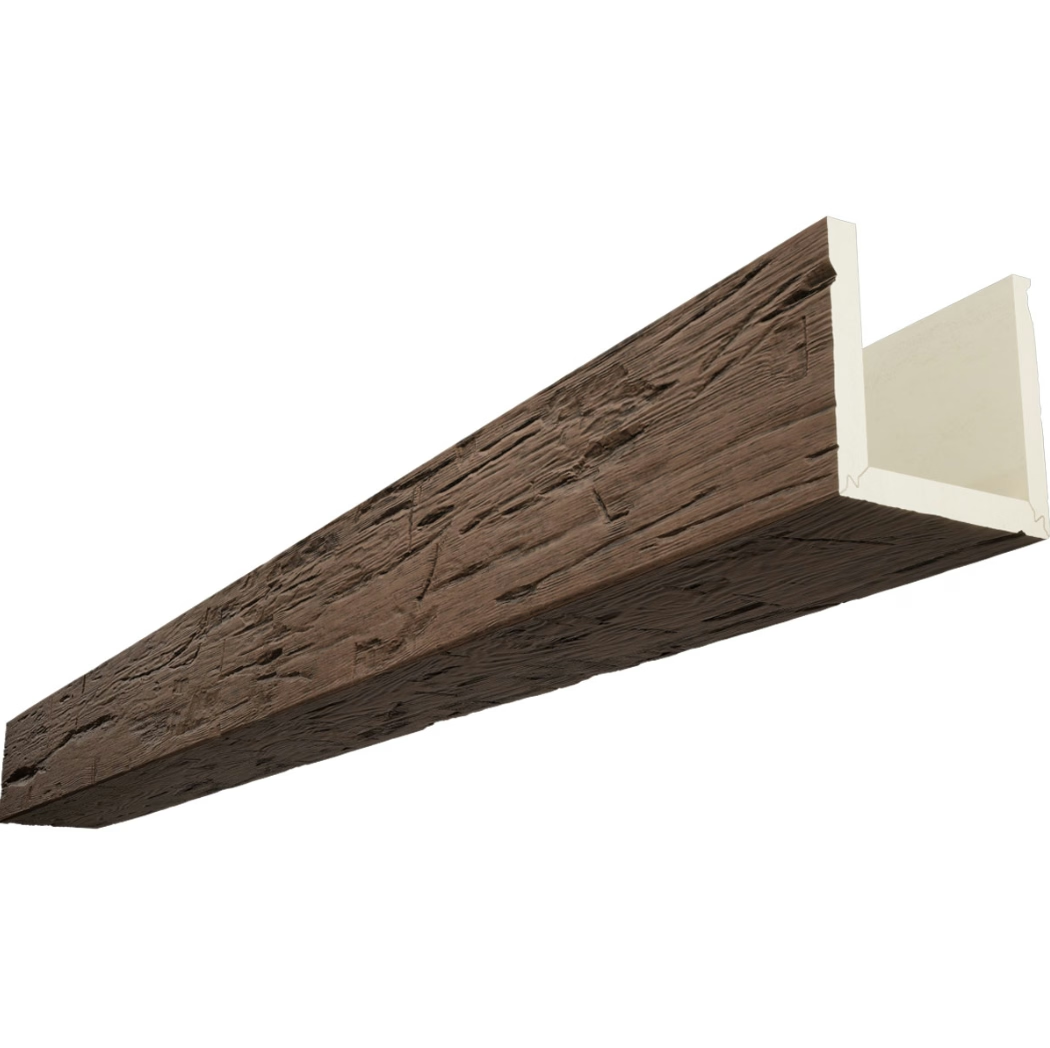
When Marcus received the purchase order from his largest client, he faced a familiar challenge: thirty containers of polyurethane faux beams needed to arrive at five different ports across three continents within a tight eight-week window. The complexity would have overwhelmed him five years ago, but today's integrated supply chain solutions transformed what once seemed impossible into manageable daily operations.
International trade in decorative building materials has evolved substantially as manufacturers, logistics providers, and technology platforms learned to work together seamlessly. For buyers sourcing faux wood beams in volume, understanding these systems creates significant competitive advantages in pricing, reliability, and customer satisfaction.
The foundation of resilient supply chain management begins with manufacturing relationships. Established producers maintain production capacity specifically allocated for bulk orders, with mold configurations and material formulations consistent across production runs. This consistency matters enormously—buyers can specify exact color codes, texture specifications, and dimensional tolerances that remain stable whether ordering one container or fifty. The documentation accompanying these specifications travels with each shipment, reducing quality disputes and replacement costs.
Lead time management has become more sophisticated as manufacturers invested in production planning systems. Rather than the fixed lead times of previous decades, today's operations offer dynamic scheduling based on raw material availability, production capacity, and shipping calendar optimization. Buyers providing accurate demand forecasts receive priority allocation during high-demand periods, whether those represent seasonal peaks or unexpected market shifts.
Shipping options span a range of cost-speed combinations that buyers can match to their inventory strategies. Full container load shipments offer the lowest per-unit transportation cost, ideal for buyers with warehouse capacity and stable demand. Less-than-container load options through consolidation services provide flexibility for smaller orders without sacrificing reliability. Air freight remains available for urgent restocking needs, though the cost premium limits this to genuinely time-critical situations.
Port infrastructure varies significantly across global destinations, and knowledgeable buyers factor this into their logistics planning. Deep-water ports handle large container vessels efficiently, while smaller facilities may require transshipment or specialized handling equipment. Understanding destination port capabilities prevents surprises that disrupt delivery schedules or inflate costs unexpectedly.
Customs and import regulations affect beam procurement differently depending on product composition and destination country. Polyurethane beams generally face fewer restrictions than natural wood products, which sometimes require phytosanitary certificates or face import quotas. However, tariff classifications, duty rates, and required documentation vary, making customs compliance expertise valuable for buyers navigating multiple markets.
Quality control protocols bridge the gap between distant manufacturing and buyer expectations. Third-party inspection services examine shipments at production facilities before loading, verifying specifications and identifying defects while correction remains possible. These inspections typically cost a few hundred dollars per container but prevent far larger costs from accepting substandard goods. Forward-thinking buyers build inspection requirements into their purchase contracts as standard practice.
Packaging optimization directly impacts both product protection and shipping efficiency. Manufacturers experienced with international transit use corrugated cartons, foam protection, and palletization methods designed for ocean shipping rigors. Buyers specifying these details in orders receive product that arrives in sellable condition rather than damaged condition requiring claims processing. The small incremental cost of proper packaging generates substantial savings through reduced damage rates.
Communication infrastructure enables the visibility that supply chain resilience requires. Real-time tracking through GPS-enabled containers provides shipment location and condition data throughout transit. Portali interfaces allow buyers to monitor order status, access shipping documents, and communicate with logistics partners from a single platform. This transparency transforms supply chain management from reactive problem-solving to proactive coordination.
Inventory strategy considerations vary based on buyer business models. Retailers serving end consumers typically prioritize rapid turnover and minimal warehousing, favoring frequent smaller shipments over large accumulated stock. Wholesale distributors serving contractor networks may optimize differently, maintaining broader inventory to serve same-day pickup orders while capturing volume pricing benefits. Both approaches can work effectively within the same supplier relationship.
Risk mitigation strategies deserve attention in any bulk procurement operation. Geographic diversification—splitting orders between manufacturing facilities or regions—reduces vulnerability to localized disruptions. Safety stock calculations based on demand variability and supplier reliability help buyers balance inventory costs against stockout risks. Insurance coverage for goods in transit provides financial protection that becomes increasingly valuable as order values rise.
Supplier relationship management has evolved beyond transactional purchasing to strategic partnership. Buyers committing to regular volume with specific manufacturers gain access to capacity reservations, priority support, and collaborative problem-solving that transactional relationships cannot provide. These partnerships weather market fluctuations more successfully than arm's-length arrangements that treat suppliers as interchangeable.
Technology integration continues advancing supply chain capabilities. Blockchain documentation offers verification of product origins and specifications. Machine learning algorithms optimize inventory positioning across distribution networks. IoT sensors monitor shipping conditions for sensitive materials. Early adopters of these technologies gain operational advantages that compound over time.
For buyers entering international procurement for the first time, the learning curve can seem steep. Partnering with established trading companies or freight forwarders provides access to expertise without requiring internal capability development. These intermediaries aggregate smaller buyers' volumes, negotiate favorable terms, and manage complexity that would otherwise overwhelm individual participants.
The resilience built through sophisticated supply chain management translates directly to competitive positioning. Buyers who reliably fulfill their customers' orders regardless of market conditions build reputations that support premium pricing and client retention. The operational excellence underlying this reliability represents a genuine business asset that compounds with consistent attention and improvement.
As global trade continues evolving, supply chain solutions will advance further, offering new capabilities and efficiencies. Buyers who invest in understanding these systems position themselves to capture ongoing benefits as the landscape improves around them.
Technical References
ASTM standards cited in every specification
Test Data
Lab results from internal testing program
Updated 2026
Reviewed against current product specs