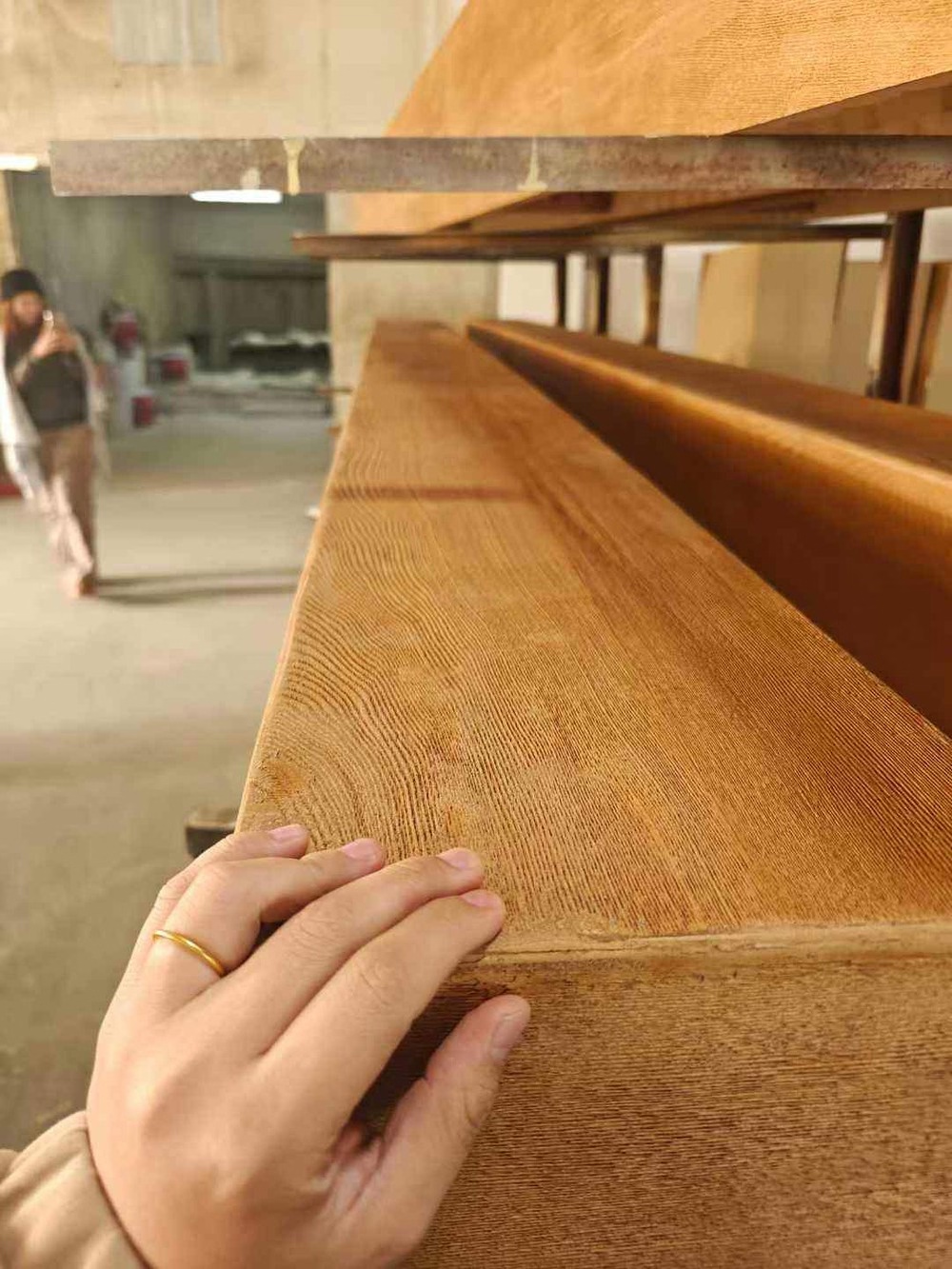
Long-term installation performance distinguishes quality polyurethane ceiling beams from products that may appear acceptable initially but fail to maintain appearance and structural integrity over time. Rigid firm shell construction provides the engineered stability that lasting installations require, ensuring that beams remain straight, secure, and attractive throughout decades of service. Understanding the structural engineering behind firm shell design illuminates why this approach produces superior results for demanding applications.
The term firm shell describes a construction philosophy that prioritizes dimensional stability and resistance to deformation over purely aesthetic concerns. While surface appearance remains important, firm shell products recognize that beautiful surfaces cannot compensate for structural failure. Beams engineered to firm shell standards maintain their shape under load, resist sagging or bowing, and remain securely attached to mounting surfaces regardless of environmental conditions or aging effects.
Core density significantly affects firm shell performance. Higher density polyurethane cores provide greater rigidity and resistance to the subtle compression that lower-density materials may exhibit over time. Quality manufacturers use closed-cell formulations that maintain consistent density throughout beam cores, eliminating weak zones where deformation might initiate. This density consistency translates directly into long-term dimensional stability that lower-quality products cannot match.
The surface-to-core bond in firm shell construction affects both appearance durability and structural integrity. Premium products feature seamless skin formation where surface texture and color extend continuously from visible surfaces into structural cores. Lesser products may exhibit delamination between surface layers and cores, leading to bubbling, cracking, or surface failure that compromises both appearance and structural performance.

Thermal cycling tests demonstrate firm shell quality by exposing beams to repeated temperature variations that simulate long-term environmental exposure. Quality products maintain dimensional consistency through these cycles, while lesser products may exhibit progressive deformation as materials expand and contract with thermal variation. These tests provide predictive evidence of long-term performance that accelerated aging cannot fully replicate.
Mounting system design interacts with beam construction to determine overall installation stability. Firm shell beams accommodate standard mounting approaches—corbel brackets, lag screws, construction adhesive—but the connection points must be designed for the specific characteristics of rigid shell construction. Manufacturer-provided mounting systems are engineered for compatibility; alternative approaches should be evaluated for appropriate load capacity and long-term reliability.
Load capacity represents a critical specification for firm shell beams, particularly in applications where they will support additional weight. While polyurethane cannot match the load capacity of structural timber, firm shell construction enables beams to support reasonable superimposed loads—light fixtures, ceiling fans, signage—without deflection or failure. Understanding load requirements before specification ensures appropriate product selection.
Environmental resistance testing validates firm shell performance across the range of conditions installations may encounter. Moisture resistance testing confirms that beams tolerate high humidity without swelling or degradation. UV resistance testing ensures that surface colors remain consistent despite years of light exposure. Chemical resistance testing demonstrates tolerance for cleaning products and environmental pollutants. Quality products provide documentation of relevant testing.
The installation environment influences firm shell specification decisions. High humidity environments—bathrooms, kitchens, pool areas—require products with demonstrated moisture resistance. Temperature extremes affect some polyurethane formulations more than others. Understanding specific installation conditions guides specification toward products optimized for those conditions rather than generic alternatives.
Surface impact resistance differs between firm shell and more flexible alternatives. While rigid construction provides superior dimensional stability, it may be more susceptible to denting from sharp impacts than flexible formulations that absorb energy through deformation. For applications where impact risk exists, evaluating impact resistance specifications helps identify appropriate products.
Quality certification from independent testing laboratories provides third-party validation of manufacturer claims. Products carrying relevant certifications have been tested according to established protocols, with results confirming stated performance characteristics. This verification proves valuable for commercial applications where building code compliance or insurance requirements mandate documented performance.
The cost-quality relationship in firm shell beams typically favors higher initial investment in quality products. While entry-level alternatives may appear attractive from initial cost perspectives, the long-term performance advantages of firm shell construction—reduced maintenance, extended service life, consistent appearance—create favorable economics over typical project lifetimes.
Professional installation contributes to long-term performance by ensuring that mounting systems and beam connections are executed correctly. Firm shell construction cannot compensate for inadequate fastening or improper preparation. Working with experienced installers or following manufacturer guidelines closely ensures that the performance advantages firm shell construction provides are fully realized.
Technical References
ASTM standards cited in every specification
Test Data
Lab results from internal testing program
Updated 2026
Reviewed against current product specs