
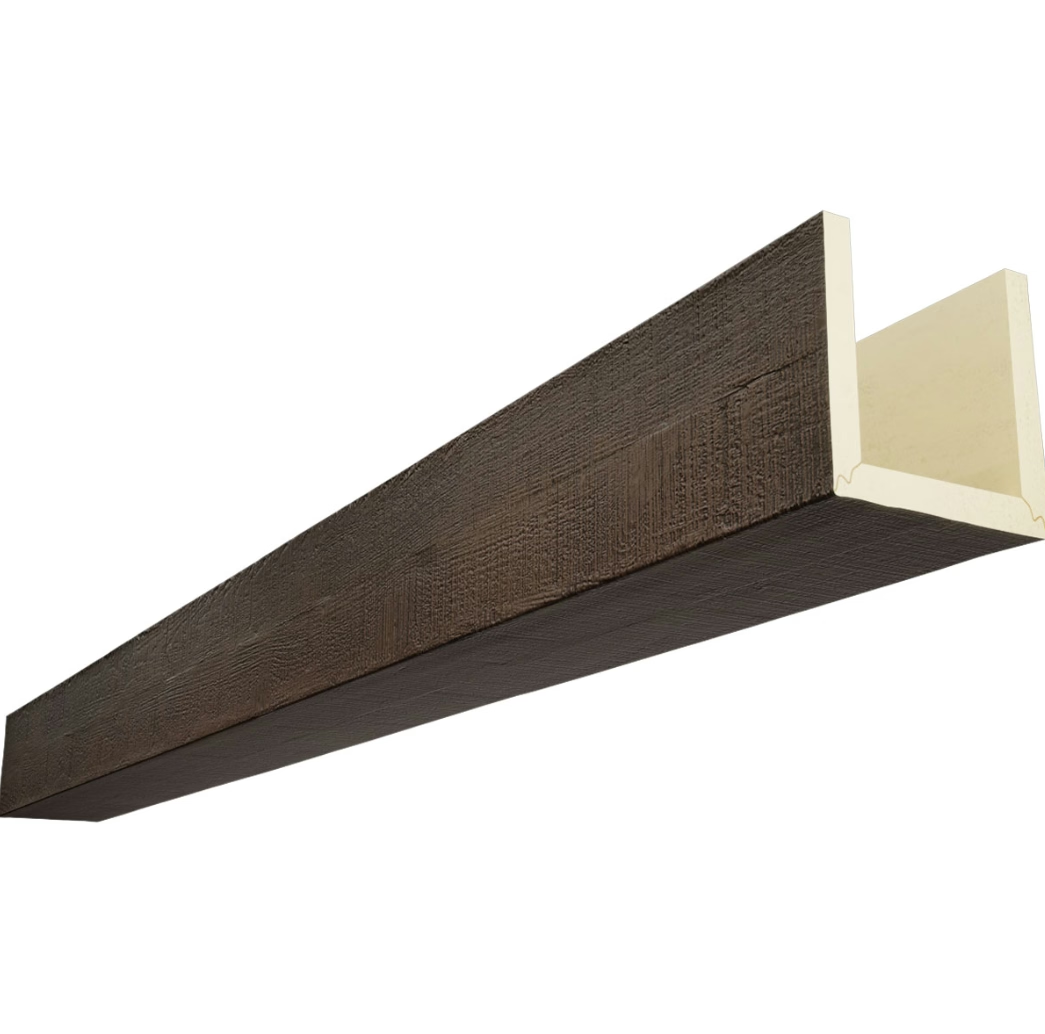
Among the most visually distinctive profiles in the world of faux timber beams is the U-shape — a beam that wraps around an existing structural element or ceiling feature on three sides, creating the appearance of a heavy timber member while leaving the center open. This profile offers dramatic architectural impact, but its hollow cross-section creates engineering challenges that require thoughtful manufacturing solutions to ensure long-term stability without warping.
The Appeal and Challenge of U-Shape Profiles
The U-shape beam's visual appeal lies in its three-dimensional presence. Unlike flat-faced beams that present only a single surface to view, U-shape beams have depth and shadow that change with the angle of light throughout the day. They can frame ceiling features, conceal structural elements, and create visual rhythm across a ceiling plane in ways that flatter, flatter profiles cannot achieve.
The manufacturing challenge arises from the U-shape's geometry. A standard rectangular hollow beam has four walls of relatively uniform thickness. A U-shape beam has three walls connected at two corners, and the thermal and hygroscopic stresses that naturally occur in any material are concentrated at these corners. If the material formulation or manufacturing process does not account for these stress concentrations, the result can be warping — a gradual change in the beam's shape over time that manifests as bowing, twisting, or dimensional distortion.
Warping in a ceiling beam is more than a cosmetic issue. A warped U-shape beam may not sit flush against the ceiling surface, creating gaps that are visually apparent and can collect dust. Severe warping can stress mounting hardware and lead to structural failure. Preventing warping requires addressing the problem at the material and manufacturing levels, not just at the installation level.
Material Formulation for Profile Stability
The first line of defense against warping in U-shape beams is the material formulation itself. As with other hollow profile beams, the polyurethane core must be designed with dimensional stability as a primary objective. This means controlling the coefficient of thermal expansion, the moisture absorption rate, and the internal stress levels that develop during the curing process.
Post-curing — a process of heating the finished beam to an elevated temperature for a controlled period — is one of the most effective manufacturing techniques for reducing internal stress. During the initial curing of polyurethane, residual stresses build up as the material shrinks slightly while setting. A post-curing cycle allows these stresses to relieve themselves while the material is still in the mold or a controlled holding fixture, before the beam is removed and allowed to cool freely. The result is a more dimensionally stable product that is less likely to warp in service.
Reinforcement additives further enhance stability. As discussed in the context of standard hollow beams, fiber and filler additives create an internal structure that resists the movement and stress concentrations that lead to warping. In U-shape profiles, these additives are particularly valuable at the corners where the three walls meet, as this is where stress is most concentrated.
Wall Thickness Engineering
The wall thickness distribution in a U-shape beam has a significant effect on its warping tendency. If the three walls have significantly different thicknesses — for example, if the bottom wall is much thinner than the sidewalls — differential shrinkage during curing and differential thermal expansion in service will create bending moments that warp the profile.
Balanced wall thickness engineering keeps all three walls at similar thicknesses, creating uniform material properties and minimizing differential shrinkage. This requires careful mold design and process control to ensure consistent wall thickness throughout the production run. Quality manufacturers monitor wall thickness as part of their quality assurance process and reject units that fall outside acceptable tolerances.
In some U-shape beam designs, the sidewalls are made slightly thicker than the bottom to account for the different stress environments each wall experiences. The mounting surfaces, which bear the fastener loads and mounting adhesive, benefit from this additional thickness. This deliberate asymmetry is a calculated engineering choice, not an inconsistency.
Handling, Storage, and Installation Considerations
Even the best-manufactured U-shape beam can warp if it is mishandled or stored improperly before installation. Beams should always be stored flat, supported along their full length, and protected from direct sunlight and extreme temperature variations. A beam left in direct sun on a hot day before installation can absorb enough heat to cause temporary warping that makes installation difficult, even if the warping reverses when the beam cools.
During installation, the mounting surface must be flat and clean. Any irregularity in the mounting surface creates uneven stress in the beam once it is installed. For U-shape beams, which have three mounting surfaces rather than one, ensuring that all three surfaces make uniform contact with their respective mounting substrates is important for preventing stress-induced warping over time.
Expansion gaps at the ends of U-shape beams are as important as they are for standard beams. The three-sided profile can experience thermal movement in all three walls independently, and if the ends are fitted too tightly, this movement creates stress at the corners. Proper expansion gaps allow each wall to move freely without transmitting stress to the others.
Quality Verification Before Installation
Before installing a U-shape beam, inspect it for any signs of warping or dimensional distortion that may have occurred during shipping or storage. Lay the beam on a flat surface and check that all three walls lie flat without gaps. Any twist or bow that is visible to the eye or detectable with a straightedge is a sign that the beam may have absorbed stress that could cause problems in service.
For beams that show minor warping due to storage conditions, laying the beam flat in a warm, controlled environment for twenty-four to forty-eight hours often allows it to return to its original shape. For beams with more significant warping, contacting the supplier about replacement or return is the appropriate response rather than forcing a warped beam into an installation where it will be under constant stress.
The most reliable approach to warping prevention is selecting a quality manufacturer from the beginning. Asking about post-curing procedures, reinforcement additives, wall thickness specifications, and any available test data related to dimensional stability provides useful information about how seriously a manufacturer takes warping prevention. A manufacturer who can explain their approach to these issues in detail is one who has thought carefully about the engineering challenges of U-shape production.
Technical References
ASTM standards cited in every specification
Test Data
Lab results from internal testing program
Updated 2026
Reviewed against current product specs


