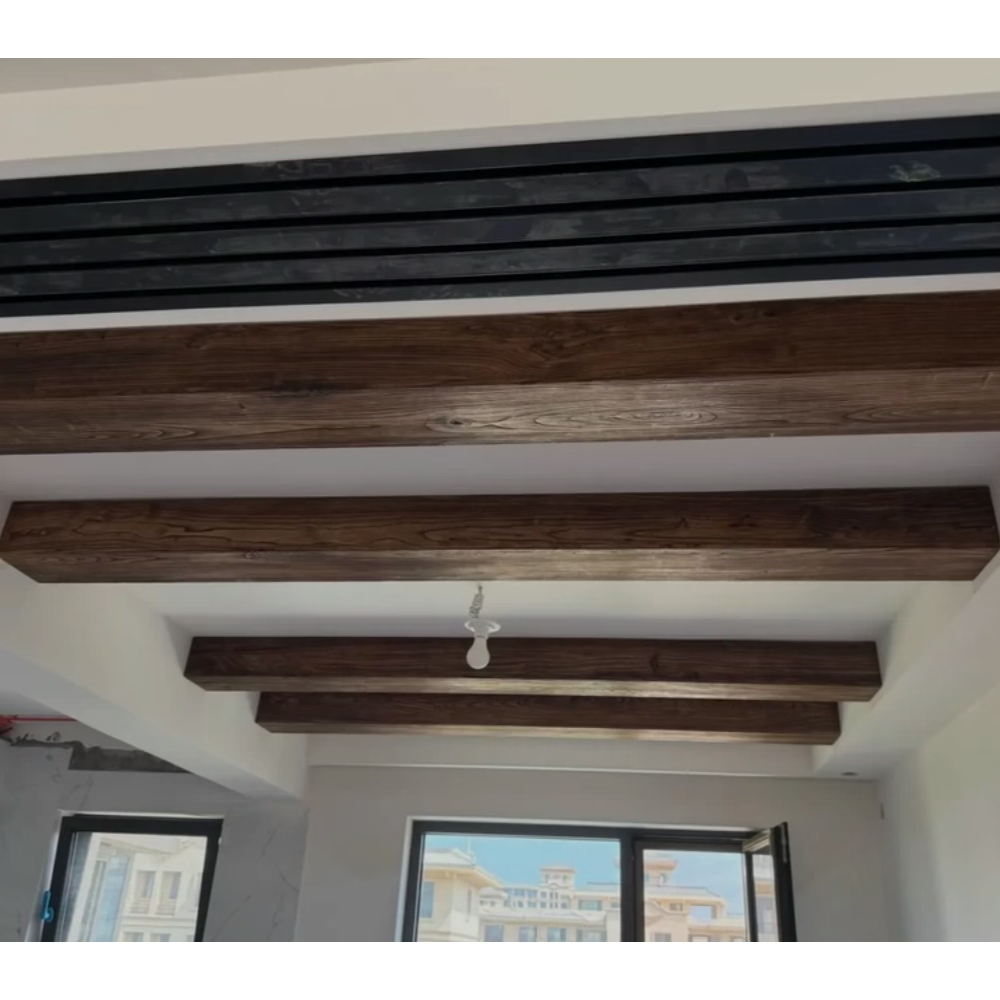
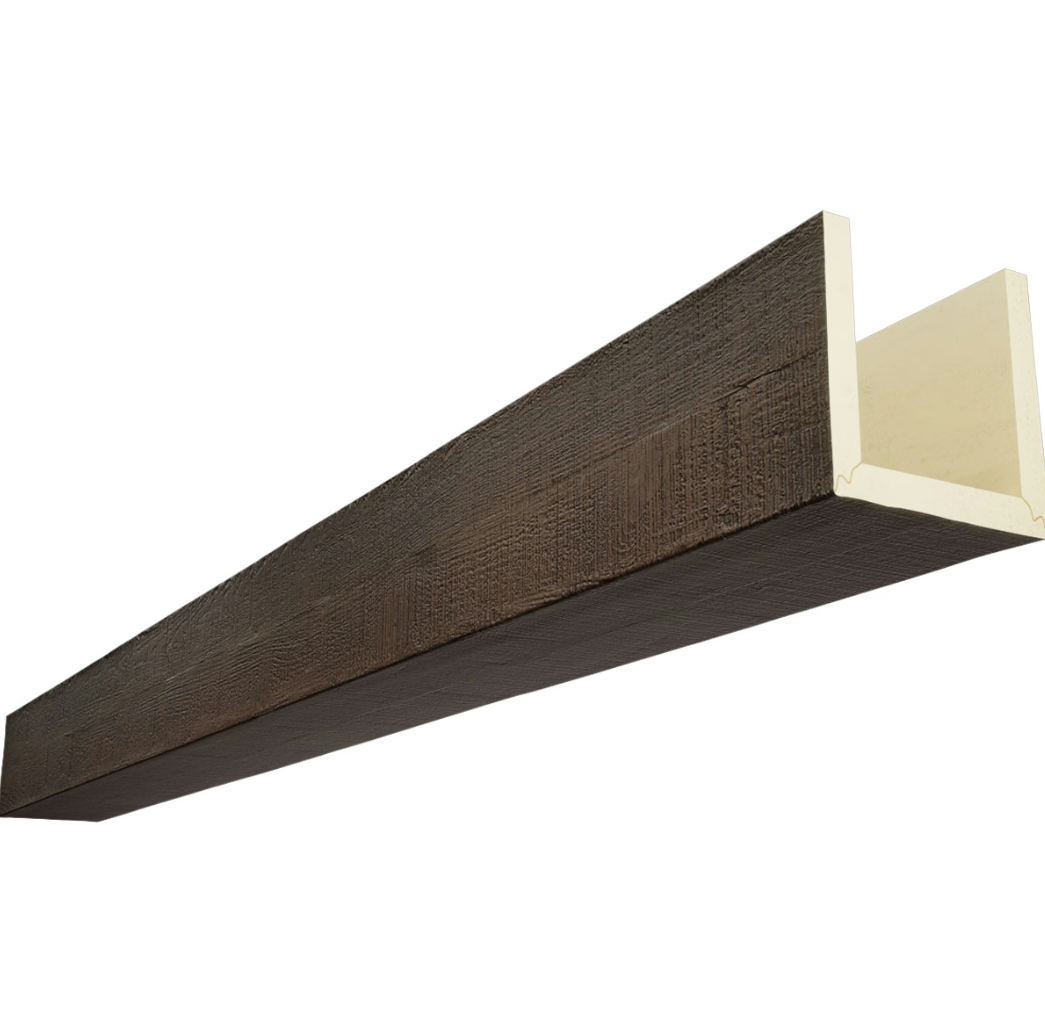
Why Solid Wood Warps (and Why PU Doesn't)
Solid wood is hygroscopic — it absorbs and releases moisture with changes in ambient humidity, causing dimensional change (movement) in three directions:
- Tangential: across the growth rings (perpendicular to the grain), highest movement — 8-10% from green to oven-dry in oak
- Radial: along the growth rings toward the center, moderate movement — 4-6% in oak
- Longitudinal: along the grain, negligible — 0.1-0.2% in most species
This differential movement is why solid timber beams twist, cup, bow and check as they age. A beam that was straight when installed will show visible deformation within 1-3 years in most climates.
Polyurethane faux beams are closed-cell foam with a uniform polymer skin. They do not absorb moisture and do not undergo hygroscopic dimensional change. The only movement they exhibit is thermal expansion, which is small enough to be accommodated by a standard 1/8 in expansion gap at each end.
A quality PU faux beam, properly installed, will not warp in 50+ years of service.
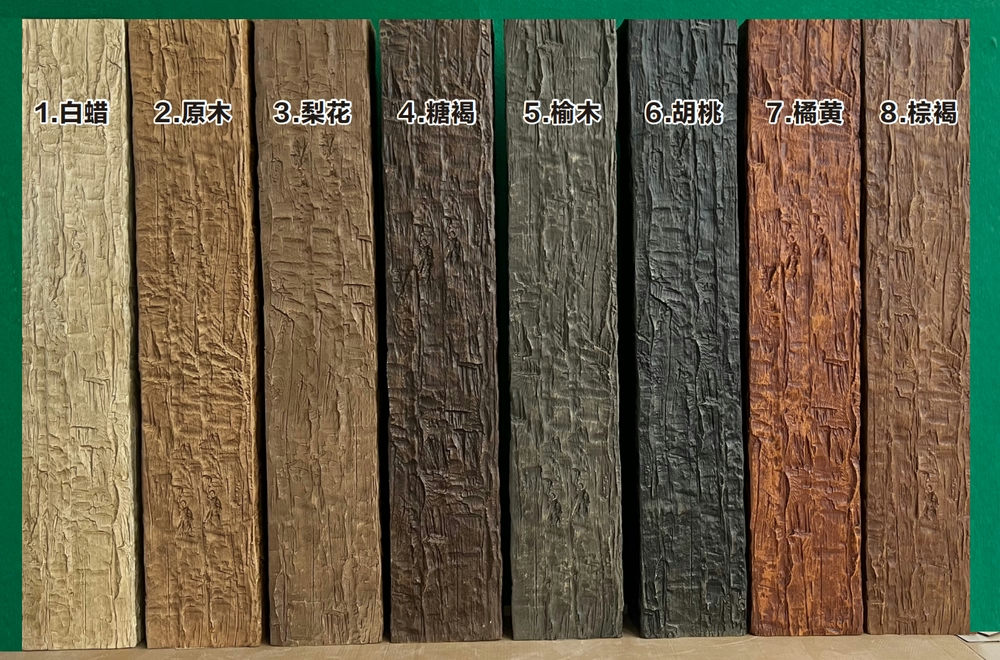
Dimensional Stability Data: The Core Comparison
Our 2025 dimensional stability study tested 6 in × 8 in × 10 ft samples across five material types, cycling from 50% RH at 70°F to 90% RH at 85°F and back over 30 days — simulating one year of seasonal humidity swing.
| Material | Width change | Thickness change | Twist | Cup | Surface checking |
|---|---|---|---|---|---|
| Solid white oak | +0.047 in | +0.018 in | 1/4 in in 10 ft | 1/8 in | Yes, 3-4 checks |
| Solid Douglas fir | +0.038 in | +0.014 in | 3/16 in in 10 ft | 1/16 in | Yes, 2-3 checks |
| MDF | +0.022 in | +0.085 in | Negligible | 1/4 in | No, but delaminated |
| Standard closed-cell PU | +0.001 in | <0.001 in | 0 | 0 | No |
| High-density closed-cell PU | <0.001 in | <0.001 in | 0 | 0 | No |
Closed-cell PU foam showed virtually no dimensional change across the full humidity cycling test. Solid timber moved measurably in width, thickness and twist. MDF swelled significantly in thickness (its greatest vulnerability) and delaminated.
Thermal Expansion: The Only Movement in PU Beams
The only significant movement in a PU beam is thermal expansion. The coefficient of linear thermal expansion (CLTE) for closed-cell PU foam is approximately 35-45 × 10⁻⁶ in/in/°F — roughly 2-3x that of solid wood (12-15 × 10⁻⁶ in/in/°F).
For a 10 ft beam cycling through a 60°F annual temperature swing (from 55°F to 115°F):
| Material | Length change from thermal expansion |
|---|---|
| Solid oak (CLTE ~12 × 10⁻⁶) | 0.007 in in 10 ft |
| PU foam (CLTE ~40 × 10⁻⁶) | 0.024 in in 10 ft |
The PU beam moves more from thermal expansion than from humidity change — but both movements are orders of magnitude smaller than solid timber's moisture movement, and both are easily accommodated by a 1/8 in expansion gap at each end.
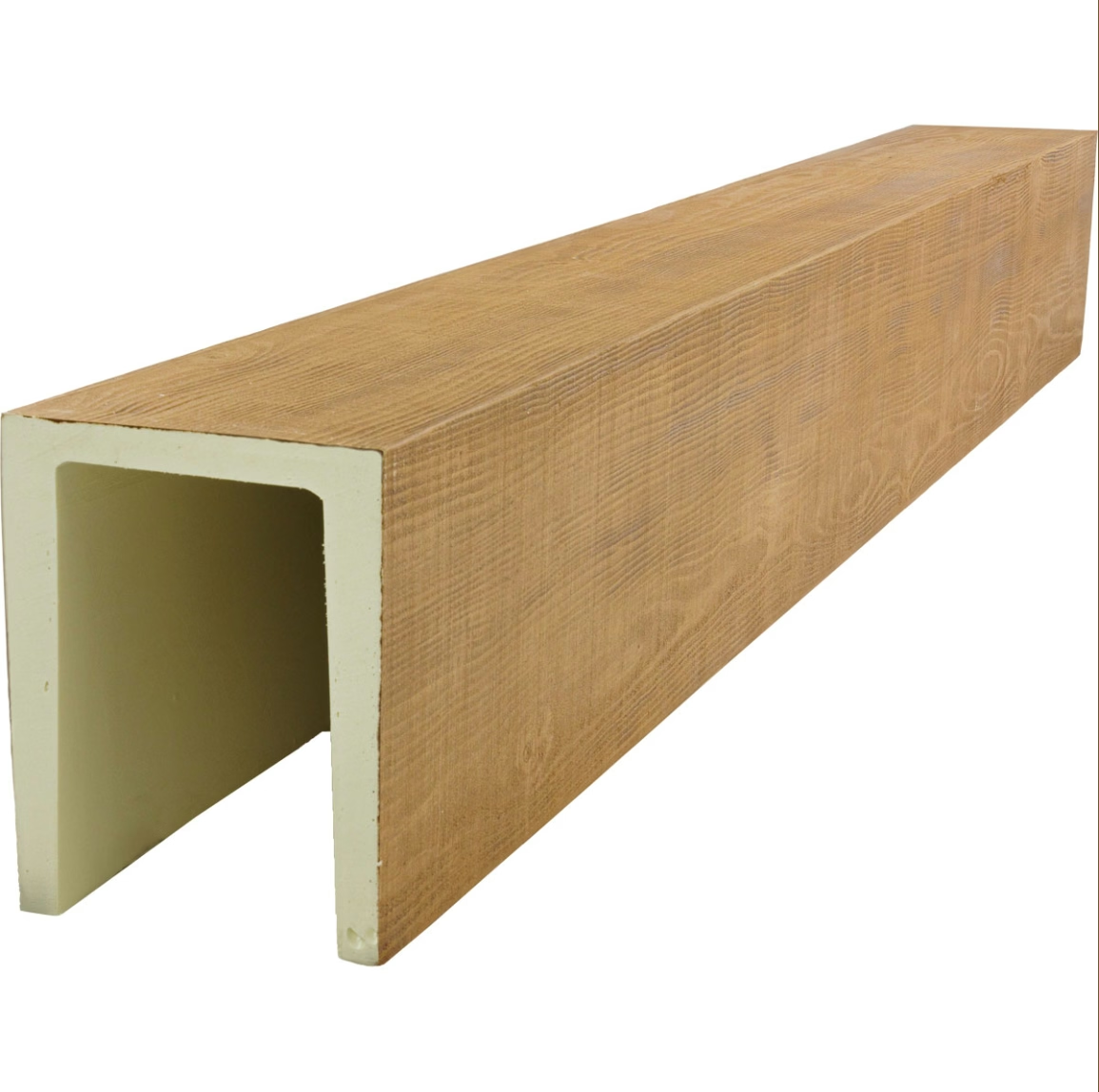
What "Warp-Proof" Actually Means
Our internal specification for "warp-proof" PU beams covers:
- Zero dimensional change under ASTM D2126 thermal cycling (-20°F to 140°F, 5 cycles)
- Zero cup, bow or twist after 30-day humidity cycling (50% to 90% RH at 85°F)
- Zero surface checking after 1000-hour ASTM G154 UV exposure
- Closed-cell foam density 0.55 g/cm³ or higher — open-cell foam will eventually compress and deform under sustained load
- Uniform polymer skin with documented peel strength ≥8 lb/in (ASTM D903)
Any supplier calling a beam "warp-proof" without these test data is making a marketing claim. Request the test reports before purchase.
Installation Details That Ensure Zero Warp
Even a warp-proof PU beam will deform if installed incorrectly. Five details matter most:
1. Expansion gap at both ends
Leave a 1/8 in gap between the beam end and the wall framing or end blocking. This accommodates thermal expansion without building stress into the system.
Do not fill this gap with caulk — fill it with backing rod + paintable latex caulk so the joint can flex seasonally.
2. Never over-fasten
Each fastener creates a stress concentration point. Drive fasteners to flush — not dimpled. A dimpled fastener point creates a micro-crack in the polymer skin that can spread under thermal cycling.
Fastener torque for trim-head screws into wood blocking:
| Screw size | Target torque |
|---|---|
| #8 × 2 in trim-head | 25-30 in-lb |
| #10 × 2-1/2 in trim-head | 35-45 in-lb |
| #10 × 3 in structural | 50-60 in-lb |
3. Back-block the full beam length
For beams longer than 8 ft, install a 1×4 or 1×6 stiffener running the full beam length, screwed into the back face of the beam. This prevents the beam from oil-canning (flexing between fasteners) and distributes fastener loads evenly.
4. Shim to the ceiling plane, not to the texture
The ceiling plane may be 1/4 to 1/2 in off from the joist line due to old texture, drywall compounds or settlement. Shim the blocking to bring it to the true ceiling plane, not to the high points of the texture. The beam then sits perfectly flush and the caulk line at the ceiling joint is clean and even.
5. Pre-drill every fastener hole
Closed-cell PU foam has high compressive strength but low shear strength along the grain direction. Pre-drilling with a 3/16 in bit for #10 screws prevents the screw from splitting the foam at the back of the beam.

Climate Zone Considerations
Cold climates (zones 4-8)
Cold climates see the largest annual temperature swings — from -20°F outdoor in zone 5+ to 75°F indoors. The beam will see a ~100°F annual swing in a heated home.
Spec: Standard PU beam is sufficient. The foam's closed-cell structure handles this temperature range without issue. Ensure the expansion gap is present at both ends.
Special case: Unheated spaces (cabins, seasonal homes) with no winter humidity control will see condensation at the beam-to-ceiling joint if the dew point drops below the ceiling temperature. Use a Class I vapor retarder behind the beam in unheated seasonal homes.
Hot-humid climates (zones 2-3, coastal)
In hot-humid climates, the beam sees high humidity from below (cooking, showering, people breathing) even in air-conditioned spaces. The topcoat handles surface moisture; the vapor retarder handles bulk moisture movement through the ceiling assembly.
Spec: Mildew-proof SKU with mildewcide topcoat, Class I vapor retarder behind the beam.
Hot-dry climates (zones 2-3, inland)
Hot-dry climates see low indoor humidity (30-40% in air-conditioned spaces), which is actually fine for PU foam. The main risk is direct sun exposure if the beam is in a sunroom or near a skylight.
Spec: UV-inhibited topcoat (standard on exterior-grade SKU). Recoat every 8-12 years in direct-sun applications.
Seismic zones
In seismic zones 3 and above, the blocking should be positively attached to the joists with two fasteners per joist per blocking piece, not just toenailed. Seismic motion will test any loose blocking. Use structural screws (not drywall screws) and verify the joist capacity with the local building department.
Common Warp Causes and Fixes
Visible beam crown (concave bottom face)
Cause: The blocking is bowed upward, forcing the beam into a concave shape. Fix: Pull the beam down, shim the blocking flat, re-hang. This is the most common "warp" we see in call-backs — it's a framing problem, not a beam problem.
Visible beam sag (convex bottom face)
Cause: Missing blocking at mid-span, or foam density below spec. Fix: Install additional blocking at the sag point. If the beam shows permanent deformation (foam cell collapse), replace under warranty.
Beam ends pulling away from wall
Cause: The expansion gap was not left, and the beam expanded against the wall. Fix: Remove the beam end, cut 1/4 in off the end, reinstall with a 1/8 in gap. Fill the gap with backing rod + caulk.
Visible seam at beam joint
Cause: The two beams were butt-jointed at the center support instead of mitered. Fix: A butt joint at mid-span will always telegraph. The correct detail is a 45° miter at a structural post or a steel plate splice hidden behind both beams.
Frequently Asked Questions
Will a PU faux beam warp over time like wood?
No — a properly installed closed-cell PU beam at 0.55+ g/cm³ will not warp, cup, bow or twist in any climate over its 50-80 year design life. Solid timber warps because it absorbs and releases moisture; PU foam does not.
What causes a PU beam to deform if it happens?
The three causes of deformation in PU beams are: (1) missing or mislocated blocking (forces the beam into a deformed shape), (2) foam density below spec (0.40-0.45 g/cm³) leading to cell collapse, and (3) over-driven fasteners creating stress concentrations. All three are installation or manufacturing issues, not inherent material behavior.
How much does temperature affect a PU beam?
A 10 ft PU beam expands approximately 0.024 in per 60°F temperature swing — negligible for most installations. The 1/8 in expansion gap at each end fully accommodates this movement. By comparison, solid oak moves 7/1000 in from the same swing.
Can I install a PU beam in an unheated cabin?
Yes, with one condition: use a vapor retarder behind the beam in any unheated space. Without a vapor retarder, warm interior air carries moisture into the ceiling cavity where it condenses on the cold beam back. Over seasons, this can cause finish bubbling even though the foam itself doesn't rot.
What's the difference between warp-proof and crack-proof?
Warp-proof means the beam retains its dimensional shape under humidity and temperature change. Crack-proof means the surface skin does not crack under UV exposure and thermal cycling. Both are engineering claims that require test data to verify — request ASTM G154 (UV + crack) and ASTM D2126 (thermal cycling) reports.
How do I verify the foam density before installation?
The simplest field check: weigh a known-length sample. For a 6 in × 8 in × 12 in block, a 0.55 g/cm³ sample weighs approximately 1.62 lb. If it weighs noticeably less, the foam is under-spec and likely to compress over time.
The beam I received looks bowed slightly. Should I reject it?
Lay it on two sawhorses and sight down the top edge. More than 1/8 in deviation in 10 ft is a rejection. Slight camber (a bow along the length) is normal in long foam products and does not affect the installed appearance if the blocking is installed to the beam's natural shape.
Technical References
ASTM standards cited in every specification
Test Data
Lab results from internal testing program
Updated 2026
Reviewed against current product specs